
Six dead as 19 Japanese encephalitis cases confirmed in Nepal’s Madhesh Province
Nineteen cases of Japanese encephalitis have been confirmed in Nepal’s Madhesh Province, with six of the patients dying, health officials said on Tuesday.
Nineteen cases of Japanese encephalitis have been confirmed in Nepal’s Madhesh Province, with six of the patients dying, health officials said on Tuesday. The cases were identified through laboratory testing of blood and cerebrospinal fluid samples collected from patients who presented with fever, headache, vomiting and, in several instances, seizures. All of the confirmed infections were traced to villages in the province’s low‑lying districts, where the disease is known to spread more readily during the monsoon season.
Japanese encephalitis (JE) is a viral infection of the central nervous system caused by the Japanese encephalitis virus (JEV), a member of the flavivirus family. The virus is transmitted primarily by Culex mosquitoes that breed in rice paddies and other stagnant water bodies. Pigs and wild birds act as amplifying hosts, maintaining the virus in the environment, while humans are incidental dead‑end hosts. Most infections are asymptomatic; however, a small proportion progress to encephalitis, producing symptoms such as high fever, severe headache, neck stiffness, altered consciousness and, in some cases, seizures. The incubation period ranges from five to fifteen days, and once neurological symptoms appear, there is no specific antiviral treatment—care is supportive and focuses on managing complications. Survivors may suffer lasting neurological deficits, including cognitive impairment, motor weakness or epilepsy.
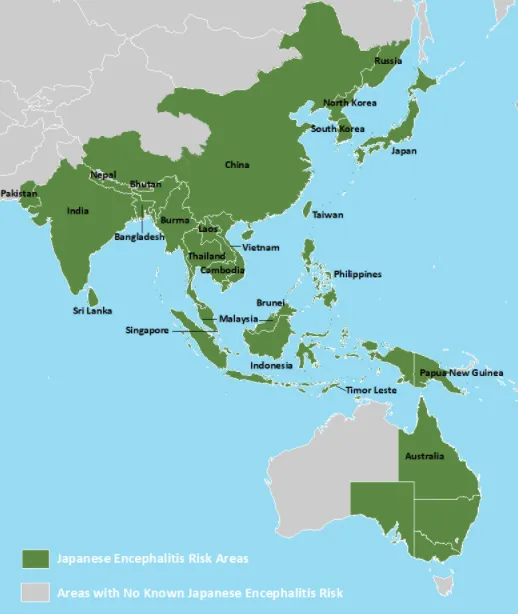
JE is endemic across much of East and Southeast Asia and the Western Pacific, affecting an estimated three billion people living in risk zones. The World Health Organization estimates roughly 68 000 symptomatic cases and 17 000 deaths occur annually, with outbreaks often linked to seasonal increases in mosquito populations and to changes in agricultural practices that expand breeding habitats. The disease’s rural predominance reflects the proximity of human settlements to pig farms and irrigated fields, where Culex mosquitoes thrive. Climate variability, such as heavier monsoon rains, can exacerbate mosquito proliferation, raising the likelihood of spillover events in vulnerable communities.
In Nepal, the Ministry of Health and Population has activated its emergency response framework for vector‑borne diseases. Provincial health officers have begun intensified mosquito‑control measures, including larvicidal spraying of stagnant water sources and community clean‑up campaigns to eliminate breeding sites. The government is also accelerating the rollout of the Japanese encephalitis vaccine, which is recommended for children in high‑risk districts and for adults engaged in agricultural work. However, vaccine coverage remains uneven, partly due to logistical challenges in reaching remote settlements and limited public awareness of the disease’s severity. Nepal has previously reported sporadic JE clusters in the Terai region, but the current fatality rate of one in three confirmed cases underscores gaps in early detection and treatment capacity.
The outbreak adds pressure to regional health coordination mechanisms that link Nepal with neighboring India, Bangladesh and China, where JE also poses a public‑health threat. Cross‑border surveillance, shared laboratory resources and joint vector‑control strategies have been promoted by the WHO’s South‑East Asia Regional Office, yet resource constraints and differing health‑system capacities can impede rapid response. International partners, including the United Nations Children’s Fund and several non‑governmental organisations, have pledged technical assistance and vaccine donations to bolster Nepal’s preparedness.
For Taiwan and the wider Indo‑Pacific region, the Madhesh incident highlights the interconnected nature of vector‑borne disease risks. Taiwan produces a substantial share of the globally distributed JE vaccine and has experience in large‑scale immunisation programmes that could be leveraged in regional emergency stockpiles. Moreover, heightened disease activity in South Asia can affect trade and travel corridors that link the subcontinent with East Asian economies, potentially disrupting supply chains for agricultural products and labor mobility. Strengthening surveillance, vaccine access and coordinated mosquito‑control efforts across borders therefore serves not only public‑health interests but also broader economic and security considerations for Taiwan and its partners in the region.
Produced by our editorial team, with AI assistance in editing.
