
Pompeii
Italy · Europe
About Pompeii
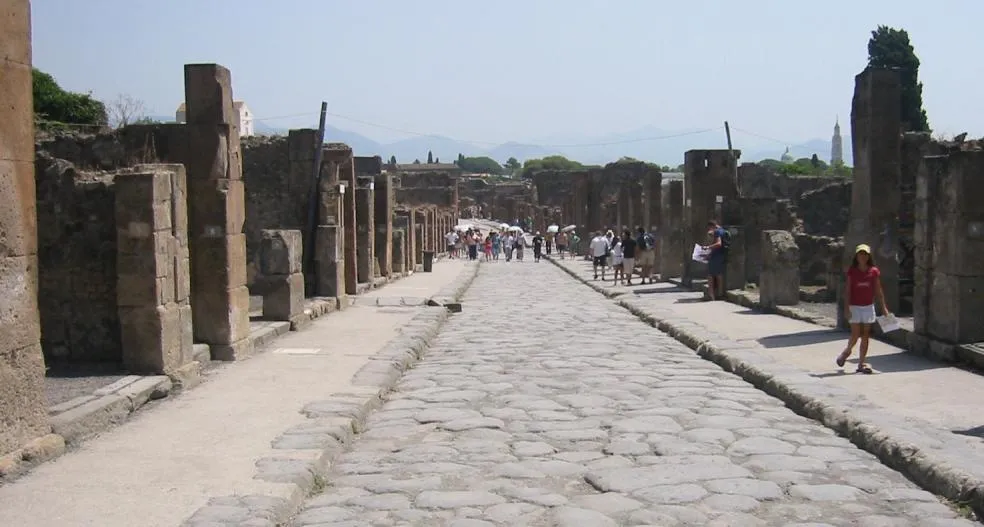
Pompeii is in Campania, Italy, not far from Naples. The ruined ancient Roman city of the same name was engulfed by Mt. Vesuvius in AD 79, and is a UNESCO World Heritage Site. It is considered to be one of the few sites where an ancient city has been preserved in detail. Everything from jars and tables to paintings and people was frozen in time, yielding, together with neighbouring Herculaneum which suffered the same fate, an unprecedented opportunity to see how Romans lived two thousand years ago.
Pompeii travel guide
Understand
Romans took control of Pompeii around 200 BC. On August 24, 79 AD, Vesuvius erupted, burying the nearby town of Pompeii in ash and soot, killing 20,000 people, and preserving the city in its state from that fateful day. Pompeii is an excavation (It: scavi) site and outdoor museum of the ancient Roman settlement.
Hours Apr-Oct: daily from 09:00 to 19:00, last admission 17:30 Nov-Mar: daily from 09:00 to 17:00, last admission 15:30 It is closed on 1 January, and 25 December.
Tickets Entrance is limited to 20,000 people per day, so buy your tickets in advance. As of July 2025, One-day tickets cost €18 per adult for the ancient city only, or €22 for the ancient city and the suburban villas (Villa of the Mysteries; Villa of Diomedes; and Villa Regina in Boscoreale with Antiquarium). There is a 3-day pass (€26) to the ancient city, the suburban villas, Oplontis, Villa Arianna, Villa San Marco, Libero D’Orsi Museum, and Boscoreale. It allows one entrance at each site, and includes a shuttlebus between sites. Admission costs €2.00 for EU citizens between the ages of 18 and under 25. The reduced tariff is also valid for non-citizens who hold a residence permit in Italy. EU citizens under 18 get in for free with valid age document. Admission is free with Artecard and on the first Sunday of the month (not including suburban villas). The MyPompeii card is valid for one year, costs €35 and is valid for all of the sites of the Archaeological Park of Pompeii. Telephone: +39 081-857-5347.
Other services Audioguides are available either at the train station InfoPoint or at the official entrance for €8 (Apr 2024), ID is required as deposit. Unofficial audio guides are on offer at one of the market stalls near this entrance. Take note that audioguide maps are not the same and the official audioguide comes with more audio points of interest. It's a good idea to check out both options before deciding. Pompeii may take several hours to explore so make sure to ask about t
Getting there
For transport in the area see Campania.
By train It takes 30 to 40 minutes to get to Pompeii from either Naples or Sorrento. One-way tickets from any Trenitalia station within Naples city limits cost €4.80 (2025). Pompeii is served by three train stations. National train operator Trenitalia has two stations: Pompei and Pompei-Scavi in the Napoli-Salerno regional line. The Pompei station is south of the modern town. A ticket from Napoli Centrale costs €3.30 per person. Getting out of the station, look for the impressive bell tower of the Shrine of the Blessed Virgin of the Rosary of Pompeii (Italian: Pontificio Santuario della Beata Vergine del Santo Rosario di Pompei) and follow the main avenue (Via Sacra) heading north for a 3-minute walk to Piazza Anfiteatro. There you will find one of the three entrances to the ruins, and the EAV bus stop for direct trip to the summit of Mt Vesuvius. If you are not willing to walk, taxi drivers at the train station will offer to take you to the entrance for around €10. Pompei-Scavi includes a bus to Scavi and costs €4.80 per person. This bus will drop you off at the station near Port Marina. The Circumvesuviana railway, operated by EAV, has two stations in the village. On the Napoli-Poggiomarino line, the Pompei Santuario station is north of the modern village, very close to the Shrine of the Blessed Virgin. On the Napoli-Sorrento line, the small station called Pompei Scavi-Villa dei Misteri is about 50 m away to the main entrance to the ruins. Being the closest, it is the most frequented station by visitors, and it can be overcrowded at closing time when everybody gets out and rush for the trains to come back to Napoli. Timetables for the Circumvesuviana railway are available on this link. There is a left luggage office which is somewhat hard to find - one has to go down the stairs to the underground passageway that connects the two platforms to find it. At Pompei Scavi-Villa dei Misteri you can leave your bags for €1.50 (c
Getting around
This is a walking site only. There are a few bicycles for rent, but the surfaces make them rather impractical. Walking the old Roman stone roads can be quite exhausting, especially in the heat of summer with loads of fellow tourists about. Everyone will be walking on cobblestones and uneven ground. The temperature is between 32° and 35°C in the summer. Make sure to take plenty of water and watch your step as the old roads have grooves in them where the carts ran. It is advisable to wear good footwear, sunscreen and hats. There is a lot to look at and in a full day, you still won't see everything. On buying your ticket you should receive a map of the site and a booklet listing the main attractions. However, these can be sometimes out of print or you may find that the only booklet available is in Italian. A map of the site is essential if you want to see a lot in as short a time as possible. Even with a map visiting Pompeii is a bit like a trip to a maze. Many of the roads, apparently open according to the map, turn out to be blocked off for excavations or repairs, or, as happened in 2010, because a building collapsed. You might think you are heading for the exit but then have to turn around and retrace your steps to find another route. Be aware that not all houses are open at all times. Check the schedule at pompeiisites.org.
See
1 Amphitheatre (Anfiteatro). This is in the most easterly corner of the excavated area, near the Sarno Gate entrance. It was completed in 80 BC, measures 135 x 104 metres and could hold about 20,000 people. It is the earliest surviving permanent amphitheatre in Italy and one of the best preserved anywhere. It was used for gladiator battles, other sports and spectacles involving wild animals. 2 Great Palaestra (Gymnasium). This occupies a large area opposite the Amphitheatre. The central area was used for sporting activities and there was a pool in the middle. On three sides are lengthy internal porticos or colonnades. (updated Jan 2023) 3 House of the Vettii (Casa dei Vettii). This is believed to have been the home of two brothers who were freed slaves and became very affluent. It contains many frescoes. In the vestibule there is a striking fresco of a well-endowed Priapus, God of Fertility and among the frescos in other parts of the building are illustrations of couples making love, of cupids and of mythological characters. 4 House of the Faun (Casa del Fauno). This is named after a statue of a dancing faun found on the site. It is considered to be an excellent example of the fusion of Italian and Greek architectural styles, and occupies an entire block. 5 Forum. This was the centre of public life, although it is now in the southwestern part of the excavated area. It was surrounded by many of the important government, religious and business buildings. 6 Temple of Apollo. This is to the north of the Basilica on the western side of the Forum. It has the oldest remains discovered, with some, including Etruscan items, dati
Overview adapted from Wikipedia, travel guide fromWikivoyage (CC BY-SA). Photography via Wikimedia Commons.