
Appian Way
Italy · Europe
About
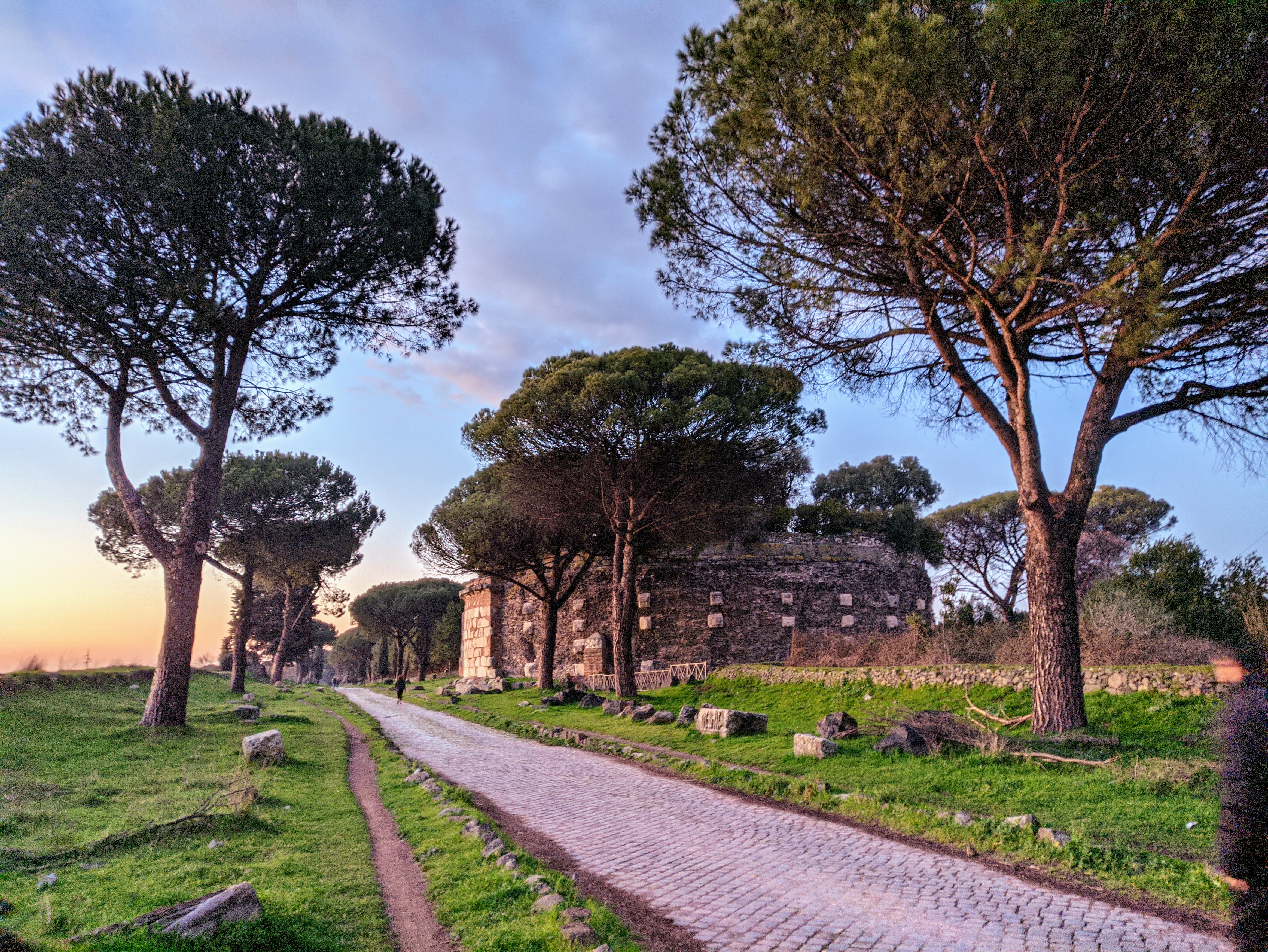
The Appian Way, also known by its Latin and Italian name, Via Appia, is one of the earliest and strategically most important Roman roads of the ancient republic. It connected Rome to Brindisi, in southeast Italy. Its importance is indicated by its common name, recorded by Statius, of Appia longarum... regina viarum ('the Appian Way, the queen of the long roads'). The road is named after Appius Claudius Caecus, the Roman censor who, during the Samnite Wars, began and completed the first section as a military road to the south in 312 BC. In July 2024, the Appian Way entered the UNESCO World Heritage List.
The Appian Way was a Roman road that the Republic used as a main route for military supplies for its conquest of southern Italy in 312 BC and for improvements in communication. The Appian Way — essential to the Romans — was the first long road built specifically to transport troops outside the smaller region of greater Rome. The few roads outside the early city were Etruscan and went mainly to Etruria.
Romans had an affinity for the people of Campania, who, like themselves, traced their backgrounds to the Etruscans. The Samnite Wars were instigated by the Samnites when Rome attempted to ally itself with the city of Capua in Campania. The Italic speakers in Latium had long ago been subdued and incorporated into the Roman state. They were responsible for changing Rome from a primarily Etruscan to a primarily Italic state. Dense populations of sovereign Samnites remained in the mountains north of Capua, which is just north of the Greek city of Neapolis. Around 343 BC, Rome and Capua attempted to form an alliance. The Samnites reacted with military force.
Between Capua and Rome lay the Pontine Marshes (Pomptinae paludes), a swamp infested with malaria. A tortuous coastal road wound between Ostia at the mouth of the Tiber and Neapolis. The Via Latina followed its ancient and scarcely more accessible path along the foothills of Monti Laziali and Monti Lepini, which are visible towering over the former marsh. In the First Samnite War (343–341 BC) the Romans found they could not support or resupply troops in the field against the Samnites across the marsh. A revolt of the Latin League drained their resources further. They gave up the attempted alliance and settled with Samnium.
The Romans were only biding their time while they looked for a solution. The first answer was the colonia, a "cultivation" of settlers from Rome, who would maintain a permanent base of operations. The Second Samnite War (327–304 BC) erupted when Rome attempted to place a colony at Cales in 334 BC and again at Fregellae in 328 BC on the other side of the marshes. The Samnites, now a major power after defeating the Greeks of Tarentum, occupied Neapolis to try to ensure its loyalty. The Neapolitans appealed to Rome, which sent an army and expelled the Samnites from Neapolis.
In 312 BC, Appius Claudius Caecus became censor at Rome. He was of the gens Claudia, who were patricians descended from the Sabines taken into the early Roman state. He had been given the name of the founding ancestor of the gens, Appius Claudius (Attus Clausus in Sabine). He was a populist, i.e., an advocate of the common people. A man of discernment and perception, in the years of success he was said to have lost his eyesight and thus acquired the name caecus, 'blind'. In antique literature, blindness was sometimes associated with great vision, cf. Homer. Without waiting to be told what to do by the Senate, Appius Claudius began bold public works to address the supply problem. An aqueduct (the Aqua Appia) secured the water supply of the city of Rome. By far the best known project was the road, which ran across the Pontine Marshes to the coast northwest of Naples, where it turned north to Capua. On it, any number of fresh troops could be sped to the theatre of operations, and supplies could be moved en masse to Roman bases without hindrance by either enemy or terrain. It is no surprise that, after his term as censor, Appius Claudius became consul twice, subsequently held other offices, and was a respected consultant to the state even during his later years.
Adapted from Wikipedia (CC BY-SA). Photography via Wikimedia Commons.