
Arras
France · Europe
About Arras
Arras (Dutch: Atrecht) is an attractive town in the Hauts-de-France region of France. It was much fought-over in World War I and is mainly visited by tourists travelling from or to the nearby ports of Calais and Boulogne. It is also a good starting point for a visit to the Canadian National Vimy Memorial (see Lens).
Arras travel guide
Getting there
By train There are regular TGV inOui trains from Paris' Gare du Nord. The journey takes less than an hour and tickets become much more affordable when bought more than a week in advance. The train will arrive at Gare d'Arras, which is only a 15-minute walk from the center area of the city.
Getting around
Walking is a great way to explore Arras given its small size. You will also notice small yellow buses called "Ma Citadine" running through the city center on two lines, with departures every 10 minutes. These are free of charge and will take you to most of the city's main points of interest (route map).
See
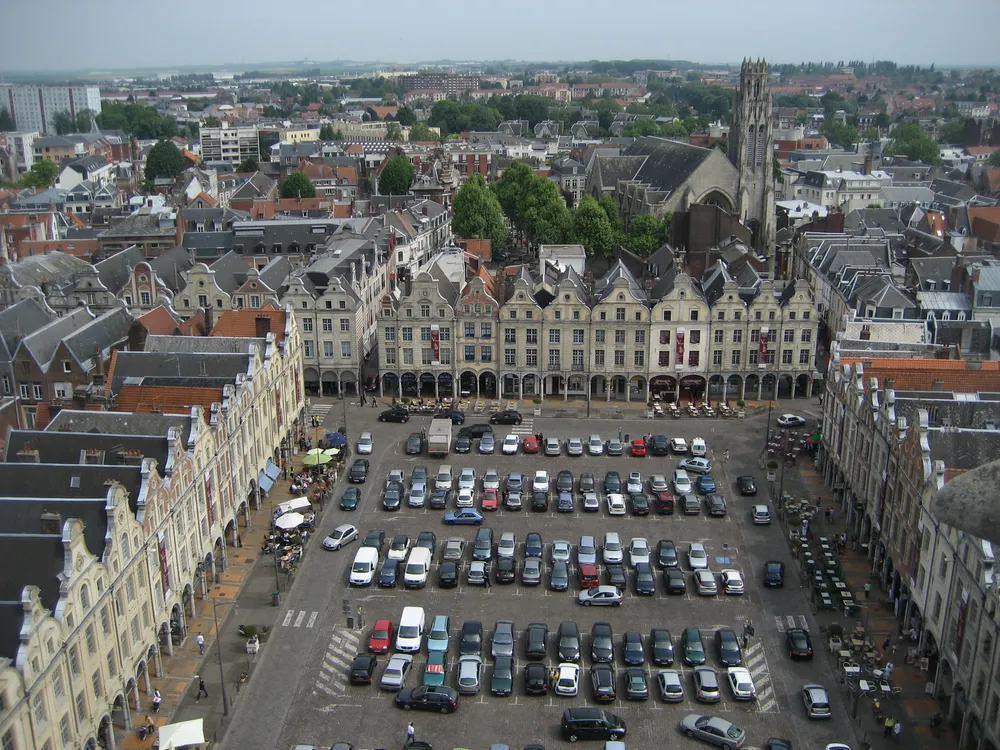
Les places (1 Grand' Place et 2 Place des Héros) - Like many town centres in France, Arras is made of cobblestone. Both main squares measure 17 000 m². The town's two great squares are quite splendid providing a collection of 155 unique façades of Flemish baroque architecture. In 1492 Arras had become part of the Spanish Netherlands and this helps explain the style of the architecture (Arras was only retaken by the French in 1640 at the time of Louis XIII). These large town squares were designed to accommodate large markets which in different periods contributed largely to the prosperity of the city.
3 L'Hôtel de Ville & Le Beffroi d'Arras. The Hôtel de Ville (Town Hall) on the Place des Héros (and not the Grand' Place) was destroyed during the war but has been recreated in its original style. The dominating belfry (beffroi) is 77 m high, or 326 steps and offers a great view of the city of Arras. Building had begun in 1463, but it was a century later in 1554 before the work was completed (by comparison the Hôtel de Ville took just four years to construct). The belfry was built in Gothic style. A 2-m-tall statue of the golden lion holding the sun can be found at the top of the bell tower. It was installed under Louis XIV (hence the sun found in its paws). The statue found at the top of the belfry is the reproduction of the original which sits in the Museum of Fine Arts in Arras (the original being damaged due to the bombings during World War I). During this period, the belfry was destroyed and it was rebuilt later, just as it had originally been with a concrete structure by the chief architect of historic monuments Pierre Paquet along the town hall of Arras. The belfry is a historical monument. Since 2005, the belfry of Arras is listed as a World Heritage Site by UNESCO in category: Belfrys of Belgium and France. The local Tourist Information Office is in an office on the left as you go in and it is open every day except Christmas and the New Year. Below, in the bas
Do
Main Square Festival. A local music festival that takes place every around late June and early July. A variety of acts, French and American, perform in the Citadelle d' Arras, an old military base. Popular American bands such as Maroon 5 have had performances here. (updated Apr 2023) KHUB Arras, 78, route de Béthune, Sainte-Catherine, ☏ +33366869833. Nice place to go out at night, a multi-activity complex with activities for the whole family: karting, bowling, karaoke/blind test, darts, pool. There is also a bar with nice Belgium beers and a terrasse. (updated Feb 2025)
Eat
1 Le Mamounia, 9 Rue des Balances (right next to the Place des Héros), ☏ +33 3 21 07 99 99. Traditional Moroccan couscous. Due to the influx of North African migrants to the Hauts-de-France region, many incredible restaurants have sprung up. This restaurant is especially useful for large parties, as it can accommodate a massive feast. (updated Apr 2023)
Overview adapted from Wikipedia, travel guide fromWikivoyage (CC BY-SA). Photography via Wikimedia Commons.