
Abbey of Fontenay
France · Europe
About
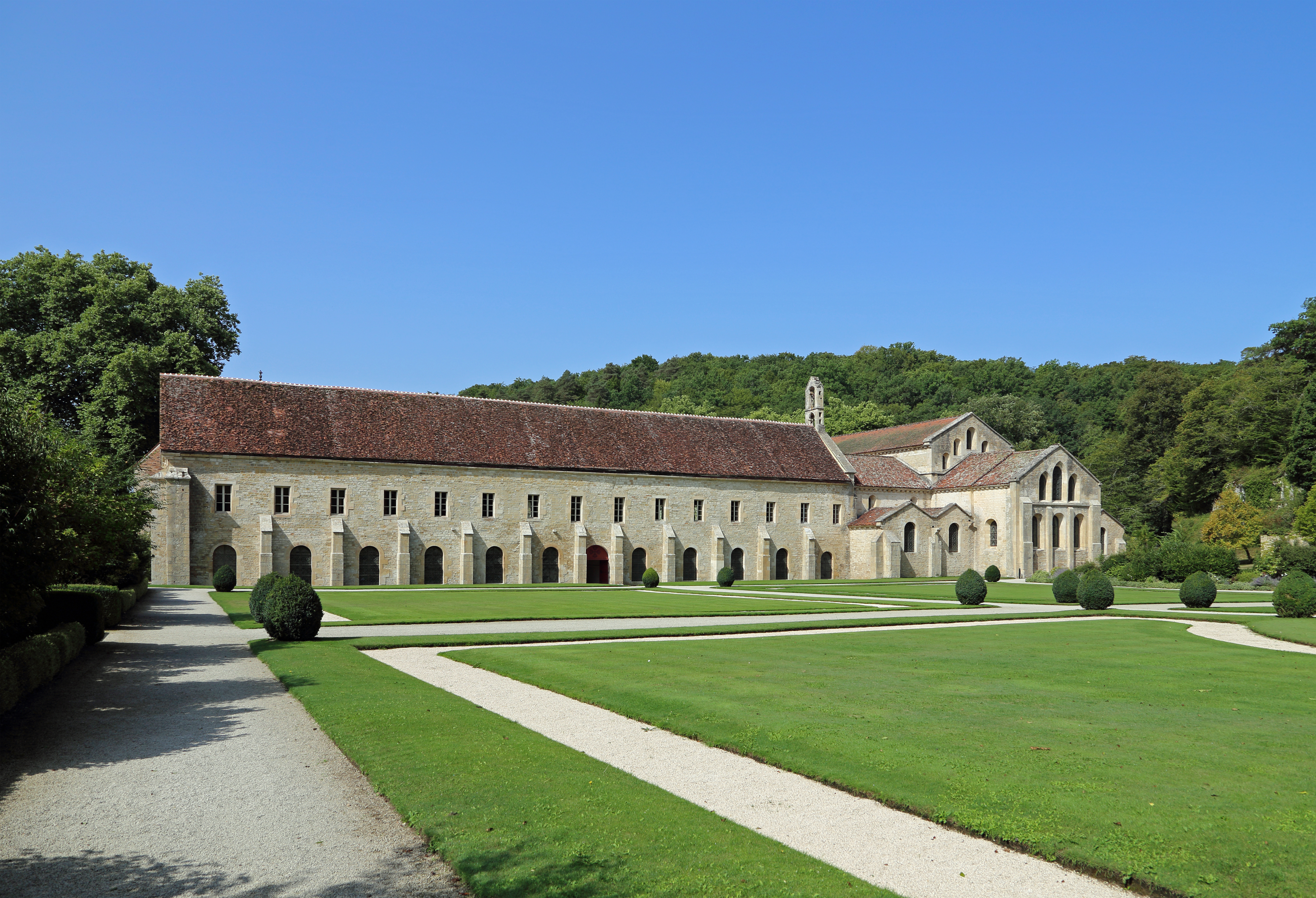
The Abbey of Fontenay is a former Cistercian abbey located in the commune of Marmagne, near Montbard, in the département of Côte-d'Or in France. It was founded by Saint Bernard of Clairvaux in 1118, and built in the Romanesque style. It is one of the oldest and most complete Cistercian abbeys in Europe, and became a UNESCO World Heritage Site in 1981. Of the original complex comprising church, dormitory, cloister, chapter house, caldarium, refectory, dovecote and the so-called "forge", all remain intact except the refectory and are well maintained. The Abbey of Fontenay, along with other Cistercian abbeys, forms a connecting link between Romanesque and Gothic architecture.
In the late 11th century during the heyday of the great church of Cluny III (a magnificent Benedictine monastery in Cluny, France), although Cluny had numerous followers, Saint Robert of Molesme, the subsequent founder of Cîteaux Abbey, led a strong reaction against it. Saint Robert thought that Cluny was against the actual Rule of Saint Benedict: “to work is to pray”. As a result, Saint Robert, along with a group of monks who shared this belief, detached from Cluny. Saint Robert established the Order of Cistercians in Citeaux, France. The new order strictly observed the Rule of Saint Benedict. As part of this rule, monks had to be poor and live a simple life. In order not to be distracted from the religious life, Cistercians built self-sufficient monasteries in isolated areas and refused to use servants. Cistercian monasteries were independent. They differed from Cluny in that all houses were under the direct control of the abbot, and each Cistercian monastery needed to take care of its own. Each of them was most likely an independent individual society. Bernard of Clairvaux, an abbot and the primary builder of the reformed Cistercian order, shared the same faith with Saint Robert of Molesme. However, Bernard felt that Cîteaux Abbey was not austere enough and did not completely reflect the Rule of Saint Benedict. Thus, in 1118 he founded the Abbey of Fontenay in a Burgundy valley with strictly implemented austerity.
The Cistercian monks moved to Fontenay Abbey in 1130. Nine years later, the Bishop of Norwich fled to Fontenay to escape persecution, and helped finance the construction of the church with his wealth. The church was consecrated in 1147 by Pope Eugene III. By 1200 the monastic complex was complete and able to serve as many as 300 monks. In 1259, the devout King Louis exempted the Abbey of Fontenay from all taxes, and being in the King's good graces, ten years later the abbey became a royal abbey. In 1359, the Abbey of Fontenay was pillaged by the armies of King Edward III of England during the Hundred Years' War. It suffered further damage during the Wars of Religion in late 16th century. In 1745, the refectory was destroyed. With the beginning of the French Revolution in 1789 all of the monks successively left the abbey due to dechristianisation during the revolution and in 1791, the site was turned into a paper mill, run by the Montgolfier brothers. In 1906 Edouard Aynard, an art-loving banker from Lyon, bought the abbey and commenced its restoration which was complete by 1911. Edouard's descendants continued to work on the abbey and it remains in the Aynard family to this day. In 1981 the abbey became a UNESCO World Heritage Site.
All Cistercian churches have the same model and are similar to one another; for example, Graiguenamanagh Abbey's church, built in Ireland in 1204, has a floor plan closely resembling that of Fontenay. The spirit of Cistercian architecture is simple, conservative, and utilitarian. Cistercian monastery churches feature Romanesque architecture, including symmetrical plan, massive walls, sturdy piers, groin vaults, round arches, and a tall central nave. In medieval Europe, the Cistercian ethic of manual labor work became "the main force of technological diffusion" in many fields, including metallurgy.
Adapted from Wikipedia (CC BY-SA). Photography via Wikimedia Commons.