
Ariano Irpino
Italy · Europe
About Ariano Irpino
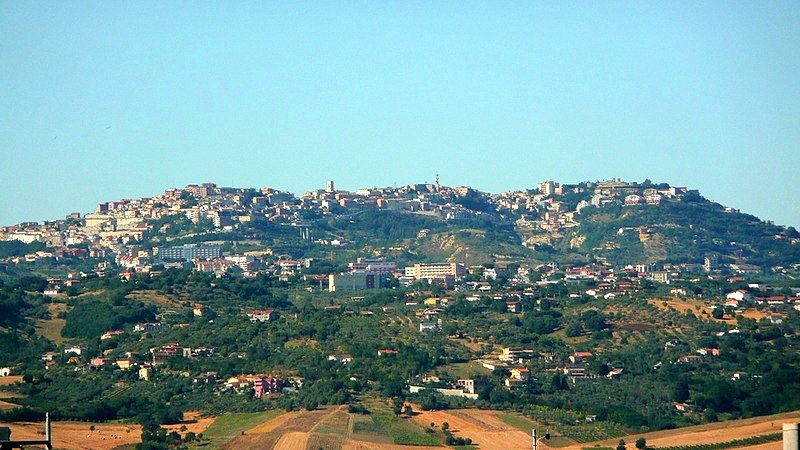
Ariano Irpino is a town in Campania. It is known as la Città del Tricolle ("the City of the Three Knolls") because it towers on three rounded hills. Ariano Irpino lies upon the Irpinian Apennines and is almost centred between the Adriatic Sea and the Tyrrhenian Sea. Despite wars and earthquakes the town retains several historic buildings and ancient sights.
Ariano Irpino travel guide
Understand
Its population is roughly 21,000 (2024) and its elevation is 788 metres (2; 585 ft) above sea level, which brings the town a mild climate in summer and some snow in winter. Because it is close to Apulia (Puglia in Italian), it was called Ariano di Puglia until 1930. Informally called simply Ariano, Ariano Irpino was legally granted the status of città ("city") in 1952. The official and most widely spoken language in Ariano Irpino is Italian. A variety of Irpinian dialect (loosely similar to Neapolitan) is used too. English is the most commonly spoken foreign language, although the average knowledge of English is far from excellent. The town has very ancient origins, and there are two archaeological sites in the area: the Neolithic village of La Starza (the oldest one in Campania) and the Roman village of Aequum Tuticum (a road junction between the Via Aemilia; the Via Traiana and the Via Herculea). The historical centre of Ariano has medieval origins. Founded by the Lombards, it assumed great importance under the Normans. King Roger II lived there and held the famous Assizes of Ariano (in the 12th century). It was devastated by the Saracens of Lucera, but rose again under the Angevins. It was one of the first southern towns to free itself from the feudal yoke (in 1585).
Getting there
By plane Naples International Airport (NAP IATA) (Aeroporto Internazionale di Napoli; also known as Capodichino Airport) is 100 km away from the town, which is easily accessible via A16 highway. From the airport you can also take an AirCampania bus for €10; you should buy your ticket at a bar or a kiosk specifying the destination ("Ariano Irpino"). There are several AIR buses on working days and Saturdays, but only a few ones on Sundays. Other useful facilities are the intercontinental Fiumicino Airport (near Rome; 275 km away), and the smaller national Foggia Gino Lisa Airport, which is only 60 km away.
By train
Ariano Irpino railway station is 6 km away from the town, but only a few trains stop there. Furthermore no taxis and hardly any buses are available, but you can conveniently book a minicab instead (Mèmoli Service: ☏ +39-338-8210012). Alternatively you can arrive at Napoli Centrale railway station and take an AirCampania bus to Ariano Irpino. You can also get to Foggia railway station and there take an AirCampania bus to Ariano Irpino, but only on working days.
1 Ariano Irpino railway station (Stazione di Ariano Irpino). (updated Mar 2024)
By bus AirCampania bus daily connects the town with Avellino and Naples; on working days (Monday to Saturday) there are bus links with Benevento and Foggia too.
By car Ariano Irpino is directly connected with the A16 highway by Grottaminarda junction. The trip takes generally less than 2 hours from Naples or Bari, and at most 3 hours from Rome. Alternatively, you can follow the A14 highway Pescara-Bari, exit at Foggia and subsequently take the SS 90 road for Naples.
Getting around
Except at peak hours, traffic is flowing and parking is easy and cheap. Most distances in the historic centre are small and can be walked in a matter of minutes: only remember to always look left for incoming cars or motorbikes because circulation follows European standards. The bus terminal is a 10-minute walk-away, but you can conveniently use the intermediate stops. There is also Circolare, an urban bus service that connects all points of the town (except the train station), but the frequency is poor (1 every hour on weekdays; 1 every 2 hours on holidays); you will pay €1.20 if you buy the ticket onboard the bus, but only €1 if you buy it at an authorized selling point or tobacco shops (Tabaccheria; easily identified by a big white "T" on a rectangular black field). In any case the validity is one hour.
See
1 Cathedral (Cattedrale di Santa Maria Assunta), Piazza Duomo. The Romanesque cathedral preserves a High-Medieval baptismal font, various artistic works and a silver museum, while nearby are the bishop's palace, many other churches, the diocesan museum and the museum dedicated to Giuseppina Arcucci, founder of the Congregation of the Holy Spirit's nuns. (updated May 2019) 2 Norman Castle (Castello Normanno), Piazza Lusi, ☏ +39 0825 875-100. Tu-Su 10:30-12:30, 17:00-19:00. Founded by the Lombards, this castle became very important under the Normans, when it was the head of a powerful county; there did King Roger II stay and there he held the Assizes of Ariano and coined the ducat. Later the castle was remodeled by the Angevins and the Aragonese. All around the castle there is a wide and panoramic public park. (updated Jun 2023) 3 Palazzo San Giacomo, Via Tranesi. On a cliff overlooking the Irpinian valleys, it used to be a hospital. Thereabouts were many ancient majolica furnaces, and nowadays the building houses a permanent exhibition of majolica art. (updated May 2019) 4 Palazzo Forte, Via D'Afflitto. Home of the European Centre for Norman Studies, and the Archaeological, Civic & Ceramics Museum. The town has a long, ancient history and is still a center of ceramics manufacturing. (updated May 2019) 5 Palazzo Bevere, Via Mancini. It is a majestic building that in 18th century was converted into a high-school complex. Today it houses the museum of Norman civilization. (updated Jun 2023) 6 Norman Civilization Museum, Largo Bevere square. Set in an evocative historical setting, it houses weapons and artifacts of all kinds dating back to the Middle Ages in general and to the Norman era in particular. (updated Jun 2023) 7 Civic and Ceramics Museum, Via d'Afflitto (Forte Palace). In addition to numerous prints and period images, the Museum exhibits a wide range of local majolica and ceramics dating back to the 12th century. 8 Silver Museum, Piazza Plebiscito (Cathedral
Do
Halfway between the Romanesque Cathedral and the Norman Castle, along via Tribunali street, there is the Communal Auditorium "Lina Wertmüller". Instead the nightclubs are in the suburbs, along the statal road.
Estate Arianese, July, August, September. Programme of cultural, musical, religious and sporting events. Ariano International Film Festival (AIFF), July and August. International film festival. Historical re-enactment of the gift of the Holy Thorns, in Italian Rievocazione storica del dono delle Sacre Spine. August. Ancient historical reenactment. Ariano Folkfestival (AFF), August. International folk music festival. Pizza party, in Italian Festa della Pizza (in Bosco Frólice; a large green area 5 km from the city center; on the road to Montecalvo Irpino). August. Traditional feast dedicated to good food and excellent company. Ariano BioFestival Irpinia. September. A festival of Irpinian biological food.
Buy
In the historic center there is plenty of small and typical shops (among which the traditional majolica ones stand out), whereas larger distribution chains find their place in the outskirts. There are seven annual fairs on Palm Sunday, Sunday in Albis, the second Sunday of May, June 13th, July 16th, the last Sunday of
Overview adapted from Wikipedia, travel guide fromWikivoyage (CC BY-SA). Photography via Wikimedia Commons.