
Voyaging along the Amazon River
Itinerary
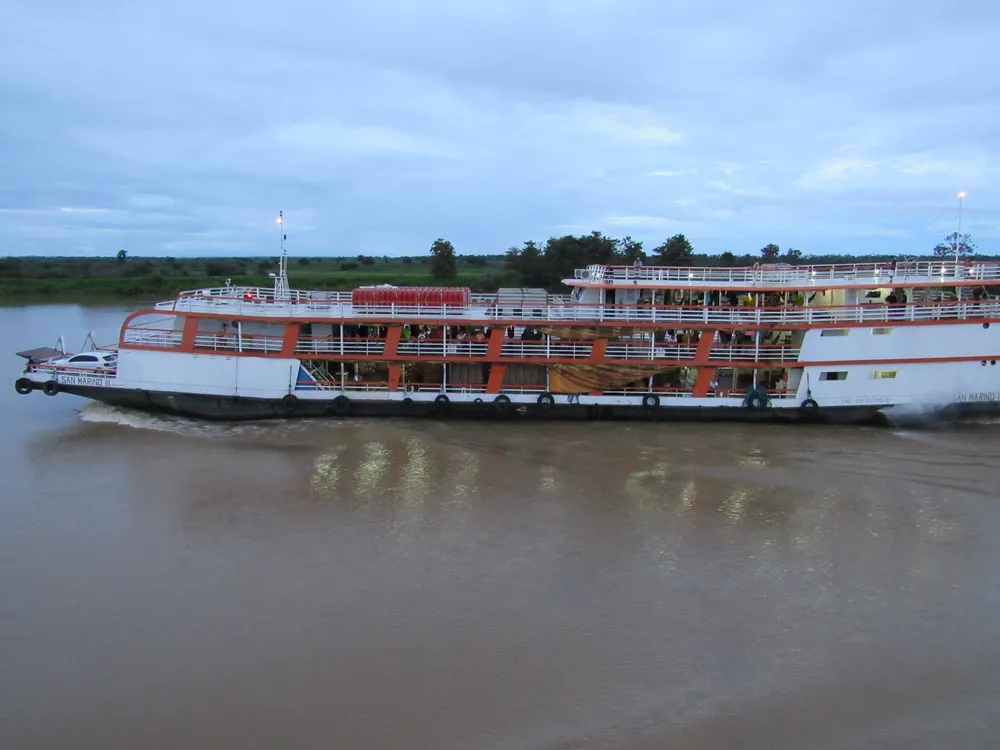
This itinerary details travelling downstream on the Amazon from Iquitos via Tabatinga, Manaus, Santarém, Santana/Macapá to Belem. This article does not point out sights along the river as for most people the journey itself is the main attraction. For sights along this trip, check out the pages specific to locations mentioned.
Understand
The boats that serve the Amazon are not designed with tourists in mind; they are the default mode of transportation for goods and people from place A to place B. Therefore:
always ask how long the boat will be in a port before leaving the boat. Somebody who manages the off-loading with a list in his hand gives you a more precise answer about when the boat is going to depart. never venture too far from the boat when in a port, it will not wait for you to return boats are not made for comfort, they are noisy and don't offer a lot of service standards are low, reflecting the standard of living of the people who use those boats (those who have money to spare prefer to fly) western people will stand out as "gringos", expect to be asked for favors (money, cigarettes, etc.) - a friendly "no" is usually accepted, though your fellow travelers are mostly poor - don't flash expensive gear or, if you have to (like a camera), keep it on you all the time (i.e. sleep with the camera in your hammock, take it with you when going to the shower or toilet). The other travelers have at least the same moral standards you have, but when stealing a camera from you is the equivalent of half a year of hard, honest work, temptations are high and after all "you can afford to buy a new one". But if you accept all that, you can have a great time - just don't put your expectations too high and you'll probably be pleasantly surprised.
Prepare
At home, or en route, if traveling for longer: Get a yellow fever vaccination. In theory it is mandatory in the tres fronteiras area where Brazil, Colombia and Peru meet, practically yellow fever is endemic along most of the Amazon and getting a vaccination upfront is better than having complications after an infection. Also, some countries require proof of vaccination when coming from an area where it is endemic (again in theory, it is rarely checked in reality). Still, get vaccinated! Also, especially when planning lots of excursions on lands and when traveling for a longer time, get a typhus vaccination. Last but not least: When traveling to riskier areas (esp. the north-eastern parts like the border to Venezuela or to the Guyanas), bringing emergency medication for malaria is a very good idea. If you want to pay on board the ticket as well as food and drinks with a credit card, ask beforehand if that is possible. Some boats only accept cash.
You'll need a number of things on the boats Hammocks and ropes: (Portuguese: redes e cordas) R$20-120 + $2.5, as of 2016. There are many different types available, just remember that it's going to be hot during the day and can get quite cold and windy at night. So best to get one with thin material and use your sleeping bag at night or get a thick one and a blanket (sold in the same shops, ca R$20). A hammock for 2 will allow for much more comfortable sleep when used by one person only. Most boats don't allow couples to share a hammock: get one per person (though kids may sleep in a parent's hammock). Bed sheet and blanket: If you decide to take a cabin or suite, you cannot rely on having more than a mattress. Bring your own sheet and blanket. Mosquito nets and insect repellents: Locals don't use nets even in wet season, but applying insect repellent at sunset and again before going to bed is a good idea to keep all kinds of insects, not just mosquitoes, away. Power plug adapters: All boats have power sockets but random plugs. Voltages differ. Though, don't count on having access to power all the time - there are many passengers and only so many power plugs. Thus, don't expect to use your laptop or smartphone permanen
Get in
Depending on your citizenship you may need a visa to enter Brazil, Peru and Colombia. Ensure that you get your passport stamped as might be checked numerous times (esp. when traveling downstream) and penalty fees can be steep when you try to leave a country and cannot show your entry stamp. The only exception is the Tres Fronteras area where Peru, Brazil and Colombia meet - here you can freely roam around the three countries. You'll still have to make sure you get your entry- and exit stamp for the country you are coming from and the one you are going to.
By plane You can get to: Belem, Macapa, Santarem, Manaus, Tabatinga, Leticia and Iquitos. Belem's international airport (BEL IATA) has flights to Lisbon, Miami Airport, Paramaribo, Georgetown and Cayenne. Macapa's airport (MCP IATA) has flights to Belém and Brasilia. Santarem's airport (STM IATA) has flights to Brasilia, Fortaleza, Manaus and Rio de Janeiro. Manaus's airport (MAO IATA) has flights to Miami, Barcelona El Prat, Panama City, Fortaleza and Aruba. Tabatinga's airport (TBT IATA has flights to Manaus. Leticia's airport (LET IATA) has flights to Bogotá, Iquitos and Pucallpa. Iquitos's airport (IQT IATA) has flights to Lima, Trujillo, Pucallpa and Chiclayo.
By bus You can reach Belem (by bus from the south), Macapa (from French Guyana via Oiapoque) and Manaus (by bus from Boa Vista).
By boat You can go to Iquitos from further south in Peru, though as of 2016 this is only recommended to seasoned travelers because of drug-related violence along the 4-day trip within Peru.
Go
Prices depend on season and those listed below (from 2016) the prices you'll be quoted will likely be different. As a rule of thumb: per day of travel you'll have to pay R$50 per day for a passage in a hammock in low season, R$60 to R$70 in high season - without food. If food is included, the price is R$15 to R$25 higher per day. If food is extra, calculate with R$15 to R$30 per day for full board. Note that the following itinerary is just listing major towns/settlements. You can get off the boat at any point in between and board another one later. Just book exactly until where you want to go, as none of the boats offers hop-on-and-off tickets. For most efficient connections buy your onward ticket immediately after getting off a boat, directly at the port after disembarking. The following information is just a rough guide, details depend on which boat you take at which season and to which destination. Boat schedules usually have a buffer at every stop so they can make up time lost earlier by speedier unloading of goods. Though, sometimes boats arrive and leave earlier than indicated by the schedule! Always be early at the port, give the booking agency your telephone number (or the one of your hotel) so they can inform you of earlier departures. In case boats arrive early at their final destination one usually can sleep on the boat until sunrise - but don't count on it, in worst case you'll have to leave the boat at 03:00 in heavy rain.
Peru In theory prices are set. In reality you will be quoted (slightly) higher prices if you are a gringo. Whether to discuss or just accept is a matter of personal preference and how well you speak Spanish.
Iquitos to Santa Rosa (Peru) - 11 hours to 2½ days
You can either take a speedboat (11 hr) or a slow boat (about 2½ days). The latter will do many stops in small settlements along the river to take on and drop off passengers and cargo.
Stops: Pebas and various smaller cities
Santa Rosa (Peru) to Tabatinga (Brazil) - 10 minutes plus bureaucracy First, get your exit-stamp for Peru at the immigration office in Santa Rosa. Then you will have to take a small boat to Tabatinga (about 10 minutes). They wait about 200 m
Eat
On some boats food is included, while on others one has to sometimes pay prices which would be considered steep for the locals. Ask when booking and maybe stock up on durable food so you don't have to pay 3 times a day for sometimes mediocre food. Going rates, as of 2016, are: R$3 to R$5 for breakfast, R$10 to R$12 for lunch and dinner. Simple sandwiches that are available on some boats' bars go for R$4. Softdrinks (0.33l can) come at R$4, beers (0.33l can) come at R$5. The quality of the food depends on the boat and cannot reliably be predicted. R$5 for breakfast can get you a single coffee and a roll
Adapted from Wikivoyage (CC BY-SA)