
Across Australia by train
Itinerary
See Rail travel in Australia for general information about travelling by train in Australia
Understand
History of the Ghan The Ghan is named after the Afghan cameleers that transported goods to Australia's remote centre prior to the construction of the railway. The sand and heat made the trip entirely unsuited to horses. The cameleers overwhelmingly weren't from Afghanistan, they were just known as Afghans in the Australian vernacular. The construction of the original Ghan from Adelaide started in 1878, with Oodnadatta reached in 1891 and, after a thirty-year break, Alice Springs in 1926. A separate but unconnected track from Darwin to Katherine in the north was also completed in the same year; this line was closed in 1976. The original Ghan was twisty, narrow-gauge and built straight through many valleys prone to flash floods that washed away tracks and bridges. A decision was thus made to rebuild nearly all of the line in standard gauge, over 100 km to the west. The new line to Alice Springs opened in 1980, and the remaining 1,420 km (880 mi) section across the continent to Darwin opened in 2004.
History of the Indian Pacific A railway connecting Perth to Australia's major eastern cities, funded by the federal government, was one of the carrots dangled before Western Australia to entice them to join the federation in 1901. Surveys for the route of the new railway began in 1907, and construction of the standard gauge Trans-Australian Railway began in 1912, with construction teams working eastward from Kalgoorlie and westward from Port Augusta. Construction of the railway was a monumental task as the sheer remoteness and desolation of the Nullarbor Plain made the logistics very difficult, with teams having to work hundreds of miles away from the nearest towns. Construction teams had to live along the tracks in tent cities, and they were supplied by "Tea and Sugar Trains" carrying water and provisions, while construction material was transported by horses and camels. Moreover, as World War I had broken out in 1914, procuring labour and construction material was difficult. Despite all that, the two teams eventually met at Ooldea on 17th October 1917, marking the completion of the railway line; this spot is marked by the Linking of the Rails Monument, which is
Prepare
Find time These are not high-speed transcontinental trains. They are slow, laid back and luxurious trains that know how to take their time and let you enjoy the scenery. The trains are privately run by Journey Beyond. The current iteration of both routes was not built for passenger traffic, but rather to serve the very lucrative freight business.
Save up Any way you look at it, The Ghan and the Indian Pacific are expensive. The more economical "Red Service" has been discontinued, and both trains now cater exclusively to the luxury market with an all-sleeper configuration. The lowest class of service is "Gold Service", which has single cabins (shared shower), twin cabins (shower en suite) and includes all meals in the dedicated restaurant car. This will set you back at least $2,115 on The Ghan, and $2,475 on the Indian Pacific in the low season, increasing to $2,845 on the Ghan and $2,835 on the Indian Pacific during the peak season. Add another $2000-4000 on top, and you can get a double-sized "Platinum Service" cabin, which also gets you a quieter dedicated lounge on board, and complimentary transfers from and to your place of accommodation at the start and end of your journey respectively. You cannot get off and board a few days later at most intermediate stations, as these trains are meant to be luxury rail cruises rather than practical modes of transportation. The exceptions are Adelaide, which is allowed as an intermediate stopping point for passengers on the Indian Pacific, and Alice Springs, which is allowed as an intermediate stopping point for passengers on The Ghan. Both these intermediate stops have to be arranged in advance, and you will need to book each leg separately if you want to stop off.
Get in
Darwin and Adelaide can be reached by plane from all major Australian cities and a few international destinations like Singapore, Denpasar, or Kuala Lumpur. Darwin does not serve any other passenger trains, while other passenger trains in Adelaide are limited to a twice-weekly service from Melbourne and its suburban rail network. Sydney and Perth are well-connected by air, each with services to all other Australian capital cities and international destinations. There are public train services from the country towns of New South Wales to Sydney, as well as trains from Canberra, Brisbane and Melbourne. Perth is also served by trains connecting it to nearby country towns in the southern part of Western Australia.
The Ghan
This itinerary assumes you start from Darwin and head south, but it's also possible in the opposite direction. The Ghan takes 54 hours to travel 2,979 km (1,851 mi). The Ghan only operates between March and November, and does not operate between December and February as that is the rainy season in northern Australia.
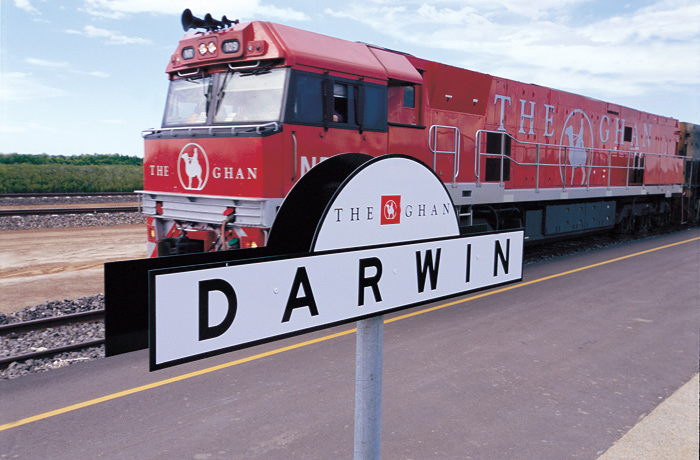
1 Darwin — From Darwin (0 km), there is a departure every Wednesday at 10AM between March and November. The three-day, two-night journey takes around 50 hours from end to end. The station is a fair way from central Darwin, about 20 minutes drive. The railway's primary purpose is freight, and the line goes straight to the port at East Arm, without passing through any built-up areas. Dedicated buses connect between the Darwin Transit Centre in Mitchell St and the rail station for an additional fee. Taxis are possible, but expensive. There is no scheduled bus. From Adelaide (2979 km), departures are on Sunday 12:15PM between March and November, with an additional train on Wednesdays at the 12:10PM between April and October.
2 Katherine (312 km) — The Ghan stops here for around five hours, with an optional guided "Whistle Stop Tour" available. The old railway from Darwin to Katherine stopped in central Katherine, and you can visit the site of the railway station. You can walk the old high level railway bridge across the Katherine river following the old alignment. However, it is around 10 km from the old station to the new one, so if you want to see Katherine, the tour may be your best option. You may not begin or end your journey here. 3 Alice Springs (1420 km) — Alice Springs is the former northern terminus of The Ghan and the largest town by far en route. The train stops here for around four hours, long enough for a quick peek around town. The station is on the edge of the CBD, a couple of blocks walk to the Todd mall. Many people opt to break their journey here for a few days and visit Uluru, about 400 km away, but there is plenty to do for a few days in Alice and surrounds even if you don't venture to the Rock. Alice Springs has all the services to make it possible. 4 Marla — Marla is a purpose built highway service centre with nothing else the
The Indian Pacific
This route connects the Perth on the Indian Ocean with Sydney on the Pacific Ocean. The 4,352-km trip takes about three days and is distance-wise by far the longest in the Southern Hemisphere and one of the longest domestic rail journeys in the world. It's notable for the 478-km-long section across the Nullarbor Plain, which is the longest straight railway stretch in the world. Unlike The Ghan, the Indian Pacific runs year-round. From Sydney, the train departs every Wednesday at 1:55PM, while from Perth, the train departs every Sunday at 10AM.
1 Perth — Either the destination of the Indian Pacific journey, or the point of departure, Perth is a useful terminus. The train Indian Pacific departs from the East Perth Terminal, just three stations away from Perth Railway Station in the CBD on the Midland, Ellenbrook and Airport lines of Perth's suburban rail network. The city caters for all levels of travellers, with budget backpackers well catered for in Northbridge, the suburb immediately north of the city railway station - to the hotels in the CBD which cater for the high spenders. 2 Kalgoorlie — Only the eastbound train stop
Adapted from Wikivoyage (CC BY-SA)