
Across Canada by train
Itinerary
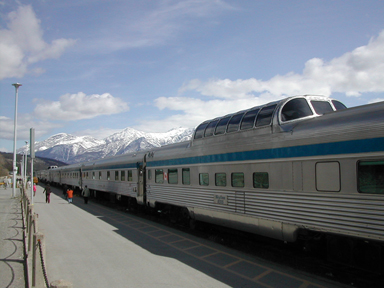
While most Canadians choose to travel between major cities by airplane, there still exists today a continuous series of connecting train services from the Pacific to the Atlantic, and a trans-continental journey on the passenger trains of Canada remains one of the greatest railway journeys of the world.
Understand
Canada is the second largest country on earth, yet with a population of almost 38 million in 2020, it has just the 39th largest population. The sheer size of the country, which spans 9,984,670 km² (3,854,085 sq mi) and six time zones means that vast areas are either sparsely populated or completely uninhabited. This itinerary explains how to book, travel and experience the scheduled passenger rail services that exist between:
Halifax (Nova Scotia) Montreal (Quebec) Ottawa (Ontario) Toronto (Ontario) Winnipeg (Manitoba) Saskatoon (Saskatchewan) Edmonton (Alberta) Jasper (Alberta) Vancouver (British Columbia) This itinerary covers 6,351 km (3,946 miles), crosses eight Canadian provinces and passes through some of North America's most vibrant and exciting cities. Whether experienced from the comfort of a private sleeping compartment or in the sociable and affordable seated coaches, it is a once-in-a-lifetime trip that demonstrates Canada's social and geographic diversity, from sea to sea, in line with the motto from Canada's coats of arms, A mari usque ad mare. There are many other passenger rail services in Canada. Information on all other rail services in Canada can be found on Rail travel in Canada page.
Prepare
Find time Canada does not have any high-speed railway lines, and much of the infrastructure was built before World War II. In modern times, Canada's railways are primarily used for freight traffic, with passenger services generally given lower priority. The train services listed here are thus not high speed services, but rather are laid back services that primarily cater to tourists with ample time on their hands to enjoy the scenery.
Whom to travel with A handful of private luxury train operators offer exclusive rail tours; however most passenger rail services in Canada are provided by VIA Rail Canada, the state-owned Crown Corporation that provides national passenger rail services. This itinerary uses only the services of VIA Rail Canada.
Which direction to travel in Travelling from one side of Canada to another by train is a great itinerary for an exciting and varied holiday. Travelling both ways is not: the vast landscape of the country will become infinitely less interesting if you have to turn round and go back again. However, the return trip will most likely have different passengers, so you will have a new group of different people to get to know during your voyage. Decide whether to start your trip in the west (Vancouver) or in the east (Halifax). Check the timetables of the trains you'll be riding on to see how this affects the arrival times in towns and cities you want to stop off in. Many travellers express a preference in going from east to west, since this follows the direction that European settlers populated the country and rewards you after the seemingly endless prairies with the breathtaking Rocky Mountains, but the decision of which way to travel is yours. Additional side trips by train to other destinations are possible at various points along the transcontinental route. See the Rail travel in Canada page for more information on these other routes.
When to go Canada's train services run throughout the year, although in some cases with reduced frequencies and shorter trains in the low season. Low season (October–April) fares are lower than in the high season (May–September) although when travelling during the winter months you shoul
Get in
Depending on which side of the country that you start your transcontinental train trip in, see either the Halifax or Vancouver pages for information on getting in.
Overview of route and trains
This itinerary presents a journey that travels from east to west, however it is quite possible and equally enjoyable to make the journey in the opposite direction. The three trains that make up the basic coast-to-coast route are:
The Ocean from Halifax to Montréal The Corridor from Montréal to Toronto The Canadian from Toronto to Vancouver
The Ocean
The Ocean departs Halifax three days per week at 1:00PM. The train travels overnight to Montréal, arriving at 10:03AM the following morning. In the other direction, the Ocean departs Montréal at 7:00PM, arriving in Halifax 5:51PM the following afternoon. Both east and west bound trains are scheduled to operate over the most scenic parts of the route during the day time, so you will travel through most of Québec along the south shore of the Saint Lawrence river by night. Bear in mind the late night departure or early morning arrival if you want to leave the Ocean at Sainte-Foy for the bus transfer to Quebec City. Perhaps the most scenic part of the route is east of Matapédia, where the line enters the province of New Brunswick and then follows the south shore of the Baie de Chaleurs, offering splendid views across the water to the receding coastline of the Gaspé Peninsula. Heading west, this is in the late evening; heading east, this is in the early morning, and makes for a spectacular distraction to breakfast in the restaurant car.
The Corridor The Corridor is the broad name given to the collection of intercity routes that connect Quebec City, Montréal, Ottawa, Brockville, Kingston, Belleville, Oshawa, Toronto and other destinations in southern Ontario. There are multiple daily departures on modern trains that carry Economy class and Business class. There are no more overnight or sleeper services. Ottawa is served by direct trains from both Montréal and Toronto, but is not on the route of most of the direct services between the two cities. Quebec City is only served by a spur line from Sainte-Foy, so you will need to book a spot on the shuttle and change trains at Sainte-Foy if you are coming from the east. If you are coming from the west, Quebec City is served by direct trains from Ottawa and Montreal. The l
Itineraries
Coast to coast, it is possible to make the journey from Halifax to Vancouver on board just three different trains, and in as little as five days traveling. Here are four recommended itineraries, based on the length of time traveling. Check the VIA Rail Canada website for schedules before making travel arrangements.
Five days Few travellers choose to do this journey straight through, not only because it can be quite hard work in coach class, but because it misses out on the opportunity to experience so many different and exciting cities. However, seasoned travelers who already know Canada well and who have limited vacation time (or just a hankering to ride the train) may relish the sound of this near-non-stop trip.
Seven days It's possible to combine the basic coast to coast itinerary with one extended layover. Again, this itinerary is probably better suited to those who have already visited Canada before, so the choice of which city to stop off in is largely up to you. Any stop on the route of the Canadian between Toronto and Vancouver would necessitate a stop of at least two, if not three days, because of the frequency of service of the Canadian. This applies in both directions. Therefore, a seven day itinerary would probably be best expanded on the five day itinerary above by adding extra days in just one of the following cities:
Halifax Montréal Toronto Vancouver You can find out more about each one on their respective travel pages. All four offer excellent public transit systems and compact downtown cores that can easily be explored on foot. With just two days, you would be well advised to research ahead, and be realistic about what you expect to see and do in the time that you have.
Fourteen days With two full weeks, you can reasonably make two or three stops en route. A two-week itinerary is probably the shortest that a first-time visitor to Canada can reasonably manage. The shorter itineraries suggested above are for the serious train fans, since after one or two days on board, you are likely to want a break off the train. . Days when you are not on board a train don't count towards your final total, but that if you depart a city at 8PM one day
Stay safe
Rail travel i
Adapted from Wikivoyage (CC BY-SA)