
Silk Road
Itinerary
For modern-day trade in China, see Shopping in China
Understand
Caravans have been travelling the Silk Road for over 2000 years; Chinese silk was reaching Rome and Roman glass was reaching China before 100 BCE. Trade over parts of the route is far older; there was trade between the Indus Valley Civilisation and Ancient Mesopotamia before 2000 BCE (cities like Mohenjo-daro in Sindh and Nineveh in Iraq), jade from Khotan in what is now Xinjiang was reaching central China by around 1500 BCE and the Persian Royal Road connected the Mediterranean port of Sardis to the Persian Gulf ports in the 5th century BCE. Around that time there was extensive trade all across the Persian Empire, which was centred in what is now Iran and in those days included much of the Caucasus, Central Asia and what is now Turkey. Around 330 BCE, Alexander the Great conquered from Greece to Egypt, where he founded Alexandria, which later became a great trading city, the main depot for goods from the Maritime Silk Road going to the Mediterranean. Then he turned East and conquered the Persian Empire, which then included much of Central Asia, and after that he took much of Pakistan and parts of northern India. His empire fell apart after his death, but trade continued. He founded what is now the city of Khujand in Tajikistan and took Samarkand; both cities later became centres of Silk Road trade.
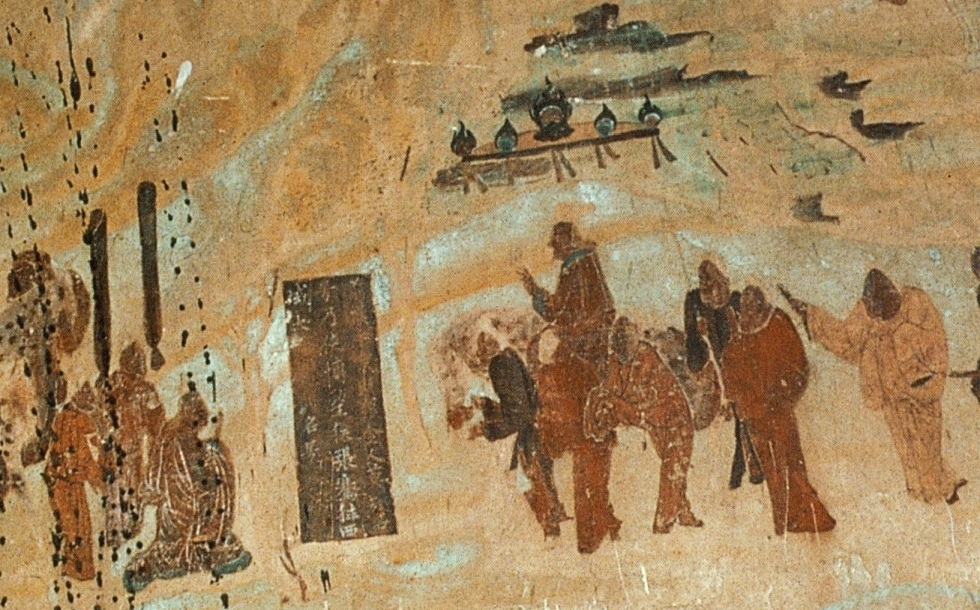
In the 2nd century BCE, Emperor Wu of the Han Dynasty defeated the Xiongnu (a belligerent confederation of nomadic peoples of the steppes, perhaps related to the Huns who later conquered part of Europe) and established Chinese control over parts of Central Asia for the first time. The pacification of the Xiongnu provided the necessary stability for traders to safely traverse the route, resulting in the first Silk Road being established. In this period, envoys from both Alexander's successors and the Chinese court reached Kashgar; this seems to have been the first contact between China and Europeans. Although it later declined as China descended into war and anarchy with the fall of the Han Dynasty, the route was re-established and expanded under the 7th century reign of Emperor Taizong of the Tang Dynasty after he defeated the Eastern Turks and Western Turks, and r
Prepare
This is not an easy route or one for the novice traveller. Consult a travel medicine specialist about vaccinations and about medicine to take along. If you are doing the full route, bring phrasebooks for at least Chinese, Russian, Arabic and Persian. Also note that large portions of the overland routes go through Turkic-majority countries, so knowledge of any of the Turkic languages (Turkish, Uzbek, Kazakh, Kyrgyz, Azeri, Turkmen, Tatar, etc.) will also help. Parts of this route may be difficult or impassable in winter, and various borders may sometimes be closed for political reasons. For most countries on this route, travellers with most passports will require visas obtained in advance. Planning ahead may be needed to get these since some of the smaller nations have few embassies. For example, Turkmenistan does not have an embassy in Ottawa so a Canadian might need to deal with the embassy in Washington, London, Beijing or Moscow to get a visa. Check country listings for details. That being said, each Central Asian country has an embassy in each of the other Central Asian countries, so some travellers will apply for visas in a neighbouring country and wait it out. Almost anyone travelling this route will want to at least take a look at the fine carpets that are traditionally traded at many places, and perhaps buy some of them. Even on a tight budget, one might want to pick up some of the common smaller items such as woven saddlebags or purses and boots decorated with carpet. Reading a book or two on carpets before setting out is a fine idea; among the most useful writers is a California doctor and carpet collector named Murray Eiland. If you do buy any carpets, be aware of any export restrictions of the country in which you purchased the carpet. For example, Turkmen carpets are some of the highest-valued carpets in the world, but the Turkmen government charges taxes of 115 manat per square meter and a 400 manat psm tax for large carpets, and you're required to obtain a permission of export to take it out of the country. Some parts of the route are arguably less safe now than they were a few centuries ago. Before heading out, read up on the security situation,
Get in
Many travellers today follow all or part of this ancient path by train, bus and private car. Some Wikivoyage itineraries partly follow the Silk Road.
Istanbul to New Delhi over land On the trail of Marco Polo Voyages of Ibn Battuta Voyages of Zheng He Moscow to Urumqi You could start a Silk Road journey from anywhere in Europe or China, but the obvious jumping-off spots are the two ends of the historic road – Chang'an, which is now called Xi'an, and Constantinople, now Istanbul. From either end, the first part of the route can be done by train; China has a good rail system which goes to Kashgar and to Urumqi where there are connections to Almaty. From Russia, there is good rail service to many places in Central Asia. The Trans-Asia Express runs from Istanbul to Tehran. From Tehran there are trains east to Mashad and from there north to Turkmenistan. and also southeast to Zahedan. There used to be a train from Zahedan to Quetta, but it was withdrawn in 2014, leaving a gap in the link. Going east from Quetta, the Pakistani rail system is quite good but the area around Quetta is considered quite dangerous and you will be escorted in the city and onto your train. To explore just the central part of the road in Central Asia, it would be easiest to fly into a city in that area with good air connections – Tashkent, Almaty or even Urumqi. One could also get into the area on several rail routes branching off from the Trans-Siberian Railway, though the main line is north of the major Silk Road routes.
Overland routes
There were multiple interlinked routes. The map shows the main route from Xi'an to Damascus in yellow with some extensions in green.
Xi'an to Dunhuang (Hexi corridor) The main caravan route from China to the West
started in the capital Chang'an, what we know today as the great city of Xi'an headed west past the gorges of Baoji, along the Corn Flake Mountain of Tianshui to Lanzhou on the banks of the Yellow River. northwest along the Hexi Corridor to the Han dynasty garrison towns of Wuwei, Zhangye, Jiuquan to Jiayuguan, the western terminus of the Ming Dynasty Great Wall, shown as a dotted blue line on the map to Guazhou, a region dotted with ancient ruins, including the World Heritage-listed Suoyang City ruins to Dunhuang, the 'Blazing Beacon' of Chinese civilization in the western regions. The Jade Gate just outside of Dunhuang delimited the Chinese realm from the semi-independent city states of the Tarim Basin. There were related routes within China; green links on the map show connections from Xi'an north to Beijing and east to Suzhou and Hangzhou.
Around the desert (Tarim Basin)
Beyond Dunhuang the main route splits to go around the Taklimakan Desert.
Northern route: Dunhuang, Hami, Turfan, Korla, Kashgar Southern route: Dunhuang, Cherchen, Khotan, Yarkand, Kashgar (also called the jade route because Khotan is famous for jade) The routes above run along the edges of the desert; there are several alternate routes that involve starting on one of the above, then cutting across the center of the desert (e.g. Cherchen to Korla) to finish on the other. The routes rejoin at Kashgar. Today, Kashgar is China's westernmost city; at other times it has been the capital of an independent kingdom, part of the Mongol Empire, or part of various other Central Asian empires. Today, the majority of its population are Uyghurs, a Turkic Muslim ethnic group that is more culturally similar to Central Asians than to the Han Chinese. The city is regarded by most Chinese to be the main centre of Uyghur culture, and is a popular domestic tourism destination. I
Adapted from Wikivoyage (CC BY-SA)