
On the trail of Marco Polo
Itinerary
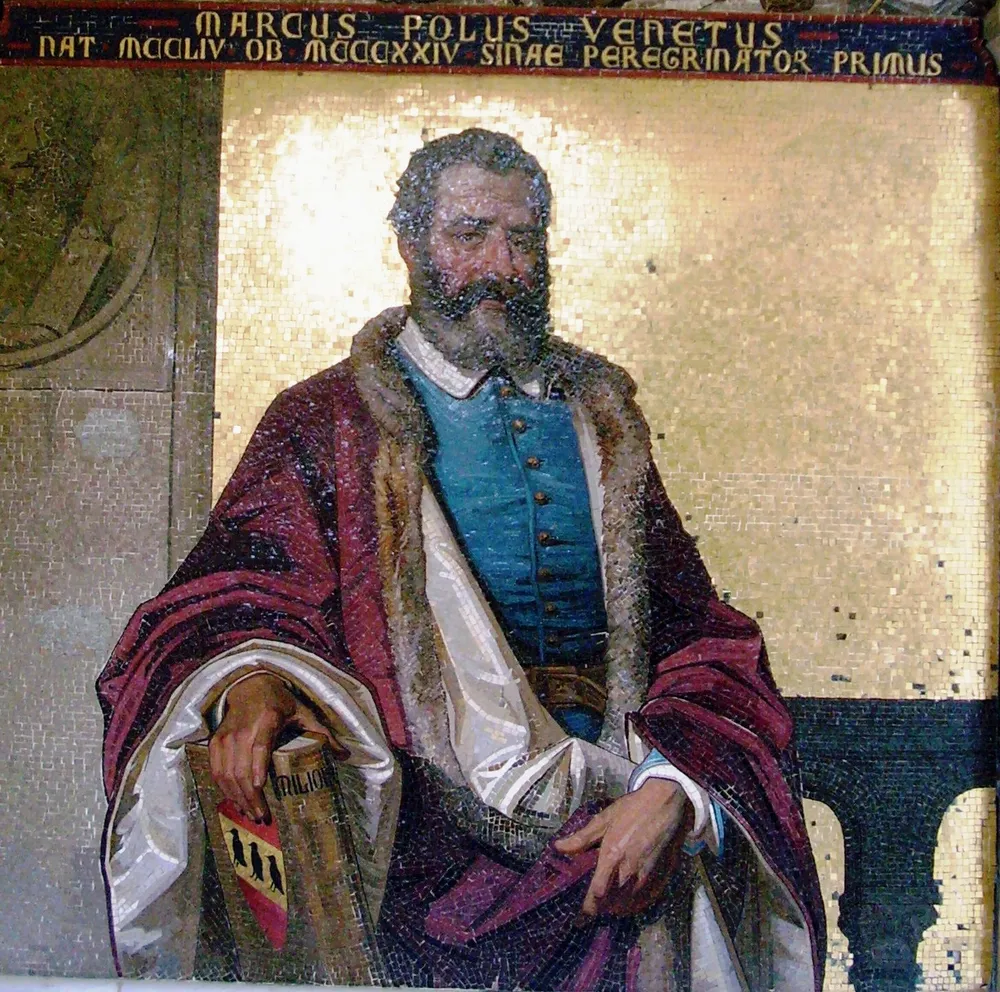
Marco Polo was a Venetian traveler who went far to the East, following some of the many branches of the Silk Road. He left in 1271 and returned about 1295. His book about his travels was a best-seller then and is still well-known 700 years later.
The book
Marco Polo owes his fame to a book which he wrote after his return. At the time, there was an intense rivalry between the great trading cities of Venice, Pisa and Genoa. The Venetian Polo and his co-author, Rusticiano of Pisa, were both prisoners of war in Genoa when they met and wrote the book. The original title translates as A Description of the World, but it is usually referred to as The Travels of Marco Polo. This was the first account of a journey to the East to be widespread in Europe, and was the best reference on Asia from its publication around 1300 until the Portuguese navigator Vasco da Gama reached the East by the Cape Route almost 200 years later. Polo's tales of the riches of the East were part of the reason for the Portuguese voyages, and also spurred on Columbus. The book was the first in Europe to mention a number of things including oil from Iran, and coal, paper money and window glass from China. Some claim that Polo introduced noodles to Italy, but this is hotly disputed. This itinerary is based on a version of the book downloaded from Project Gutenberg. They describe it as "the unabridged third edition (1903) of Henry Yule's annotated translation, as revised by Henri Cordier; together with Cordier's later volume of notes and addenda (1920)." All quotes are from that version. There is considerable scholarly controversy about the book. It was written by two Italians, but the original was probably in medieval French, the trade language of the day. The oldest known copies are from a few decades later, several conflicting versions in French, Italian and Latin. A later Italian version contains additional material, apparently based on Polo family papers. Polo actually saw some of the things he speaks of, but for others he repeats tales from other travelers. Which are which? How much did Rusticiano, the writer of romances, embellish the story? Some critics say Marco never got east of Kashgar and only heard tales of central China — he never mentions chopsticks, tea, bound feet, or the Great Wall. Others cite Mongol records indicating someone named Polo was indeed there. Fortunately, various scholars have figured out most of this. Here, we simply fo
Background
The brothers Nicolo and Maffeo Polo were Venetian traders. One brother had a wife back home, but they worked mainly out of Acre (a crusader city that is now called Akko in what is now Northern Israel) and Constantinople (modern Istanbul), which Venice ruled at the time. From 1260 to 1269, the brothers made a trip to the Far East. On their second trip, starting in 1271, they brought Nicolo's teenage son Marco. The family had strong ties to the Adriatic island of Korčula near Dubrovnik, then a Venetian possession. It seems likely Marco was born there, though he grew up mainly in Venice. Korčula is trying to develop tourism and there are some Polo-related museums and monuments there. Of course, there are also some in Venice. Some quotes from Yule and Cordier's commentary, about the political and economic situation when the Polos set out are as follows:
Christendom had recovered from the alarm into which it had been thrown some 18 years before when the Tartar cataclysm had threatened to engulph it. The frail Latin throne in Constantinople was still standing, but tottering to its fall. The successors of the Crusaders still held the Coast of Syria from Antioch to Jaffa. The jealousies of the commercial republics of Italy were daily waxing greater. Alexandria was still... the great emporium of Indian wares, but the facilities afforded by the Mongol conquerors who now held the whole tract from the Persian Gulf to the shores of the Caspian and of the Black Sea, or nearly so, were beginning to give a great advantage to the caravan routes. In Asia and Eastern Europe scarcely a dog might bark without Mongol leave, from the borders of Poland... to... the Yellow Sea. The vast empire which Chinghiz had conquered .. was splitting up into several great monarchies... and wars on a vast scale were already brewing. "Chinghiz" is an alternate spelling for Genghis Khan. The "wars on a vast scale" involved his descendants vying for power as the empire split up.
The first trip east
The brothers set out from Constantinople (modern Istanbul) in 1260, and sailed across the Black Sea to Soldaia (now Sudak) in the Crimea. Soldaia was a largely Greek city at that time and routinely traded with various Mediterranean ports.
It had belonged to the Greek Empire, and had a considerable Greek population. After the Frank conquest of 1204 it apparently fell to Trebizond. You can still take a boat from Istanbul to Trebizond (now called Trabzon) in eastern Turkey; one variant of the Istanbul to New Delhi over land itinerary uses this. There might also be boats to Sudak or nearby Sevastopol.
It was taken by the Mongols in 1223... about the middle of the century, the Venetians established a factory there... Ibn Batuta... counts Sudak as one of the four great ports of the World. Ibn Batuta was a Tunisian who set out east in 1325 and also wrote of his travels.
The Genoese got Soldaia in 1365 and built strong defences, still to be seen. In this period the great trading cities of Genoa, Venice and Pisa dominated the Mediterranean world. One of the tourist sights of modern Sudak is the ruins of a Genoese fortress. Where the brothers were more daring than most other traders was continuing beyond Soldaia, deeper into Mongol territory. They went into the Caucasus to Sarai, capital of this part of the Mongol Empire, near modern Astrakhan, Russia. Then a war between Mongol factions broke out, preventing a return west.
Unable to go west, the brothers headed east to the great city of Bokhara, which like everything else in Central Asia had been conquered by the Mongols a generation earlier.
After they had passed the desert, they arrived at a very great and noble city called BOCARA... The city is the best in all Persia. ... up till the conquest by Chinghiz, Bokhara, Samarkand, Balkh, etc., were considered to belong to Persia. "Chinghiz" is Genghis Khan. Today, Bokhara and Samarkand are cities in Uzbekistan, and Balkh is a town with some interesting ruins in Northern Afghanistan. The Persian Empire was once much larger than modern Iran, including much of Central Asia. The brothers lived in Bokhara for three years and became fluent in Persian. In Bokhara, they learne
The second trip
The brothers went back to Acre, this time with young Marco, and then up to Jerusalem to get some oil from the holy sepulchre which the Khan had requested. They then set off east again without a papal reply to the Khan's letters. Word reached them that a Pope had finally been elected, and that it was their friend Theobald, papal legate in Acre. They returned to Acre, got replies to the letters, and headed off for Kublai's court again in late 1271. They had letters from the Pope and two friars instead of the 100 scholars the Khan had requested, but the friars soon turned back. It is interesting to speculate on how history might have been different if the Pope had sent the requested 100 scholars, or even if the friars had stuck it out. The Khan also invited scholars and missionaries from other places — Tibetan Buddhists and Persian Muslims — and those had a great effect on China.
They went east overland, traveling by caravan and heading for Hormuz on the Persian Gulf. Today the city is gone but the phrase the Straits of Hormuz still turn up in newscasts; they are the narrows at the outlet of the Gulf. The nearest modern city is Bandar Abbas, capital of Iran's Hormuzgan province. Their route was indirect, setting out from the Mediterranean toward Kayseri and Erzurum in what is now eastern Turkey, through parts of Armenia and Georgia to Mosul in what is now Iraq, then into Persia (now known as Iran) via Tabriz, Yazd and Kerman to Hormuz. The book talks of Damascus and Baghdad, but it is doubtful they actually visited those cities. The original plan was to take a ship east from Hormuz, but after reaching
Adapted from Wikivoyage (CC BY-SA)