
Moscow to Urumqi
Itinerary
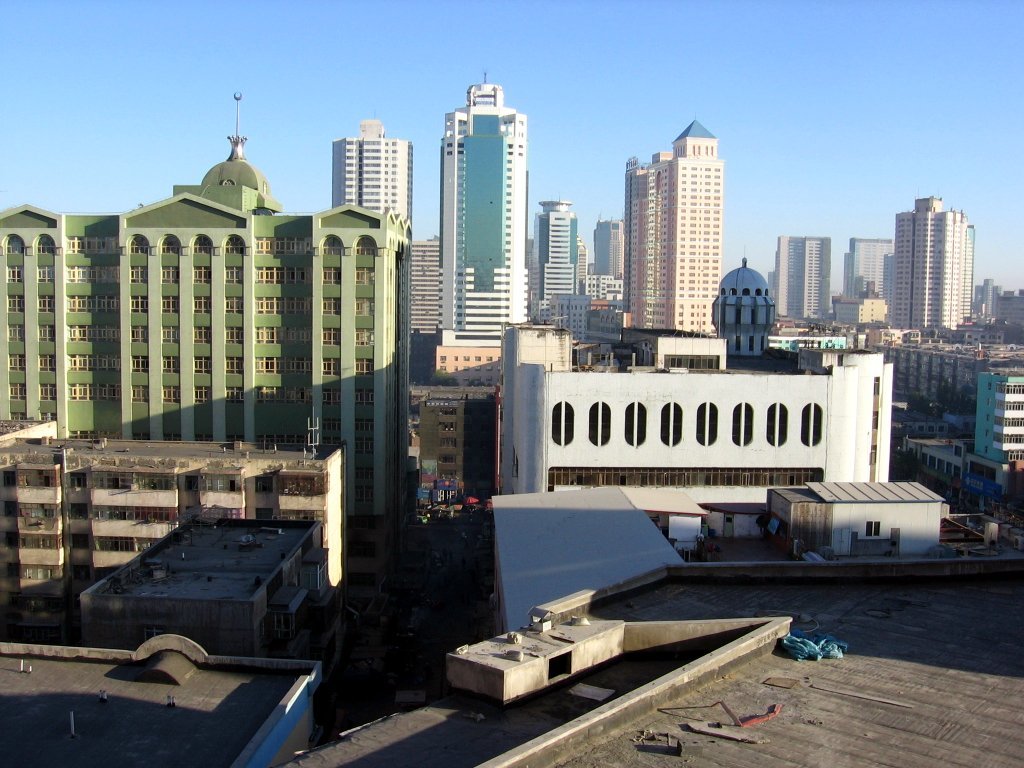
The usual overland route from Europe into China is the Trans-Siberian Railway, crossing Russia to Lake Baikal then continuing either via Mongolia or Dongbei (the former Manchuria) to Beijing. However, a less-travelled itinerary runs from Moscow in Russia to Urumqi in China via Kazakhstan. Thanks to China's rail boom, this now forms part of the fastest land route from Europe to east Asia.
Prepare
This is not a trip where you can wing it. You need to sort three things in advance: the language (at least three), visas (at least two), and trains. How much can you organise yourself, and what do you need an agency to help with? It depends on your language & business skills and sheer dogged perseverance, but you'll probably find it straightforward (in English) to book accommodation and trains within Russia and across Kazakhstan. Since the visa process has been outsourced, you probably need the help of a visa-support agency to get your visa (in UK the brand leader is Real Russia), and they can also help with the Kazakh-China trains. Once into China it gets easier again.
Talk English: it's surprising how far this will get you. Anywhere in Russia or Kazakhstan that's in the habit of seeing tourists will know where their next dollars, pounds or euros are likely to come from. Other West European languages are much less likely to be understood. Get a decent translation app for your mobile: fellow-passengers and officials will often make use of these. Russian: your main need is to get safely across Moscow, so you need to be comfortable with reading Cyrillic signage for public transport. Once aboard your train, the steward is familiar with the point-grunt-da-nyet of multiple nationalities. Russian is also widely spoken in Kazakhstan. Kazakh: no-one expects you to know any, but a few civilities will be appreciated. It is a Turkic language, so speakers of Turkish will recognise many cognates. e.g. numbers and days of the week are very similar. It is spoken not only in Kazakhstan, but also by the ethnic Kazakhs in northern Xinjiang. Chinese: once you get off the train in Urumqi, you need some basic Mandarin for survival. English is seldom understood, nor your attempts at pronouncing in Mandarin the place you need to go. Get directions to places written down in English and Mandarin and print them in advance to show, e.g. to taxi drivers. A few Uyghur civilities are nice-to-know but not mission critical.
Accommodation and trains Accommodation must be booked in advance to support your visa applications. This is the easiest part to plan because there's a wide range ava
Go
The route from Moscow to Ürümqi, without any side-trips or stop-overs, involves a direct train to Astana or change of trains to Almaty, then a final train onward to Ürümqi. Pros & cons:
Astana is the more direct route and the more interesting city - it has real contrasts of culture, and has clearly had a lot of money spent on making it a showpiece capital. It has one weekly train to Ürümqi. Almaty has lots to see & do but feels like a Russian city, of which you've maybe already seen plenty. It's only slightly further than via Astana, and is the route to the other 'stans. It has at least one and maybe two trains a week to Ürümqi.
Moscow to Kazakhstan For Astana: The direct train east from Moscow runs every second day, even dates. Train 84 leaves Moscow Kazan station at 22:48 and arrives in Astana 54 hours later at 08:00. Return train 83 (likewise even dates) leaves Astana at 11:10, arriving Moscow at 15:30 after two nights aboard. The route to Astana from 1 Moscow Kazan goes east through several interesting Russian cities, notably 2 Ryazan, 3 Samara, 4 Ufa and 5 Chelyabinsk. After 40 hours you reach the Kazakh border at 6 Petukhovo / Mamlyutka. The first city in Kazakhstan is 7 Petropavlovsk, and the train then heads south across the steppes to the capital 8 Astana. This train continues south to Karaganda, which has connections to Almaty and Ürümqi, but Astana is much the better place to stopover or change trains. For Almaty: the direct train from Moscow has been axed. Either travel to Astana as above then take the 13-hour train down to Almaty; or change at Saratov. There are frequent trains between 1 Moscow Pavletsky via 2 Tambov to 3 Saratov, taking 16 hours. The onward cross-border train runs on even dates and takes 53 hours, south as Train 8 from Saratov around 19:30 reaching Almaty by 13:00 two days later, and north as Train 7 from Almaty at 01:30 to reach Saratov around 14:00 two days later. Southbound from Saratov, the train crosses the Volga river, and reaches the Kazakh border at 4 Ozinki, about 24 hours from Moscow. The first stop in Kazakhstan is Uralsk, also known as 5 Oral. The train heads east and, by a quirk of the border, crosses back into Ru
Go next
Since you've gone to all the bother of getting a Chinese visa and getting in to Ürümqi, you probably want to explore more of the country. And you pretty much have all of China ahead of you - but not entirely, because there's a lot of it already behind you. The western tip of China is actually further west than Lahore in Pakistan! So one option is to backtrack west to Kashgar on the old Silk Road, by train or bus. Seek advice before planning to go even further west into Kyrgyzstan or south down the Karakoram Highway into Pakistan: the mountain passes are difficult in summer and snowbound in winter. Most itineraries go east to Lanzhou: frequent high speed trains take 11 hours from Ürümqi. Here the options fan out: to Xian with its famous Terracotta Army (3 hours from Lanzhou, an easy day-trip), and to Beijing with connections to Shanghai or Guangzhou (for Hong Kong and Macau).
Adapted from Wikivoyage (CC BY-SA)