
Darjeeling Himalayan Railway
Itinerary
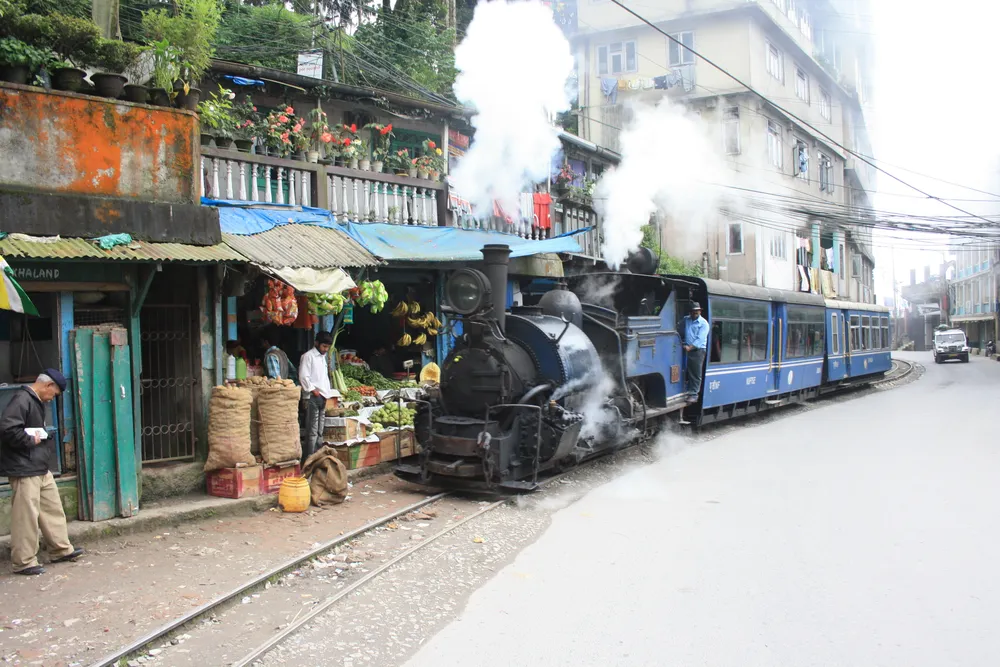
The Darjeeling Himalayan Railway, also known as the DHR or the Toy Train, is a 2 ft (610 mm) gauge railway that runs between New Jalpaiguri and Darjeeling in the Indian state of West Bengal. Built between 1879 and 1881, it is about 88 km (55 mi) long. It climbs from about 100 m (328 ft) above sea level at New Jalpaiguri to about 2,200 m (7,218 ft) at Darjeeling, using six zig-zags and five loops to gain altitude. There are both steam and diesel engines serving the route. There are 18 stops covered in the journey. This railway is a UNESCO World Heritage Site as part of the Mountain Railways of India.
Understand
This route provides breath-taking panoramic views of the Himalayas and the nearby hills. Some of the stops are special and unique in their own way. The journey starts from New Jalpaiguri in Siliguri. Sukna provides a look to the wildlife in the region. The Agony point and the Batasia Loop are one of the most important and popular stops. The train stops at the Batasia Loop for ten minutes for the passengers to enjoy the view and visit the Gorkha War Memorial which displays the selfless service of the Gorkhas in the British Raj. It halts at Ghum for another thirty minutes for a visit to the DHR Railway Museum.
History
Siliguri, at the base of the Himalayas, was connected with Calcutta (now Kolkata) by a metre gauge railway in 1878. Between Siliguri and Darjeeling, Tonga services ran on a cart road – the present-day Hill Cart Road. Franklin Prestage, an agent of the Eastern Bengal Railway, approached the government with a proposal to lay a steam tramway from Siliguri to Darjeeling. Ashley Eden, lieutenant governor of Bengal, formed a committee to assess the project's feasibility. The proposal was accepted in 1879 after a positive report by the committee, and construction began that year. Gillanders, Arbuthnot and Company were hired to construct the line, and by March 1880 track was laid as far as Tindharia, and Lord Lytton, the first viceroy to visit Darjeeling, rode to Tindharia on the train. The stretch from Siliguri to Kurseong opened on 23 August 1880, and from Siliguri to Darjeeling on 4 July 1881. The company's name was changed to Darjeeling Himalayan Railway Company.
The Batasia Loop was constructed in 1919, creating easier gradients on the ascent from Darjeeling. The DHR began facing competition from buses operating on the Hill Cart Road which took less time than the railway to reach Darjeeling. In 1934, a major earthquake in Bihar shook all of Northeast India. Many buildings in Darjeeling were heavily damaged and the railway was also affected, although it soon recovered and played a vital role in transporting repair materials. During World War II, the DHR transported military personnel and supplies to the camps around Ghum and Darjeeling. In 1951, th
Prepare
There are many businesses in Siliguri and other parts of West Bengal providing tour packages for Darjeeling Himalayan Railway. Those tour packages are well planned and can plan and book all your stop-overs, accommodation and journey legs in advance. It may also include bus rides to and from stations and hotels. If you are planning of travelling by yourself, consider booking the hotels in advance as the rooms get sold within no time. Travelling alone makes you independent. You can also camp near the forest or in the less busy parts of the town. English, Hindi and Bengali are well understood by the locals as the area was under a Christian influence in the past. Darjeeling Tea which is world famous for its aroma is found here.
Climate The climate along the route changes from warm to cold. Darjeeling is considered a cold city, temperatures even in summer tend to keep below 20 °C (68 °F). You will need warm clothes if you are visiting it in winters, when daily means are below 10 °C (50 °F), and temperatures below freezing are possible. Isolated thunderstorms are common in through the route. The trains get cancelled if there are heavy rains as it might get stranded in the sparsely populated mountains. Snowfall is rare but not an uncommon sight. Record low temperatures were recorded in 2021 which led to snowfall in the area.
Suggested packing list Warm clothes to keep yourself warm and cosy. Your destination might get cold. Ready-to-eat food, basically instant noodles and other instant Indian snacks. You might need some food to fill yourself up and enjoy while watching the views. Battery charger, charge your devices and keep them ready to take some pictures. The trains are fitted with outlets but they are not suitable for long use as they use high voltage DC to avoid vandalism. Camera, it will help you to capture memorable shots. Wet wipes, keep yourself clean and fresh throughout the journey. Flip-flops, it might be uncomfortable to wear huge, bulky shoes throughout the entire journey. Change to some sandals for a comfortable walk through the coach.
Get in
The journey usually starts from New Jalpaiguri Junction (NJP) in Siliguri. You can get to the railway station either by road, rail or air.
By road NJP is well connected to numerous national and state highway systems. The National Highway 27 links Siliguri with the adjacent state of Bihar while National Highway 17 connect the city with North-Eastern India. NBSTC provides bus services to and from different destinations in West Bengal. It also provides online booking facilities.
By train New Jalpaiguri Junction NFR DHR (NJP) is the main hub for the railway traffic in North Bengal. All trains destined to North-Eastern India pass through here. Getting a train to NJP is quite easy from any part of the country.
By plane Bagdogra Airport is the main airport in this region. It gets daily traffic from all major Indian airports like Delhi, Mumbai, Bengaluru, Chennai, Kolkata and Guwahati.
Tickets
Tickets for Darjeeling Himalayan Railway can be booked both online and at counters. For e-tickets, you can visit the IRCTC website. For counter bookings, you can visit any reservation counter of any railway station in India. DHR also provides exclusive booking facilities in Darjeeling, Ghum, Kurseong, New Jalpaiguri Junction and Siliguri Junction.
Fares You can get the fare information while you book your tickets. It you are not logged in to IRCTC, you can visit Indian Railway's fare enquiry page to get the details about the fare of different classes. The fare for trains operating in DHR are between ₹800-₹1600. More details can be found at DHR's fare page. The ticket prices change depending on the season. The prices are high during winters and low during summer. Indian Railways doesn't impose dynamic pricing in the routes under DHR.
Stations Here is the list of stations in the route with their respective station codes. This won't be useful during the journey, but it would help you search for the stations while booking tickets. Apart from these stations, there are many loops in the route, 1 Agony Point and 2 Batasia Loop being the most famous ones.
Go
Darjeeling to Ghum For tourists who want to go from Darjeeling, there are four trains a day that travel the seven-kilometre route to Ghum - sometimes also spelled Ghoom - where they turn around and return half an hour later. There is a small museum and monastery to visit in Ghum. The trains only carry first class, but is quite affordable. It is also possible to travel only one way by train and return by taxi. The ride goes along the slope, so you only have a view of the Kangchenjunga mountain from one side of the train.
Darjeeling to Kurseong to New Jalpaiguri This is the main route of DHR. It starts from New Jalpaiguri and ends at Darjeeling. It takes about 7-8 hours in total. The train usually gets delayed, but the delay are worth it as they get you some great scenic sunset views. The trains operates daily with fares from ₹970-₹1420.
Stay safe
With steam trains, it should be noted that, in addition to smoke, the locomotive emits a considerable amount of dirt and ash, which settles on the hair and clothing of passengers. Always watch your belongings. Even though theft cases are rarely reported, it is good to be vigilant. If you think that you being harassed in the train, immediately contact the Railway Protection Force at 182.
Go next
Kalimpong - It is a hill station in Lesser Himalaya and recognized for educational institutions. Most of those were formulated during British colonial period. The town has many religious sightseeing places apart from beautiful views of mountains. Kurseong - It is referred to as Karshiyang in Bengali and Khār-sỵāng in Nepali. The town is home to most expensive teas in the entire world. Some popul
Adapted from Wikivoyage (CC BY-SA)