
Dalton Highway
Itinerary
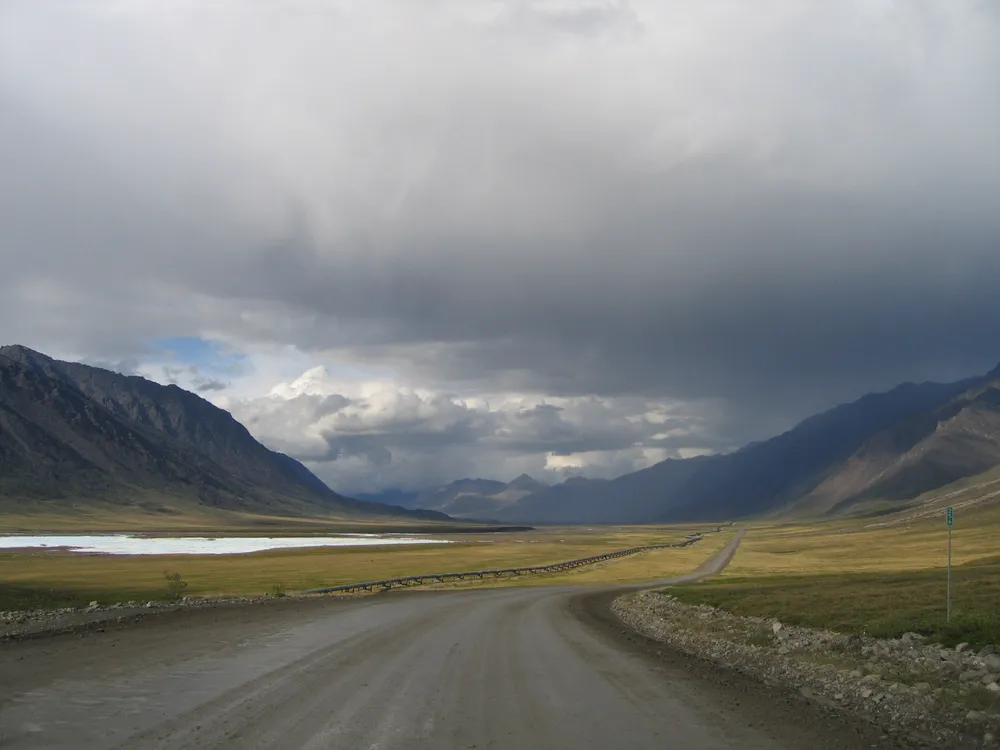
The James W. Dalton Highway (Alaska Route 11, the "Dalton Highway", "the Dalton", or the "Haul Road") is a 414 mi (666 km) road traversing central and northern Alaska. It is one of only two roads in North America (the other being the Dempster Highway in Yukon, Canada) that cross the Arctic Circle and connect to the rest of the North American road network. It begins at Mile 73 of the Elliott Highway (Alaska Route 2) 84 mi (135 km) north of Fairbanks and ends at Deadhorse near the Arctic Ocean amid the Prudhoe Bay oilfield.
Understand
History When oil was discovered at Prudhoe Bay in 1969, the state of Alaska operated as a "boom-and-bust economy" without any stable industries and, more importantly, America was critically short of oil and mostly at the mercy of volatile Arab nations (just two years after the Arab-Israeli Six-Day War). Plans for drilling the oil and for an 800 mi pipeline were thrown together at a dizzying speed, as the U.S. government and oil companies worked to settle land claims with Native Americans, attain proper permits, ensure environmental safeguards, and build ways of accessing this extremely remote area. The Dalton Highway was hastily constructed in just 5 months, in 1974, to provide access for the Trans-Alaska Pipeline under construction. It was built at a similar, dizzying pace, price, and fashion as the nearby Alaska Highway, constructed during World War Two. Built as the North Slope Haul Road (or simply the "Haul Road", as some locals still call it), it was a supply road and intended for large tractor-trailers rather than private vehicles. After completion of the pipeline, the road remained as a supply route for oil operations at Prudhoe Bay. In 1981 the haul road was opened to the public (with a permit) until Disaster Creek at Mile 211, given the designation Alaska Route 11, and named in honor of James W. Dalton, a man who aided in the development of the Cold War's Distant Early Warning System and whose knowledge of northern Alaska greatly aided the oil exploration of the region. In 1994, the public was allowed access to the entire highway to Mile 414 in Deadhorse, without permits. The road used to be gravel for its entire length, but it is now paved from Mile 37 to Mile 49; Mile 90 to Mile 197 (Gold Creek); and from Mile 335 (Happy Valley airstrip) to Mile 362. Due to the extreme temperature variations and frost heave, paved sections are prone to potholes and large cracks and some paved sections are worse than unpaved sections.
Climate
The climate of the regions this highway traverses range from subarctic to polar. During the summer months (Jun-Aug), the average maximum temperatures range from 70°F (21°C) to 50°F (10°C) with average minimum temperatures ra
Talk
English is spoken by all persons living and working along the highway, including residents of the Native Alaskan villages accessible from the Dalton via the Yukon River. As the road is primarily a trucking highway, and there is virtually no cell phone coverage along the highway, the "official" method of communication along the highway is over CB radio, Channel 19. Channel 19 is listened to by truckers, fellow travelers, pipeline security, Alaska State Troopers (police), and others. Not only can you talk in the event of an emergency, but you can also listen to others' conversation which may alert you to hazards and current conditions on the road ahead. CB radios can be rented or purchased from numerous equipment outfitters around Fairbanks. There are just a few places along the highway which offer a place to rest and encounter other persons, namely the handful of towns along the road. Deadhorse is the only location on the highway with cell phone reception. Satellite phones, while extremely expensive, are handy and commonly used by workers in the area for ranges longer than other radios. However, not all satellite phone networks have coverage in this region. The entire Dalton is covered by Iridium and Globalstar (including SPOT messenger service). Fairbanks appears to be the edge of Inmarsat coverage, with the Dalton lying outside of Inmarsat coverage. Thuraya does not provide service in the Americas.
Get in
By plane The nearest major airport to the highway is in Fairbanks (FAI IATA). Aside from numerous Alaska Airlines and turboprop flights to destinations within Alaska, Fairbanks International Airport has commercial service available from: Seattle/Tacoma Airport (SEA IATA; Alaska Airlines; seasonal, Delta Air Lines), Portland (PDX IATA; seasonal, Alaska Airlines), Minneapolis/St. Paul (MSP IATA; seasonal, Delta Air Lines), Denver (DEN IATA; seasonal, Frontier Airlines & United Airlines), Chicago-O'Hare (ORD IATA; seasonal, United Airlines), and Frankfurt Airport, Germany (FRA IATA; seasonal, Condor Airlines). Deadhorse does have an airport handling limited commercial flights (Alaskan Airlines to Barrow, Fairbanks, & Anchorage), but all organized tours originate from Fairbanks, and there are no car rentals available here. As flying into Deadhorse is more expensive and has limited options for getting onto the highway (you could try to hitch a ride with a truck driver, but don't expect any stops), the only practical means of arrival by air is Fairbanks or Anchorage (ANC IATA) if you want to rent a car there to explore southern Alaska as well (see Anchorage article for flights there).
By car
From Fairbanks, you can rent a vehicle (4x4 truck recommended) and drive to the Dalton Highway. However, the major car rental companies explicitly prohibit the travel of their vehicles on a long list of Alaskan roads, including the Dalton Highway. It is strongly recommended that you travel with a full-sized spare tire; the road is rough enough that a small spare will be of little use and towing costs can be as high as $5/mile. The following companies, in alphabetical order, rent vehicles for use on the Dalton and other rugged Alaskan highways:
1 Arctic Outfitters, 3820 University Ave. South, Fairbanks, ☏ +1-907-474-3530, fax: +1-907-474-4767, [email protected]. M-F 8AM-5PM. Rents fully outfitted Ford Escapes. Rentals include: CB radio, 2 full-size spare tires, first aid kit, tire changing kit, satellite phone. A bit pricey, but great customer service. (updated Aug 2019) 2 Go North Alaska Travel Center, 3713 South Lathrop St., Fairbanks, ☏ +1-907-479-7271, toll
Prepare
See also: Winter driving. The Dalton Highway has the distinction of (among other things) having the longest stretch of serviceless road in North America. North of Coldfoot, there is a 240 mi (386 km) stretch of road with no gas stations, restaurants, hotels, or any other basic services until the Prudhoe Bay oilfield at Deadhorse. Therefore, travelers are advised to have basic survival supplies, car repair equipment, and equipment for camping and other activities, stocking up no further north than Fairbanks, as all four communities further north offering services are extremely expensive, and since Fairbanks is a small city (pop. 32,000), there will be bargains to be found. Drivers should check and replace worn belts & hoses on their vehicles and ensure all tires (including spares) are properly inflated.
CB radio or Satellite phone (though expensive) since cellular service is extremely limited. CB radios are far less expensive. Cash and/or major credit cards (i.e. Visa or MasterCard). No services accept debit cards and there is only one ATM in Deadhorse. Spare tires (full-size, preferably on/with another rim and chains for all four tires) and basic car repair tools. Kits used to repair windshield chipping can be especially valuable in preventing chips from turning into full-fledged cracked windshields (especially valuable for rentals, where damage can be very costly). Spare windshield wipers, as well as several gallons of windshield cleaning fluid (you will need to clean your windshield many times from the dust trucks create, and mosquito/insect build-up from approximately late May to early September). At times, wipers won't clean thoroughly, so have paper towels on hand to "hand wash" the windshield. Road flares (trucks can't stop quickly and there are numerous blind corners/crests) Protection against the elements (warm clothes, rain jackets, blankets, etc.) Spare fuel (at minimum a 5- or 10-gallon container (19-38 L)), ideally purchased in Fairbanks to offset the high prices northward. Keep in mind that vapor can vent from containers of gasoline, posing a danger if stored inside of a vehicle (including an enclosed trunk). Food, including h
Adapted from Wikivoyage (CC BY-SA)