
Cairo to Nairobi overland
Itinerary
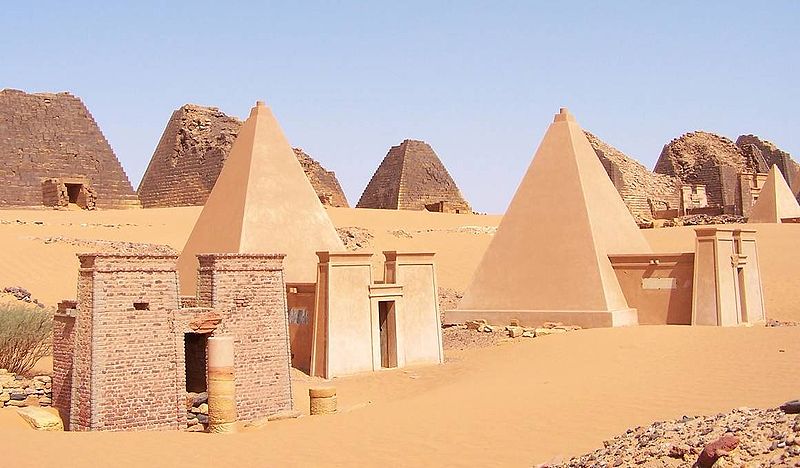
This itinerary describes the overland route from Cairo, Egypt, to Nairobi, Kenya, by public transport. This is more or less the only surface route from North Africa to East Africa accessible to Westerners, and so most overland travelers from Europe or Asia towards Southern Africa will have to pass this way (travel down the West coast of Africa is also possible, but much more difficult). The route passes through Egypt, (North) Sudan, Ethiopia and Kenya.
Visas
Almost all countries in this region prefer visas to be paid for in US dollars, and accept other currencies at unfavourable rates if at all. Egypt: Visas are available to almost all Westerners on arrival for USD 15. This is true even if you arrive by ferry at Aswan, though in this case getting the visa on arrival may cause some delays. Some embassies (e.g. Khartoum) issue advance Egyptian visas in around 24 hours, while other (e.g. Addis) take weeks for some nationalities. Sudan: Most westerners can in principle get a Sudanese visa in a couple days in Cairo or Aswan at a cost of USD 100, though this requires a "letter of introduction" (or written statement that such letters do not exist) from your own embassy, and some embassies may be reluctant to issue anything of the sort. Americans applying to get a Sudanese visa in Aswan (Egypt) must arrange a permission to visit beforehand via the US embassy, a process which takes around 2 weeks. (This does not seem to be required at the embassy in Cairo.) (Nov 2018.) In Addis Ababa, westerners including Americans can get a Sudanese transit visa in 24 hours by showing an Egyptian visa (evidence that these can be obtained on arrival is not sufficient) or a plane ticket from Sudan to your home country. For Americans this costs USD 200, other nationalities probably less. The transit visa is valid for two weeks stay (can be extended in Khartoum) and entry within one month; entry does not have to be from the Ethiopian border, though you probably still have to exit a different way than you entered. Once you have entered Sudan you are obliged to "register" your visa within 3 days; this is possible both at the borders and in Khartoum, costing USD 30-60 depending where you do it. It's not clear the 3 day deadline is enforced but you're unlikely to avoid it entirely as you will need it to exit the country. Ethiopia: Ethiopian visas are only available at Addis Ababa airport or in your home country. If you're already on the road you may have to DHL your passport home and get someone to send it to the Ethiopian embassy there for you. Your embassy may issue multiple entry visas for little more than the cost of single entries. In New York
Route
Cairo-Aswan (1 day) Air-conditioned trains link Cairo to Aswan, both during the day and overnight, taking about 12 hours. Fares are EGP 55 for second class, EGP 165 for first class, and USD 60 for a sleeper. Even second class is quite comfortable. Trains do sell out so it's worth booking in advance if you can. There are supposed to be some restrictions on which trains foreigners can take; if the train you want is subject to these you won't be able to buy a ticket from the ticket offices in Cairo or Aswan, but they will usually tell you to just buy a ticket from the conductor on the train. This only costs a few pounds more but means you don't have a reserved seat so may end up playing musical chairs. It may therefore be worthwhile to get an Egyptian (or agency) to buy your ticket for you if you want one of these trains. There are also buses between Cairo (Turgoman Garage) and Aswan (just in front of the train station), taking about the same time as the train and costing around EGP 80. There are boats along the Nile, considerably slower than trains/buses and more expensive, but more scenic. These range from fairly luxurious large riverboats to the traditional Egyptian felucca which is a fairly small boat. Recommended stops/detours:
Luxor — Capital of ancient Egypt, with vast temples, ancient royal tombs, spectacular desert and river scenery Aswan — Relaxed city next to the Aswan Dam
Aswan-Wadi Halfa (2 days) A ferry leaves Aswan every Monday around 12:00, arriving in Wadi Halfa, Sudan the next morning. Tickets can be purchased in Cairo (from a window in Ramses train station) or Aswan. You will need a Sudanese visa before you can buy a ferry ticket. The ferry dock is just beyond the High Dam; there are occasional local trains, or shared taxis cost EGP 10 or less. First class passengers pay around EGP 500 and share cabins with beds, while second class passengers pay EGP 323 and have padded bench seats. Most second class passengers lay out sleeping bags/mats on deck to sleep (the best place is directly under the lifeboats as this is the only spot with consistent shade); this leaves enough of the second class seats vacant that you can probably sleep across sever
Northern extensions
Frequent and cheap trains, buses and minibuses link Alexandria with Cairo in 2-3 hours. The Visemar Line ferry between Alexandria and Venice has been suspended, so there is no sea transport between Europe and Egypt, barring occasional cruises or maybe expensive freighter bookings. Buses run between Israel and Cairo, though this is something of a dead end because of the issues with Israeli passport stamps (which will lead to being denied entry to Sudan, Syria, Lebanon and some other countries). If you need/want to avoid Israel, there is a high speed ferry between Nuweiba in Egypt and Aqaba in Jordan; using this you may be able to make it between Amman and Cairo in one day (though stopping in Sinai is almost certainly worthwhile, as is detouring to Petra). Ordinarily one can travel between Jordan and Europe through Syria and Turkey, but the current political situation in Syria is unpredictable which may make visas difficult to obtain and travel unreliable or unsafe.
Southern extensions
The quickest route onward from Nairobi to Cape Town is probably by crossing directly into Tanzania and then proceeding through Zambia and Zimbabwe to Johannesburg and on to Cape Town. Detours via Uganda/Rwanda/Burundi, Malawi/Mozambique, Botswana/Namibia, or some combination of these are all relatively straightforward.
Stay safe
As of 2014, the British Foreign & Commonwealth Office [1] and US State Department [2] advise against all travel to South Sudan, southern portions of Sudan, and parts of Sinai. Terrorism is an ongoing risk in most of the region. The political situation in Egypt remains unpredictable but has been mostly peaceful since the early 2011 revolution. Western and Southern Sudan are subject to armed conflict. In 2019, there were large anti-government protests in Khartoum that have been brutally suppressed. Areas of Ethiopia bordering Eritrea and Somalia are unsafe but the route described passes far from these. Northern Kenya has had issues with lawlessness and armed banditry in the past, but the situation has improved and vehicles are no longer required to travel in convoy. Mugging/violent crime is a risk in all of these areas, especially Nairobi, and you will generally want to avoid walking alone at night or carrying large quantities of money. Scams abound; don't trust "friendly" strangers who will greet you on the street. Most travelers will want to take malaria prophylaxis before, during and after their visit to this region; if you choose not to, you should at least sleep under mosquito nets whenever possible, especially in more rural areas and at lower altitudes. Using insect repellent with DEET is also a good idea, but it's hard to find in some countries (Ethiopia). In general, none of these countries have potable tap water.
Adapted from Wikivoyage (CC BY-SA)