
Broken Hill Xplorer
Itinerary
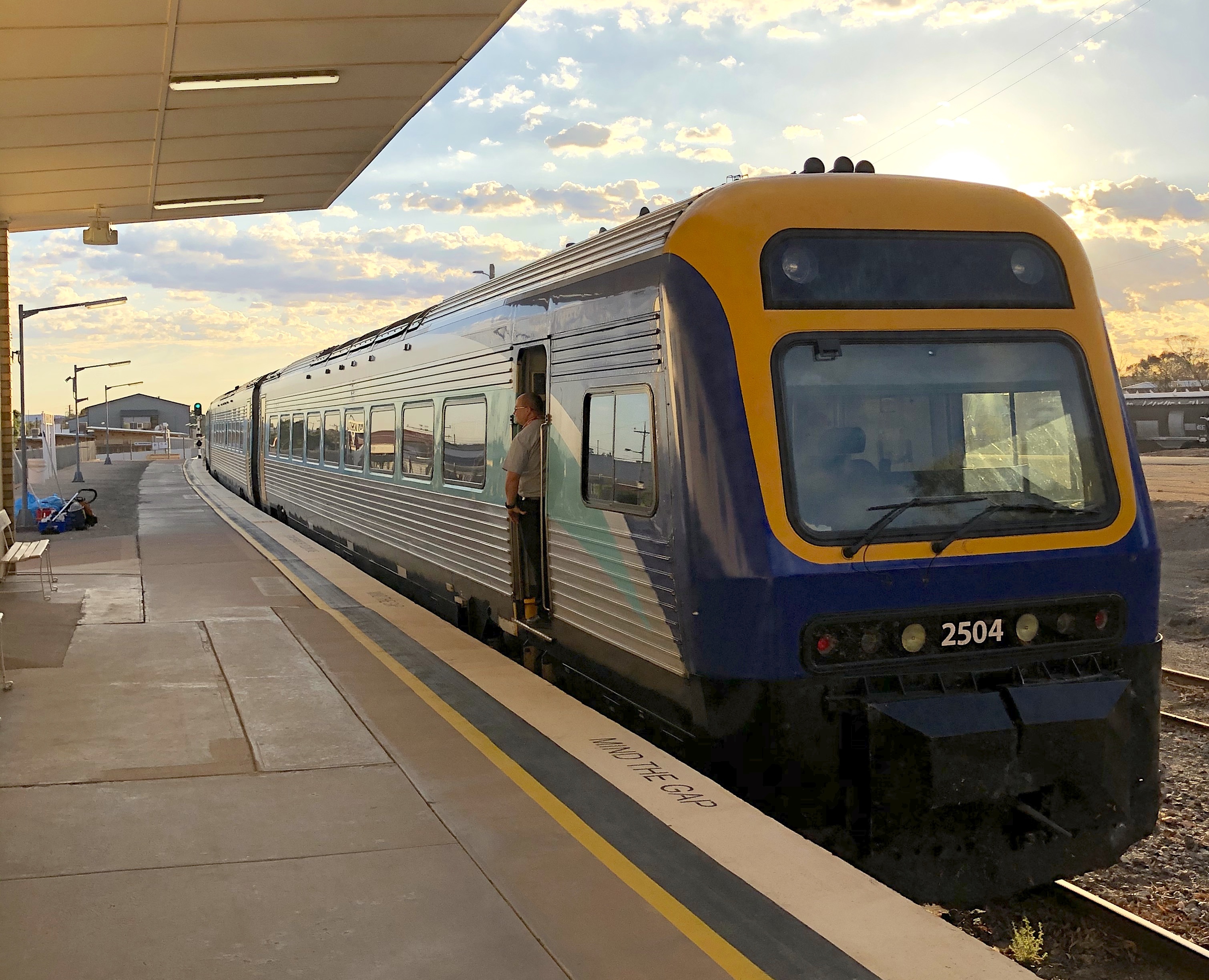
NSW TrainLink operates many train (and coach) routes throughout New South Wales. However, the state's longest passenger rail line, the Broken Hill Xplorer (sometimes also called the Outback Xplorer) is probably the most memorable. The line to Broken Hill beats out both the Melbourne and Brisbane XPT services in terms of distance and passes through some remarkable landscapes – and for a reasonable price compared to many other Outback passenger railways.
Understand
History Passenger trains have linked Sydney and Broken Hill since the 20th century – before then, Broken Hill was only connected to South Australia by rail, connected via a narrow-gauge line to the border. The rail connection to South Australia was by and large, the prime reason why Broken Hill operates 30 minutes behind the rest of New South Wales. Although a link to Menindee was constructed in 1919, it was only in 1927 when the railway was completely constructed all the way to Sydney. Regular passenger services commenced in 1937 with the introduction of the Silver City Comet, providing thrice-weekly connections to Parkes and a timed transfer to meet with the train from Sydney. The 1980s was a rough time for many of New South Wales' regional railways, and the Broken Hill Line was no exception. The Silver City Comet was due to be retired; as it was retired in 1989, it was replaced by road coaches. To this day, those train-replacement coaches are why Broken Hill receives a daily coach service from Dubbo. The Silver City Comet can be found today at the Sulphide St Rail Museum in Broken Hill. One of the election promises by Bob Carr before becoming the New South Wales premier in 1995 was to restore direct service to Broken Hill. This was later fulfilled in 1996 using a loco-hauled service, but that wasn't without its own issues. The condition of the carriages had become so bad that services had to cease in April 2000, later replaced by the Xplorer railcars, which are diesel multiple units (DMU), which still operate to this day as of 2025. As part of the New South Wales Regional Rail Fleet program, the Xplorers are bound to be replaced with the "New Regional Fleet" (NRF), a set of bimodal trains running on both electricity and diesel, which aims to overhaul all of the diesel sets used in the state. These were supposed to enter service around 2023 but have been delayed with no set timeframe. Some documents indicate that the Broken Hill service could potentially be coupled with the daily Central West service to Dubbo, decoupling at Orange.
Xplorer railcars The Xplorer is a diesel multiple unit (DMU), designed for long-distance regional daytime travel in New Sout
Prepare
Tickets Tickets can be booked on the NSW TrainLink website. Make sure you enter "Broken Hill Station" and not Broken Hill Town Coach Stop, which will only give coach options. Ticket prices are as follows, as of 2025, from Sydney Central Station to Broken Hill Station. The peak and off-peak dates can be found on the NSW TrainLink website, though as a general rule of thumb, align with NSW school holidays as well as state and federal public holidays.
Baggage As per NSW Trainlink's luggage policy, how much you can bring per person depends on the class of ticket you have. Regardless of the ticket class, large luggage may not exceed 600 mm x 700 mm x 500 mm. It may also not exceed 20 kg (44 lb). If you're in economy, you may bring only one piece of large luggage; you can bring two pieces of luggage in first class, however. In addition, you may also bring one piece of hand luggage weighing no more than 10 kg (22 lb) and no larger than 300 mm x 500 mm x 300 mm.
Direction Most non-residents of Broken Hill only use the train in one direction for good reason – the train gets into Broken Hill on the Monday and immediately returns back on Tuesday, leaving no time to explore the town of Broken Hill. If you are fully flexible and are not time-constrained by any means, this will differ by which end of the journey you want to see daylight. During winter, travelling westbound will mean that everything after Darnick will be dark, missing out on Menindee Lakes; travelling eastbound will mean that the Blue Mountains will be dark; however, that is a section of track easily doable from Sydney. During spring and autumn, travelling westbound means you will get to enjoy a nice sunset over the Menindee Lakes, though it will mean the final section into Broken Hill will be dark. During summer, daylight won't matter so much as the sun will be shining for all 13 hours.
Get in
See Sydney § Get in or Broken Hill § Get in for how to get to either end of the line. From Adelaide, it's possible to leave on the Sunday and arrive in Broken Hill on the Monday – one day should be enough to explore most of the town reasonably. Then on Tuesday morning, take the train out to Sydney. From Sydney, the daily Dubbo XPT and Broken Hill coach (which takes about 17 hours in total) can get you to Broken Hill without the need to fly in.
Route
Suburban Sydney and the Blue Mountains
The service starts at 1 Central (0 km), but also makes pick up stops at 2 Strathfield (12 km), 3 Parramatta (23 km) and 4 Penrith (50 km). This section of the trip is perhaps like taking any ordinary train through a suburban area, though one thing you'll probably notice is that the train will go much faster than a suburban train on the same tracks. Enjoy your momentary fast speeds as the next four hours past Penrith will be a struggle up slow and windy tracks – all the way until Parkes. Once you pass Emu Plains, the last suburban stop on the Sydney Trains network (note that the Broken Hill XPL does not stop there), you reach the foot of the Blue Mountains. This is where the journey starts to get real slow mostly averaging only around 50 km/h. However, the scenery starts to get much nicer onwards from here; the view up the mountains is definitely worth a look. One hour after leaving the base of the mountains, you'll reach 5 Katoomba (110 km) – perhaps the centre of the upper Blue Mountains and one of the few stations in the entire state over 1000 m in elevation. The train speeds up slightly past Katoomba and the scenery tends to be a lot better the further out you go. 40 minutes later, you'll reach 6 Lithgow (153 km), the very end of the electrified rail network. Before you reach Lithgow, you'll pass 1 Ten Tunnels Deviation – which, as its name suggests, is 10 dual-track tunnels. The reason for so many tunnels was to bypass the former Zig Zag Railway, which quite literally was a zig zag railway. You should be able to see the viaduct on your right right before you reach the station. All stations between Central and Lithgow inclusive are pick-up/set-down only – you cannot use the Broken Hill Xplorer to travel between Lithgow and Central.
Main West Line through the Central West
Past Lithgow, the scenery gets much drier and a lot less green. You'll also notice the train starts to speed up by quite a considerable margin and this should come out as no surprise – the geography is considerably flatter. The first thing you'll probably notice is the disused 2 Wallerawang Junction Station, which sits where the Main West and Gwa
Onboard
The Broken Hill Xplorers consist of three cars – the car closest to Broken Hill will be the first class car, while the other two cars closer to Sydney are the economy cars. All three cars have luggage racks on either end of the train, two toilets and overhead luggage compartments. The buffet car is in the first class section – it's not very large, nor is the range of food very large either. Most of it is either microwaved onboard or packaged. Around both lunch and dinner, a customer service attendant will come around and ask if you want any hot meals (which vary by day), which usually cost $12–15. Otherwise snacks, sandwiches, tea and coffee are available all day, except for short intervals and near the start and end of the journey. The difference between first class and economy is not that great, with the main difference being a slightly better recline and the choice of passengers surrounding you being considerably better in first class. If you value a quieter journey, it is well worth the extra price – and if you are on any type of concession, the first class usually makes up for a free upgrade from the normal adult fare.
Stay safe
The train is generally safe. Some disruptive antisocial behaviour can occur, but this is considerably less common on the Broken Hil
Adapted from Wikivoyage (CC BY-SA)