
Along the Ganges River
Itinerary
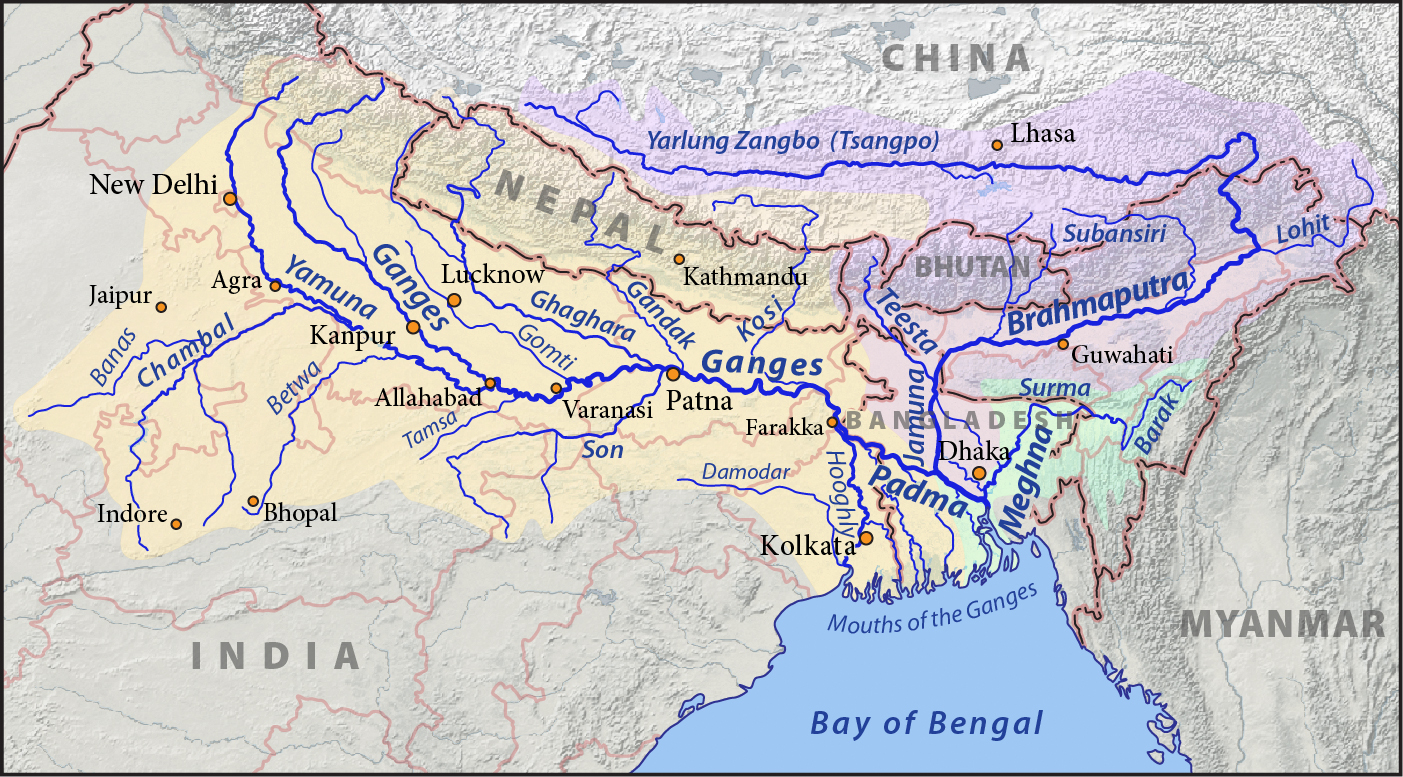
The Ganges (Hindi: गंगा Gaṅgā, Bengali: গঙ্গা Gaṅgā) is India's longest and most important river, and a sacred river in Hinduism. At over 2,500 km long, the Ganges is the third-longest river in South Asia, after the Brahmaputra and the Indus.
Understand
Often called the "lifeline of India", the Ganges has been an important transport route in the country with major cities along its banks for several thousand years. The river begins at the confluence of the Bhagirathi and Alaknanda rivers at Devprayag, Uttarakhand. Although the Alaknanada is the source stream for being longer, the Bhagirathi is usually considered as such in Hinduism. The river divides into two branches at Farakka, West Bengal: the Padma (Bengali: পদ্মা Padmā) in Bangladesh, and the Bhagirathi (ভাগীরথী Bhāgīrathī) in West Bengal. The Bhagirathi then meets with the Jalangi (itself a branch of the Padma) to become the Hooghly (হুগলি Hugli or হুগলী Huglī). Both Padma and Bhagirathi-Hooghly branches of the Ganges empty into the Bay of Bengal, forming the world's largest river delta in Bengal, as well as the mangrove forest of the Sundarbans. The Yamuna (यमुना Yamunā), a major tributary of the Ganges, is considered the "twin" of the river and is equally sacred to Hindus. It begins at Yamunotri in Uttarakhand, and runs across the cities of Delhi and Agra before meeting with the Ganges at Prayagraj. Hinduism considers another mythical river that meet at Prayagraj, called the Saraswati (सरस्वती Sarasvatī), and that's why the confluence is often called Triveni Sangam (त्रिवेणी संगम Triveṇī Saṅgam). The Brahmaputra (Assamese: ব্ৰহ্মপুত্ৰ Brahmaputra) is another major tributary of the Ganges, or rather its Padma branch. It begins at Manasarovar (near Mount Kailash) in Tibet as Yarlung Zangbo, and enters the Himalayas through Arunachal Pradesh, disputed between India and China. After that, it then enters the Assam valley as the Brahmaputra, and then Bangladesh as the Jamuna (যমুনা Yamunā), which finally meets with the Padma.
History Although the Indus Valley Civilisation was developed along the Indus River basin, due to climatic shifts, the population later migrated to the more humid Gangetic Plain. After the Indo-Aryan migration, the Ganges became central during the late Vedic period, with many small kingdoms developed around the river. The Maurya Empire was originally based around the river, with the capital at Pataliputra, present-day Patna. In addition
Prepare
While you can get away with only English in major cities, you would need a phrasebook of either Hindi or Bengali or both if you're exploring the rural areas, as well as the Sundarbans.
Get in
Delhi has a major international airport with connections to almost anywhere. The other major cities on the route (Kanpur, Prayagraj, Varanasi, Patna, Kolkata) have airports with good domestic connectivity, but few to no direct international flights. Kolkata is a mixed bag in this regard. On one hand, it has no direct connectivity to the West, that is you must lay over to an intermediate city to get to Kolkata if coming from the West. On the other hand, it has a plenty of direct flights from Southeast Asia and the Middle East. The nearest major airport to the Padma River is Dhaka. See India#Get in and Bangladesh#Get in for visa information.
Go
One of the most popular ways to explore the Ganges is the Ganga Vilas, the world's longest river cruise. Inaugurated in February 2023, the 51-day voyage from Varanasi to Dibrugarh covers the Varanasi–Gangasagar section of the river, as well as the Sundarbans, Bangladesh and Assam, covering over fifty destinations on the way. With a capacity of 36 tourists on board, the Ganga Vilas has three decks and 18 suites. The ticket costs ₹12.59 lakh per head. The Grand Trunk Road roughly covers the Ganges River from Howrah to Bandel, and from Varanasi to Kannauj. In the Hooghly River basin, especially from Kalyani to Budge Budge, travelling by ferry is also an option but not essential, as there are good rail and road connections; see public transport in Greater Kolkata.
Stay safe
Regardless of the sanctity of the river, don't drink the Ganges water (gaṅgājal) directly. The river has been severely polluted for decades, and the levels of fecal coliform bacteria from human waste near Varanasi are more than 100 times the Indian government's official limit. Many initiatives have been taken to clean up the river, including the Ganga Action Plan, but they have failed to live up to their expectations.
Go next
From Haridwar and Rishikesh one can visit Dehradun and Mussoorie. Bengal — a fertile region developed around the lower Ganges Basin, containing the world's largest delta. Godavari River — the longest river in southern India, from Nashik to Rajahmundry. Often called the "Ganges of the South".
Adapted from Wikivoyage (CC BY-SA)