
Along Mannerheimintie
Itinerary
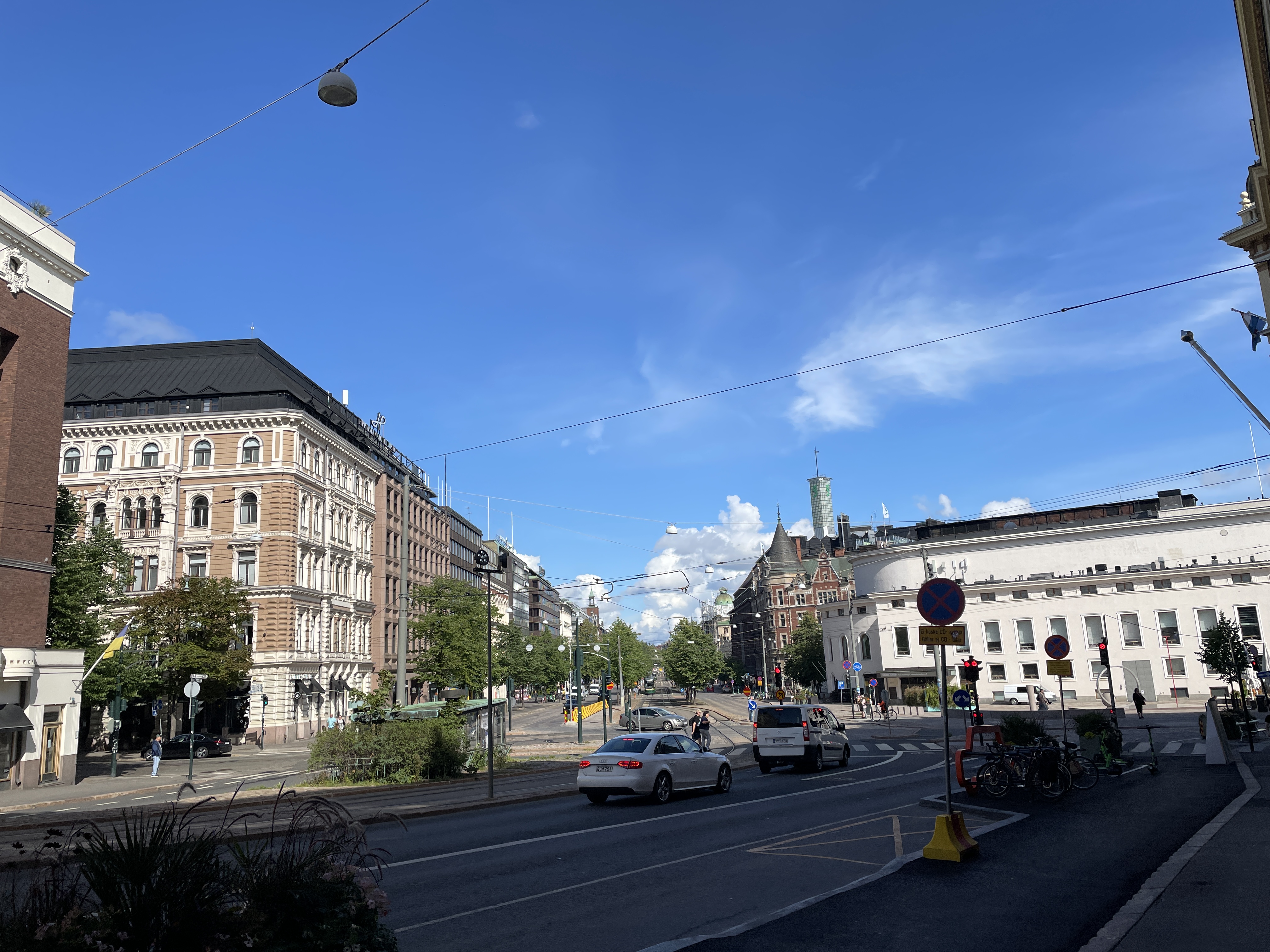
Mannerheimintie, (in Swedish Mannerheimvägen, colloquially Mansku) can be considered the main street of Helsinki – another contestant for that title would be Aleksanterinkatu, which it crosses.
Understand
Mannerheimintie translates to Mannerheim Road and got its current name from Marshal C. G. E. Mannerheim (1867–1951). The street of 5.5 km (a little less than 3.5 miles) is the main north-south route west of the railway and has been a major thoroughfare for centuries. Already in the 17th century a road existed here connecting settlements on the Helsinki peninsula to the King's Road, the main east-west road in Finland back then. With the Russian rule after the Napoleonic Wars, Helsinki became the capital of Finland and a new zoning plan was drawn up. The southernmost part of present-day Mannerheimintie was named Henriksgatan (in Swedish, which aside of Russian was the administrative language then – its Finnish name would be Heikinkatu) after then-Secretary of State, Robert Henrik Rehbinder (1777–1841). Henriksgatan was divided into a western and eastern street with a narrow park between them - this is where the tram today runs. North of the Turku barracks (where Lasipalatsi now is), the street was named Åbovägen (Sw.)/Turuntie (Fi.), i.e. Turku Road. In the 1850s Turuntie was renamed Västra chausséen (Sw.)/Läntinen viertotie (Fi.) (Western Chaussee), whereas present-day Hämeentie, the other road leading to the Helsinki peninsula back then, was renamed Östra chausséen (Sw.)/Itäinen viertotie (Fi.) (Eastern Chaussee). Both were widened and covered with gravel to the city border, in the case of the Western Chaussee, to Töölöntulli. Here voyagers had to pay a toll to cross into the city. To this day these remain important arteries for road traffic into central Helsinki, even as other major thoroughfares have been built such as the road bridges to the islands of Lauttasaari and Kulosaari (for highways 51 and 170). In 1928 the "chaussee" part was once again named Turuntie, and in 1935 the two Henrikinkatu streets were merged into one as the trees were cut down and the park transformed into lanes for trams to accommodate more traffic in the quickly growing capital. The street got its present name during WWII in 1942, when Heikinkatu and Turuntie were administratively turned into one street and renamed Mannerheimintie after commander-in-chief, Marshal Mannerheim, on his
Get around
Walking or cycling the whole route is an option if you have time. There are sidewalks and bike lanes along the whole length and the route is mostly flat. If you don't have your own, you can rent a city bike during the warmer half of the year, or an electrical scooter. Bikes can be left at dedicated stations, the electrical scooters basically where you like (but don't just drop it right at the sidewalk or in the front of a door). Several tram lines go along the street, but line 10 goes virtually the whole length of Mannerheimintie so it serves as a good "hop on-hop off" line for this itinerary. In addition many city bus lines ply the route. Getting around by car is doable but certainly not the best idea. Driving is not a big problem (though there may be some congestion), but parking is. In practice parking and even stopping is banned along all of Mannerheimintie though you can park on side streets if there is space available (in central Helsinki you better opt for a parking garage), see nearby attractions you're interested in and drive a bit further and park again.
Go
Part 1 Downtown The 1 southern end of Mannerheimintie is a crossing with three other notable streets. Facing Mannerheimintie, you will have Eteläesplanadi to your right, Erottaja behind your back and Bulevardi to your left. The Esplanade and the Boulevard are lined by trees. Esplanadi is made up of two streets, Eteläesplanadi (Southern Esplanade) and Pohjoisesplanadi (Northern Esplanade) on the other side of the Swedish Theatre and between them Esplanadinpuisto (Esplanade Park) leading to the Market Square and the sea. You can walk up Erottaja (lit. the separator) for a nice view along Mannerheimintie, including all of the first and some of the second section's (as defined in this itinerary) sights. Erottaja, at least in Wikivoyage's district division, separates Central Helsinki from the calmer and more residential Southern Helsinki. To the left of Mannerheimintie is what we call Kamppi and Southwestern Helsinki. The first part of the journey takes you through some of the most central parts of the city. The white building to the right is the 2 Swedish theatre, possibly the finest Swedish-speaking cultural venue of Helsinki. In the front of it is a work of modern art "Faith, hope and love". Crossing Pohjoisesplanadi, the next notable building is the 3 Stockmann department store. This large brick building is the fifth largest department store in Europe, and one of four big shopping places along or near this part of Mannerheimintie. Opposite Stockmann is 4 Hotel Marski, as of 2021 operated by Scandic. "Marski" is the nickname of Marshal Mannerheim. The street next to Marski is Lönnrotinkatu, named after 19th century writer Elias Lönnrot. One block further north, the street leading into Kamppi (parallel to Lönnrotinkatu) is Kalevankatu. The block after Kalevankatu is more or less occupied by the 5 Forum shopping center, first opened in 1952, demolished and rebuilt in 1985 at which point it made up the northern 2/3 of the block but its shops and restaurants have since "spread" into parts formerly used serving as office spaces. In 2024-25 the Aktia House, a 1960s office building that made up the part of this block closer to Kalevankatu was demolished, and replaced
Go next
The 55 terminus of tram 10 isn't far away from the northern end of Mannerheimintie, just a few hundred meters west along Vihdintie. There are also buses both back to downtown and in other directions, after all this is a major traffic junction. If you've traveled in the opposite direction you're right in the middle of everything, so why not consult our district articles for Central, Southern and Southwestern Helsinki for interesting things to experience nearby.
Adapted from Wikivoyage (CC BY-SA)