
Kanchenjunga
Nepal · Asia
About
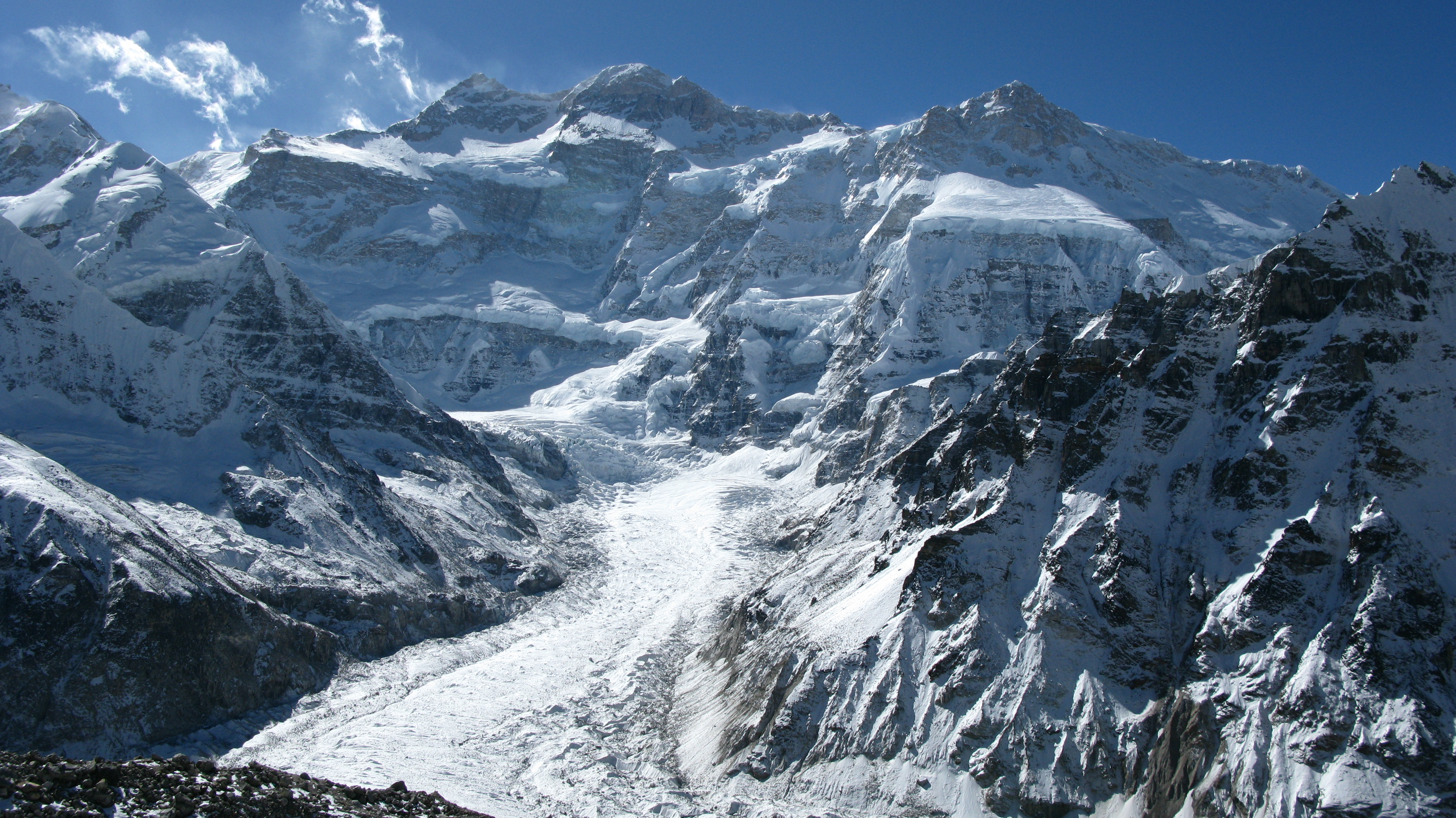
Kangchenjunga is the third-highest mountain in the world. Its summit lies at 8,586 m (28,169 ft) in a section of the Himalayas, the Kangchenjunga Himal, which is bounded in the west by the Tamur River, in the north by the Lhonak River and Jongsang La, and in the east by the Teesta River. It lies in the border region between Koshi Province of Nepal and Sikkim state of India, with the West and Kangbachen peaks located in Nepal's Taplejung District and the Main, Central and South peaks directly on the border.
Until 1852, Kangchenjunga was assumed to be the highest mountain in the world. However, precise calculations and meticulous measurements by the Great Trigonometrical Survey of India in 1849 showed that Mount Everest, known as Peak XV at the time, is higher. After allowing for further verification of all calculations, it was officially announced in 1856 that Kangchenjunga is the third-highest mountain in the world.
Kangchenjunga is considered a sacred mountain in Nepal and Sikkim. It was first climbed on 25 May 1955 by Joe Brown and George Band, who were part of the 1955 British Kangchenjunga expedition. They stopped just short of the true summit, keeping a promise given to Tashi Namgyal, the Chogyal of the Kingdom of Sikkim, that the top of the mountain would remain inviolate. The Indian side of the mountain is off limits to climbers. In 2016, the adjoining Khangchendzonga National Park was declared a UNESCO World Heritage Site.
Adapted from Wikipedia (CC BY-SA). Photography via Wikimedia Commons.