
Visegrád
Hungary · Europe
About Visegrád
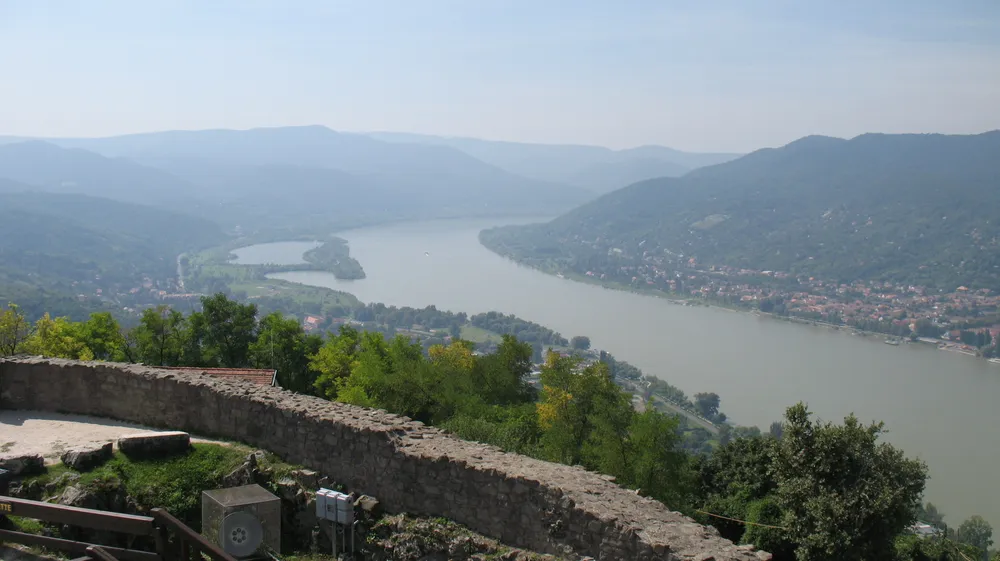
Visegrád (German: Plintenburg, Slovak: Vyšehrad) is a small castle town in the Danube Bend region. It is north of Budapest on the right bank of the Danube. Visegrád is famous for the remains of the Early Renaissance summer palace of King Matthias Corvinus of Hungary and the medieval citadel.
Visegrád travel guide
Understand
The name Visegrád (Vyšehrad) is of Slavic origin, meaning acropolis, literary "the upper castle" (the castle with a privileged position) or "the upper settlement". Visegrád was first mentioned in 1009 as a county town and the chief town of an archdeaconry. After the destructive Mongol invasion of Europe in 1242, the town was rebuilt in a slightly different location to the south. King Charles I of Hungary made Visegrád, his hometown, the royal seat of Hungary in 1325. In 1335, Charles hosted at Visegrád a two-month congress with the Bohemian king, John of Luxembourg, and the Polish king, Casimir III. It was crucial in creating a peace between the three kingdoms and securing an alliance between Poland and Hungary against Habsburg Austria. Another congress followed in 1338. Sigismund, Holy Roman Emperor and King of Hungary and Croatia in personal union with Hungary, moved the royal seat to Buda between 1405 and 1408. King Matthias Corvinus (1443–1490), King of Hungary, used Visegrád as a country residence. Visegrád lost importance after the partition of the Kingdom of Hungary following the Battle of Mohács in 1526.
1 Visegrád Info, Duna-parti út 1, ☏ +36 26 397-188, [email protected]. Tu–Su 10:00–16:00. Tourist information. (updated Feb 2020)
Getting there
By train The closest train station is Nagymaros-Visegrád, which is located at the opposite site of the Danube river. From Budapest-Nyugati pályaudvar, you can travel by train to Nagymaros-Visegrád train station, then transfer to ferry towards Visegrád. The whole journey from Budapest to Visegrád takes about an hour and costs 2000 Ft (Aug 2024).
By bus
Direct buses from Budapest-Újpest-Városkapu are available hourly. The journey takes 75 minutes and costs 745 Ft (Aug 2024).
By ferry There are ferry services available between Visegrád and Nagymaros, and between Szentgyörgypuszta and Kisoroszi.
1 Visegrád Ferry Station, Visegrád, Rév utca (Visegrád centre), ☏ +36 26 398344. 06:20 07:45–19:45 hourly. Boats from Nagymaros Adult: 850 Ft; senior, student: 425 Ft. (updated Aug 2024) 2 Szentgyörgypuszta Ferry Station (100 m off from Hwy 11), ☏ +36 26 392-015, [email protected]. 05:10–22:10. Ferries to Kisoroszi. Adult: 300 Ft; senior, student: 200 Ft. (updated Feb 2020)
By boat Boats are available between May–Sep daily except on Mondays from Visegrád to Nagymaros, Zebegény and Dömös. Further destinations available only from Friday to Sunday: Budapest, Szentendre, Leányfalu, Tahitótfalu, Vác. 3 Visegrád Port, ☏ +36 1 484-4013, [email protected]. Scheduled boating: 500 Ft per day, hydrofoil service: 2800 Ft–4300 Ft. (updated Aug 2020)
Getting around
There is no local public transport service. You can use the regional buses operated by Volánbusz. There is the "Hop on/Hop off" tourist bus which takes you to different tourist attractions, regional bus stop and ferry piers on weekends.
By taxi City-Bus Visegrád, ☏ +36 30 727-6565, [email protected]. (updated Feb 2020) Dunakanyar Taxi, ☏ +36 20 266-6662, [email protected]. (updated Feb 2020)
Parking 4 Castle of Visegrád Parking, Panoráma út. Parking area with souvenir shop, bar, picnic zone and toilet. upfront payment. (updated Jul 2024) 5 Panorama parking area, Panoráma út. Nice panorama of danube bend, with picnic area. free. (updated Jul 2024)
See
Medieval buildings
1 Castle of Visegrád (Visegrádi vár) (Bus 883 from Budapest stops at the castle 5 times a day during weekends and public holidays. Otherwise; take the Hop On/Hop Off bus which runs every hour from 10:00 to 17:30 on weekends and holidays.), ☏ +36 6-26-398-101, [email protected]. Jan Feb: F–Su 10:00–16:00; Mar Oct: 09:00–17:00; Apr–Sep 09:00–18:00; Nov: 09:00–16:00; Dec: F–Su 10:00–15:00. After the Mongol invasion, King Béla IV of Hungary and his wife had a new fortification system constructed in the 1240–1250s near the one destroyed earlier. The first part of the new system was the Upper Castle on top of a high hill. The castle was laid out on a triangular ground plan and had three towers at its corners. In the 14th century, at the time of the Angevin kings of Hungary, the castle became a royal residence and was enlarged with a new curtain wall and palace buildings. Around 1400 King Sigismund had a third curtain wall constructed and enlarged the palace buildings. At the end of the 15th century, King Matthias Corvinus had the interior renovated. The Upper Castle also served for the safekeeping of the Hungarian royal insignia between the 14th century and 1526. In 1544 Visegrád was occupied by the Ottoman Empire, and, apart from a short period in 1595-1605, it remained in Turkish hands until 1685. The castle was seriously damaged by the Turks and was never used afterwards. The castle is now open to the public to visit. Adult: 2500 Ft; senior, student: 1250 Ft. (updated Aug 2024) King Matthias Museum (Mátyás Király Múzeum), ☏ +36 26 597-010, [email protected]. A branch of the Hungarian National Museum. Finds of the local archaeological excavation and photos, drawings and textile can be seen here. (updated Aug 2024) 2 Royal Palace (Királyi Palota), Fő utca 23. Nov–Mar: Tu–Su 10:00–16:00; Apr–Oct: Tu–Su 09:00–17:00. The first royal house on this site was built by King Charles I of Hungary after 1325. In the second half of the 14th century, this w
Do
Pilis Protected Area 1 Pilis Protected Area (Pilisi Tájvédelmi Körzet), Visegrád, Danube-Ipoly National Park Directorate, Pilis Forestry branch (Pilisi Parkerdő Zrt. Visegrádi Erdészet), Office: Visegrád, Mátyás király Way 4 (Center of Visegrád), ☏ +36 1 2004066, +36 1 3914610, fax: +36 1 2001168. The protected area covers 64,512 ha, 59,362 hectares of which are forest land areas. This woody area in the Danube Bend is cut by the Dera- stream and the Cserepes- valley in two parts. Ft 10 000/group/hour max. 20 persons. Guided tours in nature protection area. Take a walk to the most highest place in the Pilis Mountains is the 757 m high "Pilis Peak" and enjoy the superb view from Boldog Özséb (Blessed Eusebius) Lookout. Take one of the cave tours: The rock-bed of the Pilis Hills stretching from Esztergom to Budapest is made up of limestone and dolomite. Because of the basic characteristics of limestone karst formation, the hills are exceptionally rich in caves. Therefore it is not surprising that most of the caves of the National Park can be found in the Pilis Hills. Moonshine Canyon (Holdvilág-árok) The Holdvilág ditch is a popular tourist destination a water habitat, a memorial site, in the Visegrad Mountains Northwest from Pomáz, about 6 km away. In addition, however, is considered an ancient burial ground, place of worship. it has botanical value. Miklós Bertényi Fűvészkert, Pilisszentkereszt Cistercian Monastery ruin and gorge (Pilisszentkereszti Szurdok) ravine in forestry of Pilisi Park, in the near of Pilisszentkereszt on the blue marked tour, Rám Abyss and trail gap, Mogyoró Hill trails in Visegrad: Mogyoróhegyi natural history trail and educational path i
Overview adapted from Wikipedia, travel guide fromWikivoyage (CC BY-SA). Photography via Wikimedia Commons.