
Szeged
Hungary · Europe
About Szeged
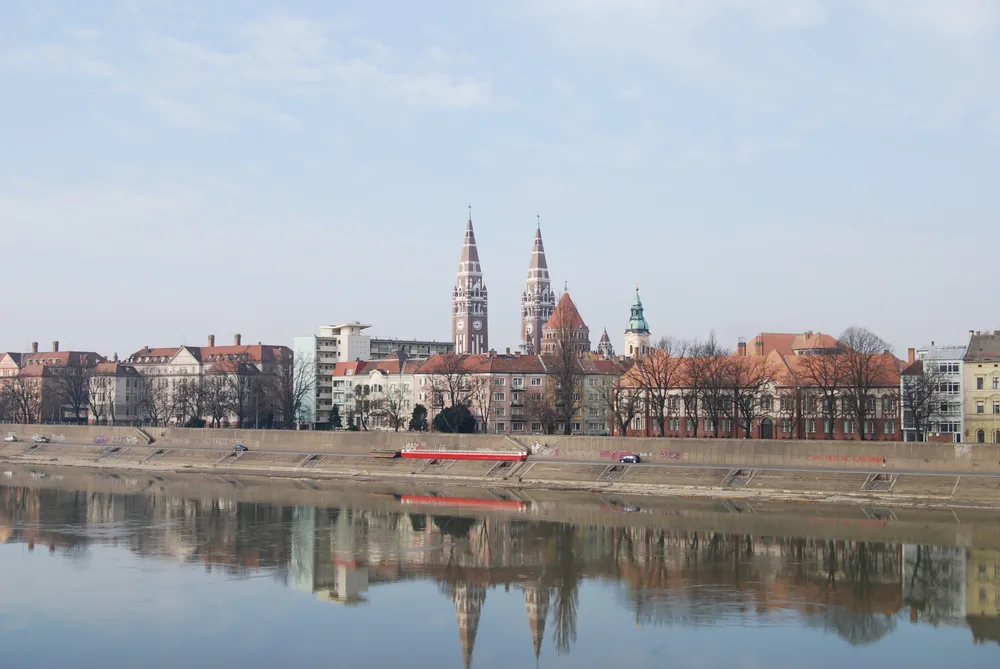
Szeged is a Hungarian city in the Csongrád-Csanád County. The third largest city in the country, it is sometimes called "the city of sunshine", for its brilliant weather. It is known for the imposing cathedral, a wealth of Art Nouveau and historicist buildings, and for the fish soup Halászlé.
Szeged travel guide
Understand
Szeged lies on Hungary's south-eastern border, just south of the mouth of the Maros river on both banks of the river Tisza. It is about 171 km south of Budapest on the M5 highway. It is the lowest elevation city in the country and is known as the "City of Sunshine", because it has the most sunny days throughout the year. Szeged is the main city in Csongrád-Csanád county and serves as a commercial and cultural center of the region. The city's population was around 170 000 in 2011. Szeged's Open Air Theatre Festival held in the summer attracts people from all over Europe. Szeged is also famous for its gastronomy. Its delicious fish soup is known all over the world, and it has its own festival in September. One of the main attractions of Szeged is the River Tisza, that offers possibilities to do different water sports or boat trips. While boasting hundreds years of history, Szeged has been rebuilt almost entirely after the flood of 1879, which destroyed most of the city. Today, with its avenues, ring roads and beautiful palaces, Szeged is one of the nicest Hungarian cities.
Tourist information 1 Tourist Information, Dugonics tér 2 (North of the University of Szeged), ☏ +36 62 488-690, +36 62 488699, fax: +36 62 488-690. Nov-Mar: M-F 09:00-17:00; Apr-May: M-F: 09:00-17:00, Sa 09:00-13:00; Jun-Aug: M-F 09:00-18:00, Sa 09:00-13:00; Sep-Oct: M-F 09:00-17:00, Sa 9:00-13:00. Today's Szeged is an important university town and a popular tourist attraction. Services of the office: reservation of accommodation, Wine and Gastronomical Tourism, facultative programmes, professional and field trips. Information about accommodation, restaurants, transport, programmes, attractions and services in the local, region or national perspective. Ask about tours to the area (Szeged-Tape: Árpád Age settlement (12th century), Szeged - Kiskundorozsma (remains of a Benedictine monastery), Fehér (White) Lake (Hungary's largest; 14 km² alkaline lakes; fish ponds today), Ópusztaszer (first natio
Getting there
By car If you are flying to Hungary, you will most likely be arriving to the Liszt Ferenc International Airport in Budapest and you will want to take the M5 highway South to Szeged. It will take 1½-2 hours to drive from the airport. You must get a sticker for your car to drive on the highway, which you can buy at any gas station (ask for "matrica"). Szeged has a parking zone system, parking tickets are available from newsagent's, local stores, etc.
By train It takes about 2 hours to travel by train from Budapest Nyugati train station to Szeged. These trains also stop at Ferihegy, the station for Budapest Liszt Ferenc Airport, meaning it isn't necessary to travel into the centre of Budapest if travelling to Szeged from the airport. Additionally, there are regional cross-border trains from Subotica in Serbia.
1 Szeged railway station (Szeged pályaudvar). The main station, also known as Nagyállomás. (updated Jun 2021)
By plane Szeged airfield. Szeged has a small airport for small private airplanes. The nearest major international airport is Budapest. Another option, albeit a less convenient one, is Timișoara, airport, located across the Hungary-Romania border. A minor base for Wizz Air, there are also flight to Bucharest and Munich. There are no public transport options, but driving takes about an hour.
Getting around
Szeged lies on the banks of Tisza river. The western side is generally referred to as "Szeged", while the newer eastern side is called "Új-szeged" ("New Szeged"). There are further parts of the city, which you can think of as districts (although they do not work as districts): Belváros (the center of the city; downtown), Alsóváros, Móraváros, Rókus, Újrókus, Fölsőváros, Tarján, Fodor-kert, Petőfi-telep, Makkosház, Baktó, Tápé, Újszeged, Odessza, Marostői kiskertek, Klebelsberg telep, Kecskés István telep, Iparváros, Béke-telep, Baktó.
Public transportation For the size of the city, Szeged has a really good public transportation network. Within the city you can get around by cabs (taxi), trams (villamos), trolley buses (trolibusz) or autobus (autóbusz). If you wish to use these types of public transportation, you will need to find out about their routes, stops and schedules. During the work week, in the busy hours, within the city, most public transportation vehicles will leave every 10–15 minutes.
Schedules Schedule of public transport: [1] Schedule of City buses Schedule of buses leaving and arriving to Szeged Schedule of trolley buses and trams
Tickets There's no difference in the tickets for the different types of transportation methods. You can usually purchase tickets from the driver, for which you will always have to get on the vehicle using the frontmost door. On trams, you can also purchase tickets on board using your credit card (Visa or MasterCard only). You can also purchase weekly and monthly passes as well as single-trip tickets from various kiosks and newspaper stands throughout the city. These passes will be valid for all 3 types of public transportation, so you can travel by trams, trolley buses and buses. There are also discounts offered to students and seniors.
Taxi There are a few taxi services in the city. You can call and "order" one to your location. The drivers may not speak English, but should be able to get you where you want
See
Churches
1 Cathedral of Our Lady of Hungary (Votive Church; Szegedi Dóm; Fogadalmi templom), Dóm tér ("Cathedral Square"), 15 (Beside the Dömötör tower), ☏ +36 62 420157, +36 20 8232901 (mobil), fax: +36 62 420157, [email protected]. Church: M-Sa 06:30-19:00, Su 7:30-19:00. Sacristy: 06:15-08:00 and 16:00-19:00, Su 07:30-12:30 and 16:00-19:00. Parish Office: M W 08:00-12:00 and 14:00-16:00, Tu Th F 08:00-12:00. This twin-spired church serves as the cathedral of the Roman Catholic Diocese of Szeged–Csanád. After the great flood of 1879 the municipal board made a vow to erect a monumental Votive Church. It was built between 1913 and 1930, in neo-Romanesque style according plans of Frigyes Schulek and Erno Foer. It is the fourth largest church in Hungary. The dome is 54 m outside (33 m above the inside floor) and the towers are both 91 m high. The cathedral decorated inside and outside with numerous mosaics, statues and low-reliefs. Europe's third largest church organ with over nine thousand pipes is in the Cathedral. One of the most remarkable artistic work among the inside statues is "Christ on the Cross" by János Fadrusz which won Grand Prix in Paris in 1900. Another curiosity is on the ceiling of the sanctuary where Maria is depicted dressed in shepherd's felt cloak and Szeged slippers in mosaics. In the crypt of the Cathedral eminent clerical personalities are buried. The "Heroes' bell" (or bell of St. Gellert) in the tower on the Tisza side weights 8600 kg,-made in 1927,-only seven times per year used. The second biggest bell of the church is 'St. Emeric', (2669kg; made in 1927) and there are more three smaller bells. Walk around clo
Overview adapted from Wikipedia, travel guide fromWikivoyage (CC BY-SA). Photography via Wikimedia Commons.