
Székesfehérvár
Hungary · Europe
About Székesfehérvár
Székesfehérvár is the largest city and the county seat of Fejér county, Hungary. It's roughly 60 km southwest of Budapest, and is considered Hungary's first, as this was the royal seat of King Szent István (also known as Saint Stephan). Though most of the medieval city was destroyed by the Turks, it was rebuilt to glory under Maria Theresa Habsburg. The city is between Lake Velence and Lake Balaton, making it an ideal stop-off between the two.
Places outside of the city that are in the district of the same name are listed in the Székesfehérvár district article.
Székesfehérvár travel guide
Understand
Székesfehérvár (Latin Alba Regia) is one of the most ancient towns in Hungary. During his principality (972 - 997) Géza, the Grand Duke, established Székesfehérvár as his princely dwelling on the hills surrounded by swamps and therefore considered safe. His palace was fortified by ditches and ramparts, and the Byzantine-style, quatrefoil church, which was one of the first Hungarian stone built churches and later served as his resting-place. During the reign of King St Stephen (1001 -1038) it was a populous and extended settlement, surrounded by palings and walls built of soil. King Stephen's basilica was built in this time. It was one of the most monumental buildings in Europe at that time. In the 12th century there were great building operations in Székesfehérvár. The monks settling in the city and the inhabitants enriched Alba Regia by building pompous churches, monasteries, and dwelling houses. The construction of Saint Peter's cathedral - next to Saint Peter's church, built under the principality of Géza - was started in the 13th century. King Béla IV was crowned in this cathedral. The city was fenced with walls in the 14th century. The Turks occupied the strategically important town in 1543 and kept it under their rule for 145 years. In 1703 the city regained its title as a free royal city. In the 1720s major construction were started: first the Franciscans then the Carmelites built churches, and under the rule of Maria Theresa there were Baroque-, rococo-, and so called copf-style town-houses built. In 1800s the first Hungarian and German primary school opened its gates, the education was started at the Jesuits' secondary school, and this town was the first to embrace the cause of the Hungarian theatrical art. In 2014, it was home to 98,000 people.
1 Tourinform (Tourinform Iroda; Fehérvári Ajándékbolt), Oskola u. 2-4 (Center), ☏ +36 22 537261, [email protected].
Getting there
By train
1 Train Station. There are very frequent rail services from Budapest. First, there is an hourly commuter train service (labelled személy) to Székesfehérvár, stopping at almost every station (although; between Kelenföld and Érd felsö it only stops in Budatétény) and taking 80 minutes to arrive. Second, there is an hourly intercity rail service (labelled gyors and not InterCity) running to Szombathely and Nagykanizsa alternately, stopping only at Kelenföld on its way and taking 65 minutes to arrive. All trains depart from the Budapest-Déli station and do not serve the Nyugati and Keleti stations. Check the timetable at MÁV's website. The train station is roughly 1 km south of the town centre and can easily be walked. Alba Volán runs frequent bus connections to the town centre. One last option is to use City Taxi, at +36 22 311111. (updated Feb 2026)
By bus 2 Bus Station (Székesfehérvár autóbuszállomás), Piac tér 30 (south of Piac square and a short walk around the corner to the old town centere), ☏ +36 22 514714. Prebooking cashdesk open: M-F 05:30-19:00 (first week of the month), Sa 07:00-14:00, in second half of the month only till 18:00 and 12:00. Direct connections from Budapest, Népliget bus station. The journey takes roughly 1 hr 15 min. Prices are exactly the same for the bus and for the train. The only advantage then to taking a bus instead of the train would be that the city bus station is located exactly in the downtown. Buses to Pápa (between 08:00 and around 19:00; hourly; about 2 hours).
By car The M7 runs just south of Székesfehérvár and is the fastest way to arrive. From the exit merge onto 63 which will eventually take you into Piac Square.
By taxi Because the city is 60 km out of Budapest this is by far the most expensive option. If, however, you are arriving at Ferihegy and are going directly to Székesfehérvár, Zona Taxi offers a fixed rate of Ft 20 000.
Getting around
Buses only accept cash on board. If you are going to Bory's Castle you will need to travel either by car or bus. From the bus station take bus #26 or #26A and from the train station #32. Make sure to tell the bus driver you're going to Bory Vár because none of the buses will take you directly there and you won't know otherwise when to get off.
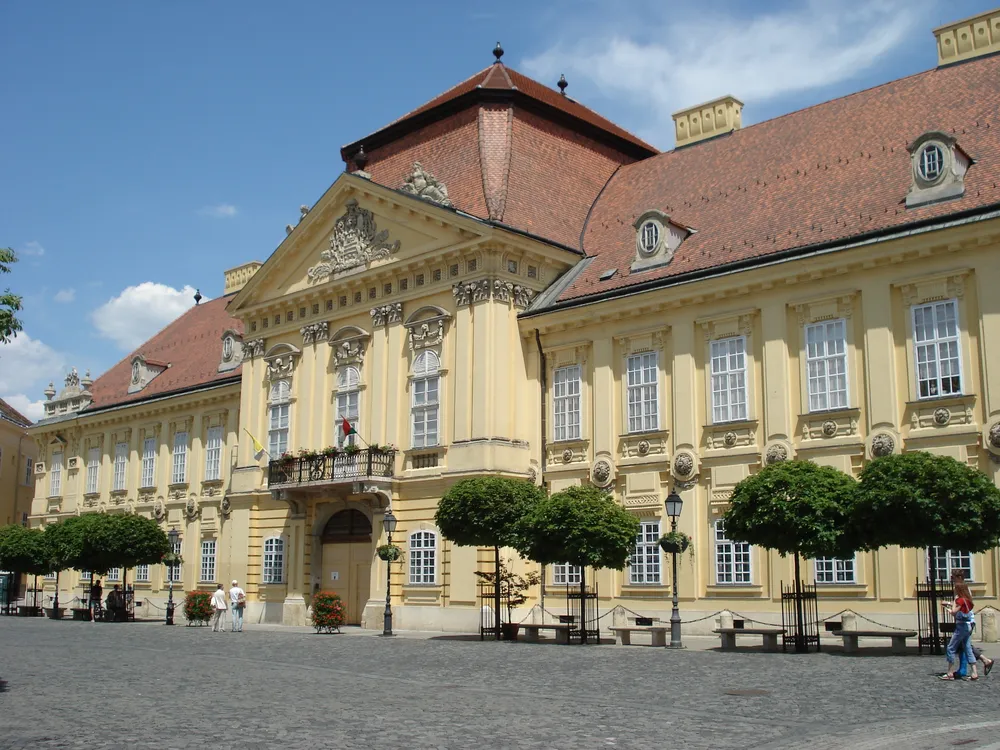
See
Churches
1 St Anna Chapel (Szent Anna kápolna), Arany János utca (next to the Szent István Cathedral). Szent Anna's is one of the few medieval buildings left untouched by the Turks. The church was constructed in 1470 in a Gothic style. 2 Bishops Palace (Püspöki Palota), Városház tér. 5 (Center), ☏ +36 22 510694. This large pile dominates Városház square and but basically made in Baroque style is there are some Cpof element that way this is one of Hungary's most important Copf style buildings. The palace was constructed in 1800-1801 from ruins of the former cathedral in the Ruin Garden exactly made from ruins of the former Holy Mary Provost (Coronation) Church. 3 the Saint István Cathedral (Szent István székesegyház), II. János Pál pápa tér / Arany János utca 9 (Centre), ☏ +36 22 315114, [email protected]. Built in 1235 by King Béla IV, who was later crowned there. Most of what you see today, however, was from after 1777, when the cathedral became the episcopal seat. The interior is baroque in style and the towers were begun at the beginning of the 19th century.
4 Medieval Ruin Garden (Középkori Romkért; the ruins of the Basilica of Our Lady; Nagyboldogasszony-bazilika romjai), Koronázó tér, Várkörút 5. (the ruins can be seen in the middle of Székesfehérvár), ☏ +36 22 315583. A national memorial on Koronázó tér, just east of the main square. In the middle ages this was the site of Hungary's most important church and had it not been for the Turks blowing it up. Here is the ruins of the main church of the medieval Hungary, Here stand the basilica dedicated to the Virgin Mary, it would be to Hungary what Westminster Abbey is to England. The church was begun in 1016 under Hungary's first Christian king, Szent István. At the time, Székesfehérvár was the capital of the kingdom, and this church was the site of numerous coronations. In addition, from 1038 to 1543 fifteen Hungarian kings were put to eternal rest here (starting with Szent István himself and
Do
Football: Fehérvár FC were relegated in 2025 and now play soccer in NB 2, the second tier. Their home ground Sóstói Stadion (capacity 14; 200) is by the lake 1 km southwest of the railway station. American football: Fehérvár Enthroners play in the European League of Football at First Field.
Events Királyi Napok Nemzetközi Néptáncfesztivál Öreghegyi Mulatságok Fehérvári Zenei Napok - FeZeN Musica Regia (Aug) Királyi Borlakoma - Virágálom Pünkösdkor (Pentecost) Kortárs Művészeti Fesztivál (May) Fúvószenekari Koncertek a Zichy ligetben (Aug Sunday evenings) Harmonia Albensis templomi koncertek (Jul) Aranybulla Művészeti Napok (Aug) Fehérvári Vigasságok - Lecsófesztivál (end of Sep) Fehérvári Advent - Karácsonyi Sokadalom (Dec) Bolondballagás (end of Apr)
Buy
Alba Plaza II shopping center (Alba Plaza I bevásárlókö
Overview adapted from Wikipedia, travel guide fromWikivoyage (CC BY-SA). Photography via Wikimedia Commons.