
Split
Croatia · Europe
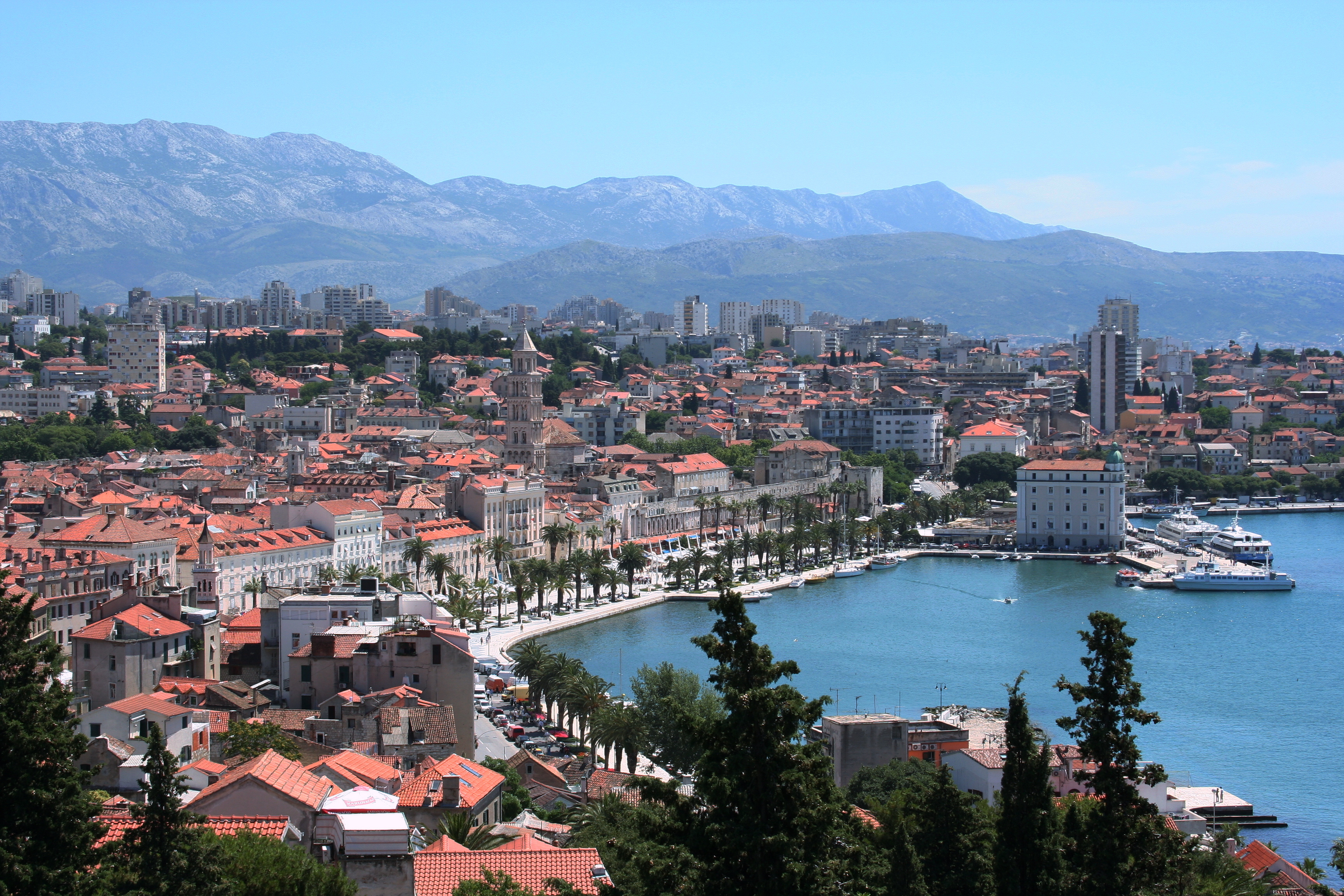
About Split
Split is a city in Central Dalmatia, Croatia, and the seat of the Split-Dalmatia county. The city was built around the Diocletian palace (a palace/fort built for the retired Roman emperor Diocletian) where the locals sought refuge centuries ago.
Wandering the historic centre of Split you can still clearly see the Roman walls, squares, and temples.
Split travel guide
Understand
Because of its ideal climate, with 2,800 hours of sunlight each year, local people have a few nicknames for Split: "The most beautiful city in the world" and "Mediterranean flower". Many famous Croatian sports people were born in Split, so locals often nicknamed their city "The sportiest city in the world". The most popular sport institution is the football club Hajduk. Large portions of the city are painted with the club's colors and logo. This is done by Torcida, the oldest supporters group in Europe, established in 1950. Besides the bell tower of St. Duje, the symbols of city are the Dalmatian dog and a donkey. Locals have a high regard for the donkey because of its past indispensable place in field work and transport across the Dalmatian mountains. Winters in Split are generally mild for Europe, with temperatures above 0 °C (32 °F), but despite the popular saying that the city experiences snowfall once every 30 years, there is actually at least one snowy day nearly every winter, usually in January or early February. If you find yourself in Split on a day with significant snowfall, expect serious traffic disruption. Walking through the historic center in a bikini or shirtless is banned. Municipal wardens can issue on-the-spot fines of €150.
Tourist information 1 TIC Riva (Tourist Information Centre), Obala Hrv. narodnog preporoda 9. (updated Aug 2016) 2 TIC Peristil (Tourist Information Centre), Peristil bb (at a tiny former chapel). (updated Aug 2016) Split city government website
Getting there
By plane 1 Zračna luka Split (Split Airport SPU IATA) (25 km west of Split, 5 km east of Trogir). Most flights are budget and charter airlines bringing in holiday-makers, highly seasonal. Destinations include Amsterdam, Athens, Barcelona, Belgrade, Berlin, Cologne, Copenhagen, Dublin, Düsseldorf, Frankfurt, Geneva, Glasgow, Gothenburg, Hamburg, Hannover, Helsinki, Katowice, Leeds-Bradford, London LCY LGW LHR Luton & Stansted, Lyon, Madrid, Marseille, Milan MXP, Moscow SVO, Munich, Nantes, Naples, Nice, Oslo, Paris CDG & Orly, Prague, Rome FCO, Stockholm ARN, Toulouse, Venice, Vienna, Warsaw and Zürich. There are domestic flights from Dubrovnik, Zagreb, Pula, Rijeka and Osijek. Enter from the large bus park into the ground floor check-in area next to Arrivals. Go to the first floor for departures; it has a cafe and limited seating, but there's a much larger ground-side seating area and cafe on the second floor. From the first floor go through security and you enter seating for domestic Gates 1 & 2, often empty but with no other facilities. For all international flights go through passport control to the open-plan Gates 3-10, with cafes and shops. A coffee costs €2.20 ground-side and €3.50 air-side, which shows what a bargain their "duty-free" prices are. There's free WiFi internet. (updated Sep 2019)
Ground transport To Split: the Airport Shuttle Bus runs at least hourly between the airport and inter-city bus station, taking 30 min. From town it runs 05:00-21:00; into town it runs 07:30-23:00. One-way fare is €8. Bus 37 plies every 20-30 min 04:00-00:00 between Trogir, the airport, and Split's local bus station Sukoišan; it doesn't run to the inter-city station. The bus stops are just outside the airport, walk south out of the parking lot onto the highway Cesta Dr. Franje Tuđmana. The stop on the near side is westbound for Trogir, which takes 10 min, fare €2.5; the opposite-side stop is eastbound via Kaštel Stari and Solin to Split, taking 50 min, fare €3.00.
Getting around
Central Split is quite compact and most sights can be easily seen and best experienced on foot, but there are frequent local buses to outlying attractions and the airport.
By bus Public transport is run by Promet. Most of the city buses in Split are new, but some are very old and dilapidated. You can find routes and schedules from Easyway journey planner. The station for town and local buses is 5 Kolodvor Sukoišan - these don't use the main station 1 km south by the harbour. To transfer between stations use Bus 9 / 10 or just walk. The fare is determined by the number of zones traveled, ranging from €2 for within Split to €4 between Split and Trogir one way. These can be purchased from the driver, at a kiosk, or using the Promet ticket app from a smartphone. (The app is in English and tickets purchased through the app are discounted.) Two-way tickets cost €2.30, but you have to buy them in blocks of 5 or 10 from a kiosk. A one-month ticket is €39. Local buses you might use are Bus 37 to the airport and Trogir described earlier, and Bus 60 to Omiš and Ravnicki Most which runs every 30 min. Long-distance buses from the inter-city station also pass through Omiš en route to Makarska.
By bike Rent a bike and enjoy beautiful biking along Split's waterfront (Riva), continue to Marjan hill (approximately 7 km), climb to the top of the hill for great view on the Split town and surrounding islands. You can bike to the east side, along the coast to nearby village of Stobrec. Another great option from Split is to take a day tour to nearby islands of Solta, Brac, Hvar or Vis. You can take the bike on a regular ferry (they leave approximately every couple of hours in the summer season) and bike along quite roads and charming villages, explore great beaches and restaurants and return in the evening to Split! Older but rideable mountain bikes are available for €2/hour (March 2012) at the northern entrance to Marjan hill (near Mandalinski put).
By boat 3 RAFT Croatia (RAFT
See
Diocletian's Palace UNESCO World Heritage Site The historic centre of Split is built around the remains of this Roman palace. Most probably this one of a kind Imperial Palace was built from 298-305 AD and is one of the most significant original structures of the period mostly because so much of it has been preserved. It is probably the best preserved Roman palace in the world. Later this Palace contributed to the broadening of the town because as the city evolved beyond its walls. You only need to wander around to experience it but you can also pay to visit the excavated remains of the basement of the palace. The palace has well preserved main streets cardo and decumanus. Roman palace is enriched with some Gothic and Reinassance buildings which makes a perfect match. The palace has four monumental gates Porta Aurea (Zlatna vrata, Golden gate), Porta Argenta (Srebrna vrata, Silver gate), Porta Ferrea (Željezna vrata, Iron gate) and Porta Aenea (Mjedena vrata). The unique substructure halls were newly explored and each year more of them are opened to the public. Some have fascinating artefacts on display. May-Oct 10:00-19:00. Nov-Apr, opens at 11:00, duration 90 min. In English language. Starts in front of the tourist info centre, please arrive 15 min before tour is due to commence.
1 Peristylium (Peristil square). Main square of Diocletian's palace with well preserved Roman architecture. 2 Katedrala sv. Duje (St. Duje's cathedral). Built around 305 AD as a m
Overview adapted from Wikipedia, travel guide fromWikivoyage (CC BY-SA)。Photography via Wikimedia Commons.