
Pamukkale
Turkey · Asia
About Pamukkale
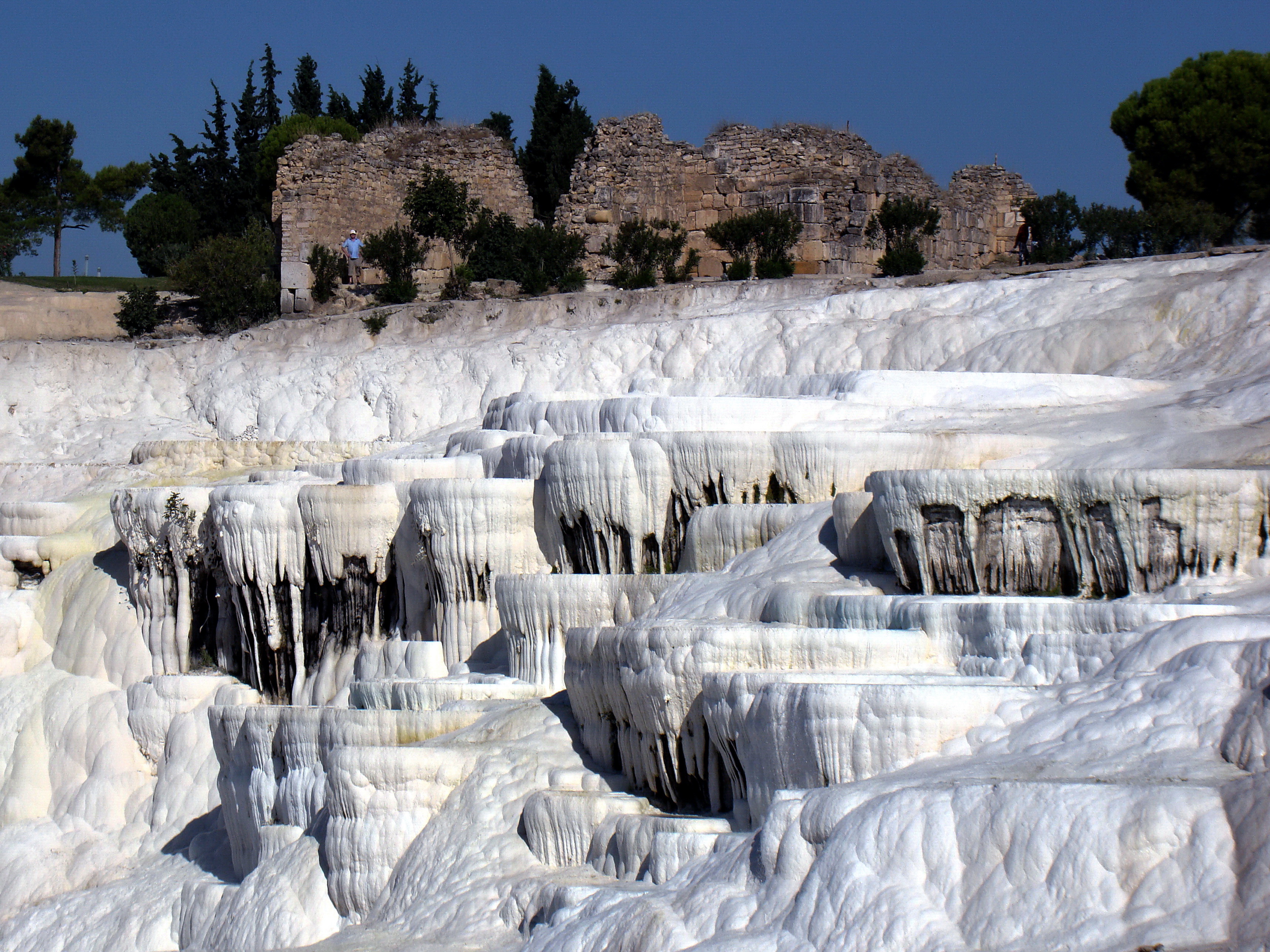
Pamukkale is a village in the Southern Aegean region of Turkey, famous for its hot springs, Roman spa town of Hierapolis, and white terraced pools: the village name means "cotton castle". It is a UNESCO World Heritage Site and one of the country's top sights, mobbed in summer. The nearest town is Denizli, 20 km south.
Pamukkale travel guide
Understand
Carbon dioxide dissolves in water to make it slightly acidic, so it dissolves limestone - calcium carbonate - when it comes into contact. The limestone is re-deposited if the water evaporates or if the carbon dioxide bubbles out, and in karstic caves this creates stalactites and stalagmites. Travertine is created when hot volcanic springs, heavily charged with carbon dioxide from deep in the earth, flow through limestone then emerge at ground level and blow off their gas. Travertine rocks are found in dozens of places and take their name from the Tivoli district of Rome, where of old they were quarried for building material. At Pamukkale the water cascading down the hillside has deposited travertine in spectacular terraces, glistening white and with each terrace lip retaining a shallow pool. Early people were drawn by the scenery, the hot mineral waters, and the mysterious vapours from below, with the earliest known settlement from 7th century BC. The town became Hellenised and known as Hierapolis in the 2nd century BC, with a lively trade in therapeutic use of the waters, and ritual observances at the smelly vent of the Ploutonion. Many Jewish and other peoples settled, and the Romans and Byzantines further embellished the place. The waters and smelly rituals had limited success as therapy, but fortunately there was plenty of room in the huge necropolis. The town however suffered repeated severe earthquakes, and after the quake of 1334 was abandoned. Visitors were few until 1980, so their impact on the place was sustainable, then mass tourism set about wrecking it. Hotels encrusted the plateau above and the valley below, while visitors energetically hacked off bits and crunched the rock terraces beneath their Birkenstocks. Tighter protection came in 1988 when Pamukkale was recognised as a UNESCO World Heritage Site. Most of the terraces were then placed off-limits, and the plateau hotels were removed leaving accommodation in the valley village. Late spring / earl
Getting there
For intercity public transport, travel via Denizli, which has frequent buses from Istanbul, Ankara, Izmir and elsewhere. Tour buses run from all the coast resorts within a 100 km radius. If you are driving you don’t have to go into Denizli, as Pamukkale is 10 minutes drive from a motorway junction. Denizli bus station is downtown, and intercity buses arrive and depart on its upper level. Go downstairs for local buses: the service to Pamukkale runs from Platform 76 every 20 min, taking 20 min, and in 2023 costs 24 TL. 1 Cumhuriyet Meydanı - Republic Square - is where the public bus deposits you. No bus station, it's just a wide section of Turgut Özal Cd, with ticket offices and cafes scattered around.
Getting around
Walk: the main sights are within 15 minutes. From the bus stop walk east along Atatürk Cd and cross the main road for the path to Town Gate entrance to the travertines. Dolmuşes ply to Karahayit and run past North Gate. For South Gate take a taxi - tour buses go there direct.
See
Travertines and Hierapolis are within the same ticketed area. There are three gates and you can enter, buy tickets or exit at any. Entry for adults or children costs 30€ in 2026, and the site is open daily 08:00-20:30 (South Gate from 06:30 in summer). Headphones are automatically added to the price, cost 8€ and cannot be refused: the real price you have to pay is 38€. Beware: The price is stated in euros but if you pay with card, you will be charged in Lira. Make sure you know the conversion beforehand and check the amount before you pay! 1 Town Gate (aka Lower Gate) is convenient if you're staying in town or dropped off there. It leads into a 15-min ascent through a cascade of dazzling travertine pools, where you have to go barefoot and carry your shoes. At the top is the museum, where you join the trail from South Gate. 2 South Gate is the main entrance for motorists, and anyone with restricted mobility may prefer to enter here. From town follow Yeniköy Yolu and the cavalcade of tour buses. From the gate you walk straight into Hierapolis. 3 North Gate is the other car and bus park - dolmuşes to Karahayit pass this way. It is then a wait for a shuttle (old minibus 40tl per person in 2024), pay for a 5 person electric tour cart and driver, or a 2 km walk on a poor trail, slowly descending through the necropolis past a series of tombs and monuments. Gymnasium is the first structure encountered past South Gate. It was built in 60 AD; five columns have been re-erected. These Greek institutions inspired the gymnasium school system of Germany and Denmark. 1 Sunset Spot is a look-out with a grand vista over the travertine terraces, impressive at any time of day if the sun's out. However in winter and in dry spells the pools are dry - there's enough natural piping hot water to keep them flowing, but too many hotel spas have tapped into the source. Pools and terraces fill the scarp below the plateau but are mostly off-limits to protect them. The exception is the cascade fr
Do
Alanı Park is next to Town Gate but is outside the ticketed area. It's a pleasant picnic spot with a view of the travertines and its own pool. There's a cafe terrace, where the geese will bug you for food. Pamukkale Flights waft you over the area by hot air balloon, tandem paraglider or gyrocopter. They pick up from local hotels.
Buy
Pamukkale Market at the bus stop is open daily 11:30-22:00. Cotton and homewares are local produce.
Eat
1 Aliş Restaurant, Memet Akif Ersoy Blv 25, ☏ +90 538 606 7700. Daily 08:00-22:00. Excellent open-air restaurant at the foot of town, with trad Turkish fare and views across the valley. (updated Oct 2023) 2 Kayaç Wine House, Atatürk Cd 3, ☏ +90 534 561 1080. Daily 10:45-00:00. Very central so it's popular, but the food is only so-so. (updated Oct 2023) Kale Hotel at Atatürk Cd 16 gets dismal reviews for its restaurant and its rooms. Seven Spices, Turgut Özal Cd 24 (100 m south of Kayaç Wine House), ☏ +90 544 204 2048. Daily 11:30-22:30. Occasional lapses, and it's not the cheapest, but most customers reckon this is quality authentic Indian food. (updated Oct 2023) 3 Mehmet's Heaven, Atatürk Cd, ☏ +90 258 272 2643. Daily 08:00-00:00. Friendly restaurant with good Turkish food. (updated Oct 2023) Gürme Restaurant, Memet Akif Ersoy Blv, ☏ +90 545 769 0020. Daily 08:30-23:00. Mostly good reviews for this trad place by the lane up to Town Gate entrance to the travertines. (updated Oct 2023)
Drink & nightlife
No free-standing pubs, the cafes and restaurants serve beer (usually Efes or Tuborg), wine, and rakı the anise-like spirit. Ayran is a salty yogurt drink similar to lassi. Pamukkale is a wine-producing region, mostly fruity reds such as Shiraz. Turkey doesn't have geographical denominations as in western countries.
Sleep
Artemis Yoruk Hotel, Atatürk Cd 2, ☏ +90 552 841 8420, [email protected]. Simple hotel opposite the bus stop with a pool, garden, and rooftop restaurant. Clean rooms with en-suite, TV and air-con. B&B double 800 TL. (updated Oct 2023) 1 Melrose House, Vali
Overview adapted from Wikipedia, travel guide fromWikivoyage (CC BY-SA). Photography via Wikimedia Commons.