
Ani
Turkey · Asia
About
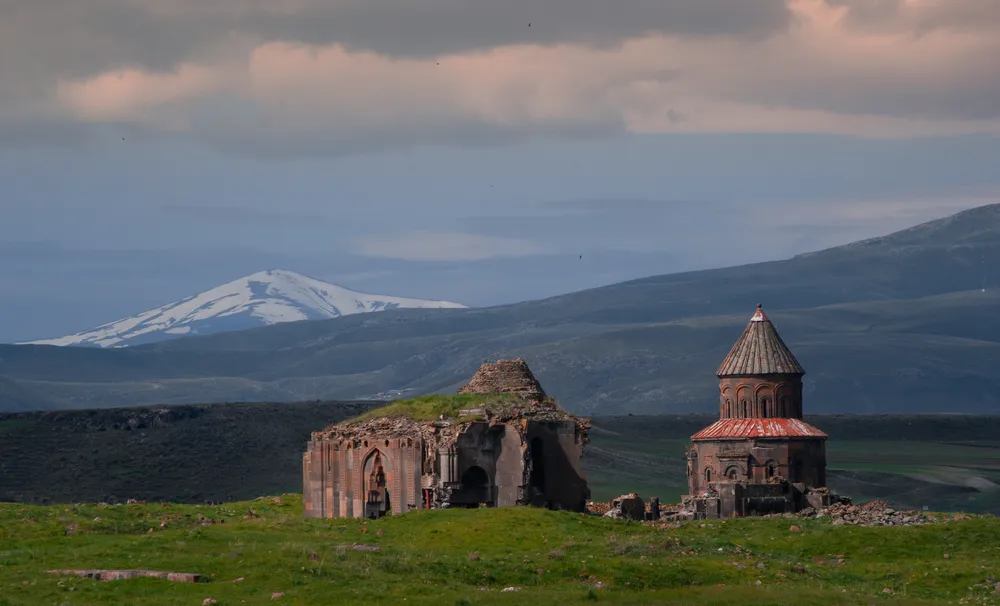
Ani (Armenian: Անի) is a ruined medieval Armenian city now situated in Turkey's province of Kars, next to the closed border with Armenia. Between 961 and 1045, it was the capital of the Bagratuni Armenian kingdom that covered much of present-day Armenia and eastern Turkey. The iconic city was often referred to as the "City of 1,001 Churches," though the number was significantly less. To date, 50 churches, 33 cave chapels and 20 chapels have been excavated by archaeologists and historians. Ani stood on various trade routes and its many religious buildings, palaces, and sophisticated fortifications distinguished it from other contemporary urban centers in the Armenian kingdom. Among its most notable buildings was the Cathedral of Ani, which is associated with early examples of Gothic architecture and that scholars argue influenced the great cathedrals of Europe in the early gothic and Romanesque styles; its ribbed vaulting would not be seen in European cathedrals for at least another two centuries. At its height, Ani was one of the world's largest cities, with a population of perhaps 100,000, though given its limited area historians have cast doubt at this estimate. Renowned for its splendor, Ani was sacked by the Mongols in 1236. Ani never recovered from a devastating 1319 earthquake and, more significantly, from the shifting of regional trade routes, and was abandoned by the 17th century. Ani is a widely recognized cultural, religious, and national heritage symbol for Armenians. According to Razmik Panossian, Ani is one of the most visible and 'tangible' symbols of past Armenian greatness and hence a source of pride. In 2016, it was added onto the UNESCO World Heritage List. After two decades of continuous international efforts, Ani Archaeological Site has transformed from a seat of conflict and geopolitical instability to a center of cultural tourism that might foster cultural exchange and deepening historical understanding.
The city took its name from the Armenian fortress-city and pre-Christian religious center of Ani-Kamakh located in the region of Daranaghi in Upper Armenia. Ani was also previously known as Khnamk, although historians are uncertain as to why it was called so; according to philologist and Armenologist Heinrich Hübschmann, this name has nothing to do with the ordinary Armenian verb khnamel ("to care for"). According to the second edition of the Encyclopedia of Islam: "A suggestion has been made that the town may owe its name to a temple of the Iranian goddess Anāhita (the Greek Anaďtis)". The Turkish government previously attempted to obscure the name of the town as Anı in order to give it a "more Turkish character".
The city is located on a triangular site, visually dramatic and naturally defensive, protected on its eastern side by the ravine of the Akhurian River and on its western side by the Bostanlar, or Tsaghkotsadzor, valley. The Akhurian is a branch of the Araks River and forms part of the currently closed border between Turkey and Armenia. The site is at an elevation of around 1,340 meters (4,400 ft). The site is located in the Turkish province of Kars. Kars is currently an important center for local livestock trades and cheese production. It is linked by railroad with many important Turkish cities and is also considered to be an important military site due to its position near Turkey's border with Armenia. Ani is about 400 m (1,300 ft) from the Turkey-Armenia border. Across the border is the Armenian village of Kharkov, part of Shirak Province.
Armenian chroniclers such as Yeghishe and Ghazar Parpetsi first mentioned Ani in the 5th century. They described it as a strong fortress built on a hilltop and a possession of the Armenian Kamsarakan dynasty.
Adapted from Wikipedia (CC BY-SA). Photography via Wikimedia Commons.