
Montserrat
Spain · Europe
About Montserrat
For the Caribbean island, see Montserrat.
Montserrat is a multi-peaked mountain in Catalonia and part of the Montserrat Natural Park. Santa Maria de Montserrat monastery situated high up in the unusual rock mountain is very popular among Catalans, and Catholic pilgrims come from far and wide to see the Black Madonna. Is a stage in the Catalan Way of St. James
Montserrat travel guide
Understand
The monastery is Catalonia's most important religious retreat and groups of young people from Barcelona and all over Catalonia make overnight hikes at least once in their lives to watch the sunrise from the heights of Montserrat. At 1,236 m above the valley floor (Sant Jeroni summit), Montserrat is the highest point of the Catalan lowlands, and stands central to the most populated part of Catalonia. The stone monolith is ideally located to play an important role in the cultural and spiritual life of Catalonia. However, don't expect a tranquil and enlightening experience at the top; the monastery is surrounded by many touristy boutiques, shops, stands and restaurants.
Getting there
Montserrat is about 48 km away from Barcelona, and is easily accessible by train, car and bus. For distances and transport options from Barcelona: Montserrat from Barcelona - Distance & Transport Guide. Most public transit options will take you to the Montserrat-Aeri or Monistrol de Montserrat terminals at the foot of the mountains, where you transfer to cable car or rack railway to reach Montserrat and its monastery, high up in the mountains.
By train If you plan to take the train from Barcelona, decide before you leave Barcelona whether you will take the cable car (from Montserrat-Aeri) or rack railway (from Monistrol de Montserrat) for the second stage of the journey because they leave from different train stops and tickets are either including the cable car or the rack railway (return ticket €25.80). You can buy a combined, round trip ticket for both the train and either the cable car or the rack railway when you depart from Barcelona, at a discount from buying individual tickets for each segment of the journey. Travelling from Barcelona, take FGC (R5 Line) train from Plaça d'Espanya to Montserrat-Aeri (or Monistrol de Montserrat respectively). Trains run every hour and travel time for the R5 is around 60 min each way. There are combined tickets available for train and rack railway or cable car, see website below. The combined tickets can be bought from the vending machines at the train station, or at the booth located right in front of the access gates to the trains. Buying from the booth is recommended as you'll also be given a brochure with an overview of the surroundings of the monastery and train timetables, and the machines sometimes have trouble with foreign credit cards. It’s also possible to buy a voucher for a ticket through the website, which can be exchanged at the railway station.
1 Aeri de Montserrat railway station (Estación de Aeri de Montserrat). (updated Apr 2021) 2 Monistrol de Montserrat railway station (Estación de Monistrol de Montser
Getting around
On foot Most of the Montserrat monastery complex is explorable on foot.
By funicular 5 Funicular de la Santa Cova. If visiting the Santa Cova, there is a funicular which copes with the steepest part, although its lower stop is a bit far away from the Santa Cova itself. It is very useful on the way back as it's uphill. 4.10€ (one-way), 6.30€ (return). (updated Oct 2024) 6 Funicular de Sant Joan. 10:00 until 18:30. This funicular connects the monastery and an upper viewing point. The upper viewing point is at the junction of three hiking trails: they connect to the monastery, to the hermitage of Santa Magdalena, and to the Sant Jeroni summit. 10,70€ (one-way) 16.50€ (return). (updated Oct 2024)
See
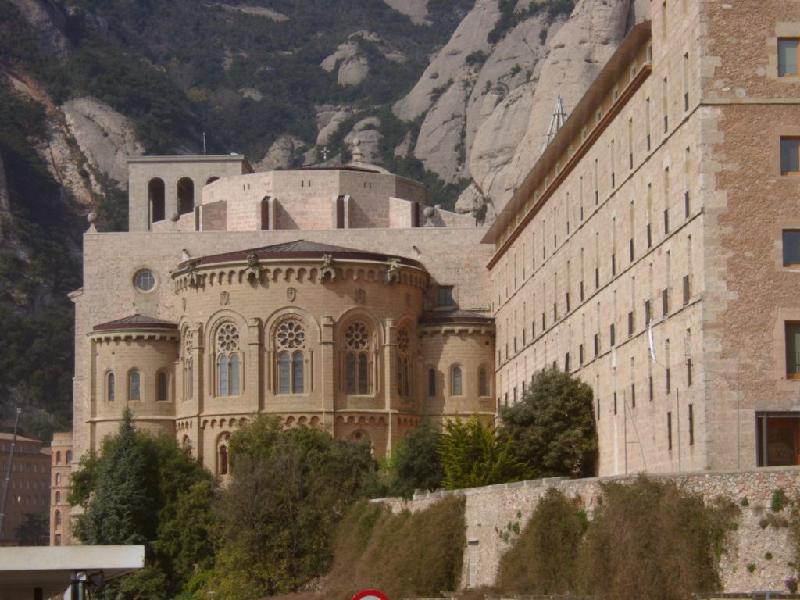
Monastery and the Black Virgin of Montserrat Santa Maria de Montserrat is a Benedictine abbey which hosts the Virgin of Montserrat, and the Publicacions de l'Abadia de Montserrat, a publishing house, the oldest press in the world, still running, with the first book published in 1499.
1 Basilica. 07:30-20:00. Construction on the basilica of Montserrat began in the 16th century, and Pope Leo XIII granted it the status of minor basilica in 1881. Its current façade, however, dates back to the middle of the 20th century, and includes a representation of the monks who died during the Spanish Civil War. The basilica is open daily from 07:30 to 20:00, but keep in mind mass is held several times throughout the day. (updated Jul 2019) 2 Virgin of Montserrat (La Moreneta). 08:00-10:30 and 12:00-18:15 all year, also 19:15-20:00 Jul 15-Sep 30. A statue of the Virgin Mary and infant Christ, and one of the two patron saints of Catalonia. She is popularly known in Catalan as La Moreneta, meaning “the little dark one”, due to the darkness of her skin. Believed by some to have been carved in Jerusalem in the early days of the Church, it is more likely a Romanesque sculpture in wood from the late 12th century. It can be seen inside of the basilica. For the full story and visiting tips: Black Madonna of Montserrat - Complete Guide. (updated Jun 2026) 3 Escolania choir. Salve: M-F 13:00, Su 12:00; Vespers: M-Th Su 18:45. A boys’ choir, one of the oldest in Europe, which performs during religious ceremonies in the basilica: you can attend either the midday Salve and Virolai, or the evening Vespers. Times may vary due to religious celebrations and school holidays; so do check the daily calendar on the choir’s website. Expect large crowds, especially for the midday Salve, which is the most visited daily act at the monastery. The choir may be accompanied, as required by the repertory, by the Montserrat Chapel Choir, composed of old choirboys, and the monks of the Ministry Chapel Choir. (
Do
There are four main hiking trails that can be done around the monastery. These lead to the hermitage of Santa Magdalena, and to Sant Jeroni, the highest point of Montserrat. At an altitude of 1,237 m, almost all of Catalonia can be seen from Sant Jeroni, and on a clear day, the island of Majorca is visible. The trails are well marked with signs along the way, but you may still want to pick up a map at the tourist information office first. At the upper station of the Funicular de Sant Joan, there’s a sign with a map, listing the four trails as:
Trail 1 (Camí nou de Sant Jeroni; "New Trail of Saint Jerome") connects the upper station of the Funicular de Sant Joan and Sant Jeroni, the summit. The trail also passes two other viewing points, and the chapel of Sant Jeroni. A return trip takes about 2 hours. Trail 2 (Camí vell de Sant Jeroni; "Old Trail of Saint Jerome") connects the monastery and the summit, with a side trail (not shown on some official maps) to the funicular station. It can be used as an alternative route to, or back down from, the Sant Jeroni summit. It also passes by the hermitage of Santa Anna and the chapel of Sant Bennet. Note that compared to the first trail, the second trail covers a bigger height difference in a shorter distance; there are some steep steps along the way. It takes about an hour in one direction. Trail 3 (Camí de Sant Miquel; "Trail of Saint Michael") connects the upper and lower stations of the Funicular de Sant Joan. It’s used as a driving route by staff, so it can be easily walked, which takes about 40 minutes. Trail 3a connects the upper station of the
Overview adapted from Wikipedia, travel guide fromWikivoyage (CC BY-SA). Photography via Wikimedia Commons.