
Monschau
Germany · Europe
About Monschau
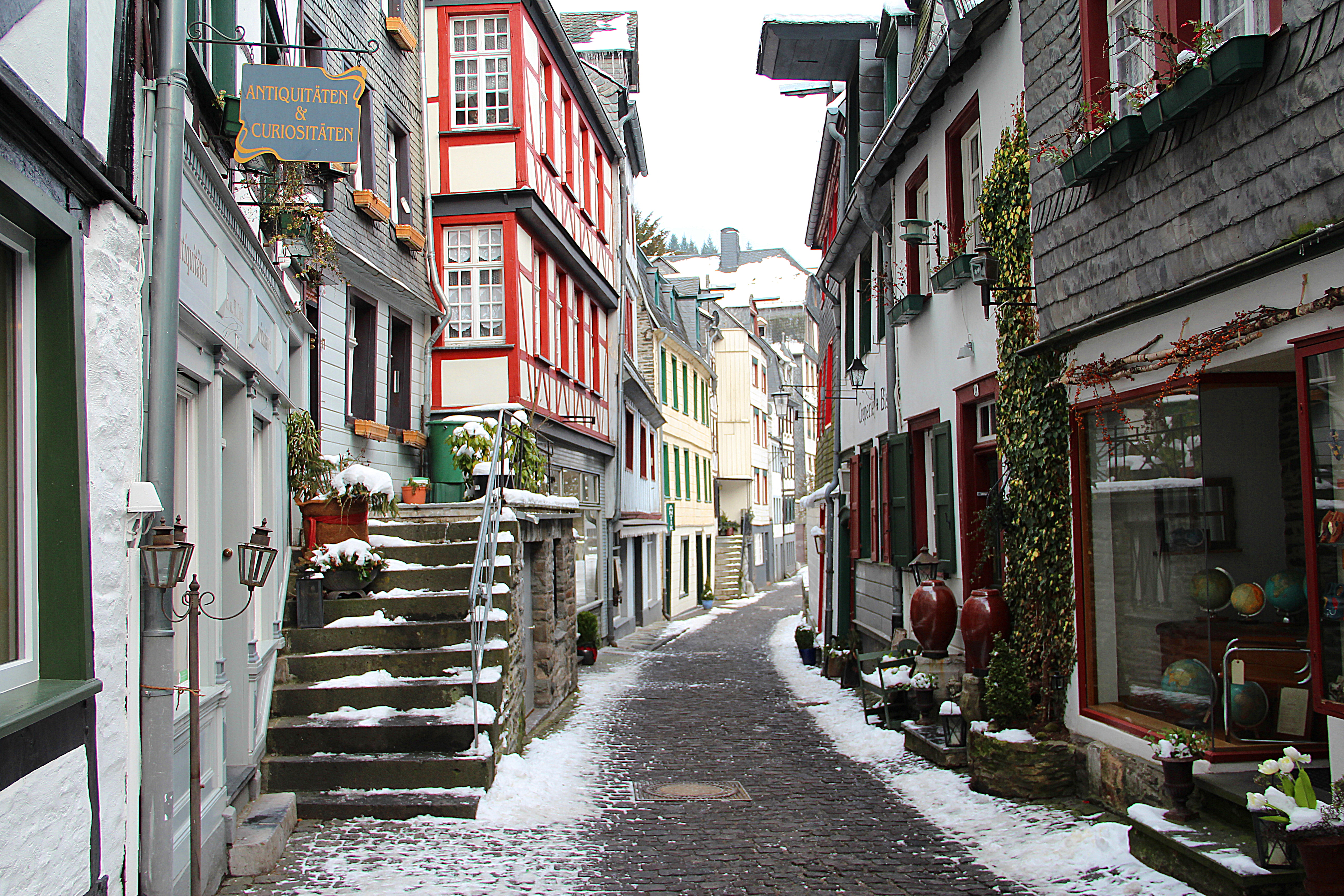
Monschau, sometimes called the "Pearl of the Eifel", is a small, historic town in the German Eifel. Largely unchanged for over 300 years, the narrow, cobblestoned streets and traditional half-timbered houses have made this charming place one of the main tourist attractions of the region. Set in the beautiful landscapes of the Eifel region, at a stones-throw from the Eifel National Park, it makes an excellent base for hikers and cyclists. While popular in summer, it only becomes truly overrun for its famous Christmas market in winter.
Monschau travel guide
Understand
The historic heritage that makes Monschau the main tourist destination in the Eifel today, is largely due to its former fame as a centre for textile production. As early as the 12th century it was one of the primary towns of the region. City rights were obtained in 1352, but the town really flourished in the 18th century, when some 6000 textile workers alone were employed in Monschau. As the textile industry diminished in the 19-hundreds, tourism grew and became the main source of income. Nowadays, Monschau has about 12,000 permanent residents (2020). However, with over 170,000 hotel night bookings and 2 million day trip visitors per year, it remains the urban centre of the Eifel region.
1 Monschau Touristik GmbH, Stadtstraße 16, ☏ +49 24728048-0. Daily 10:00-17:00. The towns tourist information office is easy to find and has a selection of good hiking and cycling maps (from €5), simple leaflets with the so-called Roten Faden city walk along the main sights (€0.50) and a simple free town map. The friendly staff speaks English and is also happy to help with bookings or hotels or the wide range or guided tours, and can assist with general information or other questions you might have. (updated Jul 2015) Many of the hotels, shops and restaurants here are small family businesses which may not accept foreign credit cards. Fortunately, there might be two ATMs available in the town centre. You might find them at the bank offices of: Sparkasse, Laufenstraße 42. (updated Nov 2015) and Raiffeisenbank, Stadtstraße 1. (updated Nov 2015) Take this information with a grain of salt, ATMs in this region get blown up quite often and the Banks aren't as quick to respond with new ones. In Rotegen and Simmerath, there are both Raiffeisenbank and Sparkasse Bank branches.
Getting there
The city centre itself is a low-traffic area, but Monschau is easily reachable from nearby cities like Aachen and Cologne, as well as from Belgium. There is no train station in Monschau. Your best rail option is to get to Aachen. There are some direct buses available from the main bus terminal Aachen Haubtbahnhof as well as from Aachen Rote Erde. Alternatively, from the Belgian side, you can get as far as Eupen by rail on weekends, from where you'll need to catch the TEC bus that runs every two hours.
By car Driving is a common way to get in. In peak season, and especially during the Christmas market, parking spots can get very scarce and taking a bus might be a better idea. The Bundesstraße 258 connects the town north with nearby Roetgen and on to Aachen (45 min), as well as with Schleiden in the south-east. From Cologne it's about a 90 minute drive via the L246 or via Aachen. From the Belgian city of Liège, it's less than an hour by car via the E40 and (taking exit 38 for Eupen) on via the N67, which leads to Monschau through the High Fens Natural Park. From the directions of Luxembourg or Trier, the E42 will get you as far as Prüm, where you exit onto the B265 to Schleiden and again on to the 258 from there.
By bus From Aachen Bushof and Aachen Rote Erde station, AVV line SB66 runs every half-hour on weekdays and every hour in weekends and holidays. The bus heads in direction Monschau Altstadt (Old Town) and takes about 70 minutes to get there. From the main train station of Aachen, Aachen Haubtbahnhof, first take AVV line SB63 towards Simmerath/Vogelsang/Gemünd and change to line SB66 at Station Roetgen Post. This connection runs Parallel to the SB66. On Saturdays and Sundays, bus 385 takes you from Eupen train station to Monschau centre and back in 25 minutes.
By bike The former railway line Vennbahn was converted into a bike trail in 2013 and connects Monschau with Aachen, Trier and the country of Luxembourg. While it is rather flat (no more than 3%
Getting around
The town is small and its lovely narrow streets are best explored on foot. Most of the main sights, shops and restaurant are situated around the river side, but for some areas you should count on fairly strong elevation. Also for those using walking aids, the cobblestoned streets may be less than ideal, especially when wet or frozen. Cycling is another option, but again, if you don't mind the rattling over the cobblestones. Alternatively, there's a bright yellow and green Stadtbahn or city-train (which is only made to look like a train and does not in fact run on rails) for tourists which slowly makes its way along the main sights in the old town. The tour takes about half an hour, and the train departs every 45 minutes starting from 09:45 in high season or 11:15 in low season. You can get on at the Burgau parking lot or at the central market square. While slightly overpriced at €6.50/€2 for adults/children, it may prove a fun way to get around.
See
The ancient atmosphere of the town, with its countless traditional houses and cobblestoned streets, and its setting in the lush green surroundings, is Monschau's main attraction. Over 300 buildings are listed as monuments.
1 Red House (Rotes Haus), Laufenstr. 10, ☏ +49 24725071. In the heart of town, named after the pronounced colour of its façade, this is one of the most noticeable buildings. This 1756 mansion was owned by Johan Heinrich Scheibler, one of the most prominent cloth producers and traders in town. His famous 18th century fabrics found their way to the courts of the French king and the Turkish sultan. The mansion is now a museum, boasting a full historic interior with all the grand features of the Rococo / Louis XV style that marked the wealth of its former proprietor. Of particular interest is the three story open-newel spiral staircase, decorated with wood carvings depicting all the main steps in the cloth production. Two surviving original cloth sample books showcase the huge collection of cloths designed and produced here. Guided tours start every hour. €2.50. (updated Jul 2015) 2 Burg Monschau (Monschau castle). The old castle overlooking town originates in the 13th century but was attacked and seized by Emperor Charles V in the 16th century. The castle fell into ruins after private owners had the roofs removed in 1836/37, in order to avoid property taxes. At the turn of the 20th century, the province initiated an effort the save the historic building from complete destruction. Since the 1970s, it houses the local youth hostel and serves as the stage for concerts in summer. Unfortunately, as it is in use by the hostel, it's not open for the general public. (updated Jul 2015) 3 Mustard mill, Laufenstr. 116-124. Mustard remains a typical produce of Monschau, and in the old mustard mill the traditional recipe is still being made. When it was installed in 1882, the mill relied on a waterwheel. Today, it's driven with electricity. The small shop sells
Do
Situated inside the Eifel National Park, the town makes a great base to explore the rugged Eifel landscapes. Hiking and biking is very popular, with countless paths available and plenty of marked and unmarked routes to follow. While you should always wea
Overview adapted from Wikipedia, travel guide fromWikivoyage (CC BY-SA). Photography via Wikimedia Commons.