
Aachen Cathedral
Germany · Europe
About
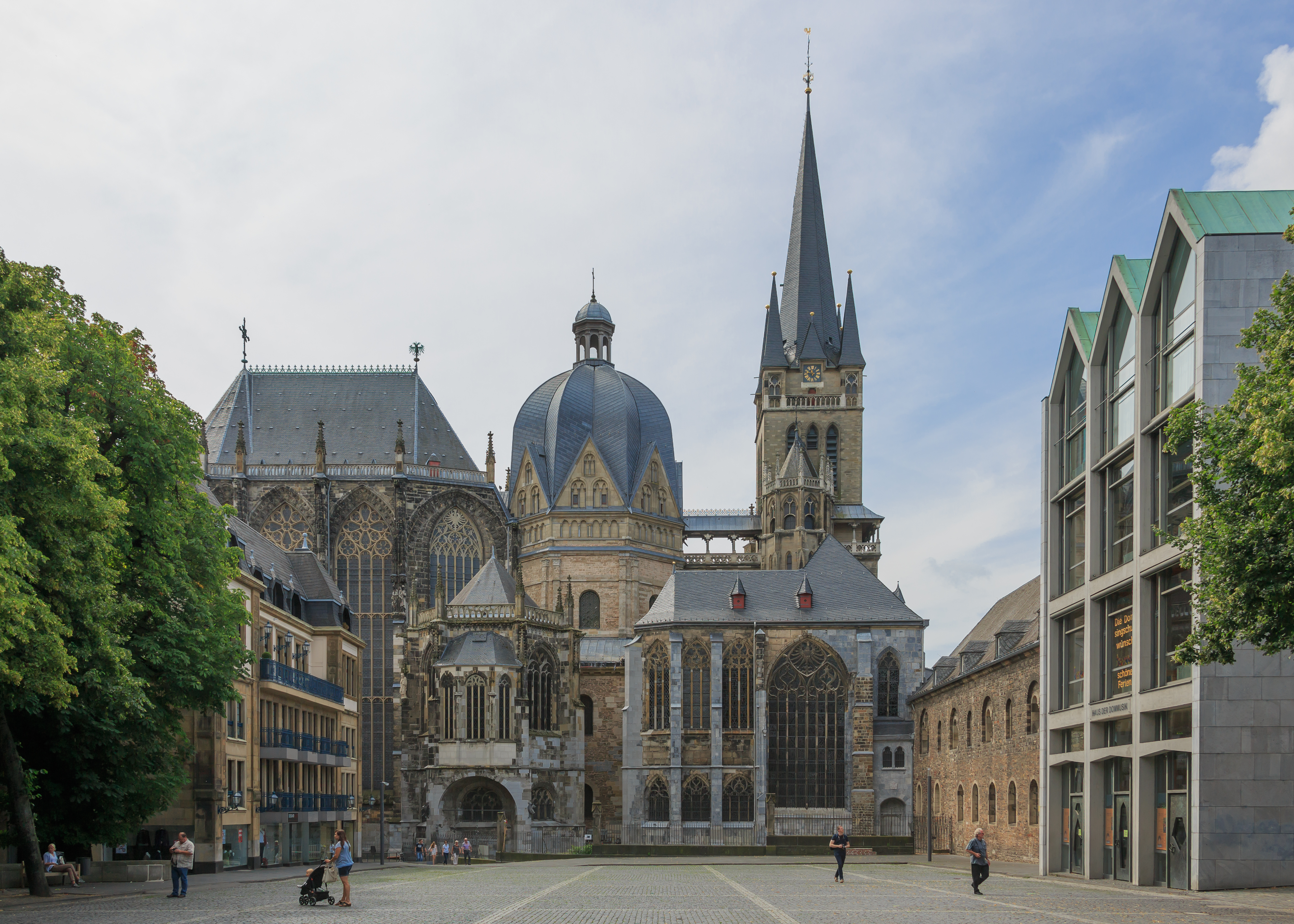
Aachen Cathedral (German: Aachener Dom) is a Catholic church in Aachen, Germany, and the cathedral of the Diocese of Aachen. One of the oldest cathedral buildings in Europe, it was constructed as the royal chapel of the Palace of Aachen of Emperor Charlemagne, who was buried there in 814. From 936 to 1531, the original Palatine Chapel saw the coronation of thirty-one German kings. Later, much expanded, it was a minster and collegiate church, becoming a cathedral briefly from 1803 to 1825, and again in 1930 when the Diocese of Aachen was revived. In 1978, Aachen Cathedral was one of the first 12 sites to be listed on the UNESCO list of World Heritage Sites, because of its exceptional artistry, architecture, and central importance in the history of the Holy Roman Empire. The cathedral mostly uses two distinct architectural styles. First, the core of the cathedral is the Carolingian-Romanesque Palatine Chapel, which was modeled after the Basilica of San Vitale at Ravenna and is notably small in comparison to the later additions. Secondly, the choir was constructed in the Gothic style. There are portions that show Ottonian style, such as the area around the throne, and some areas were not completed until the 19th century, in revivalist styles.
Charlemagne began the construction of the Palatine Chapel around 796, along with the rest of the palace structures. The construction is credited to Odo of Metz. The exact date of completion is unclear; however, a letter from Alcuin, in 798, states that it was nearing completion, and in 805, Pope Leo III consecrated the finished chapel. A foundry was brought to Aachen near the end of the 8th century and was utilized to cast multiple bronze pieces, from doors and the railings, to the horse and bear statues. Charlemagne was buried in the chapel in 814. It suffered a large amount of damage in a Viking raid in 881, and was restored in 983. Following Charlemagne's canonization by Antipope Paschal III in 1165, the chapel became a draw for pilgrims. Due to the enormous flow of pilgrims, in 1355 a Gothic choir hall was added, and a two-part Capella vitrea (glass chapel) was consecrated on the 600th anniversary of Charlemagne's death. A cupola, several other chapels, and a steeple were also constructed at later dates. It was restored again in 1881, when the Baroque stucco was removed.
During World War II, Aachen, including its famed cathedral, was heavily damaged by Allied bombing attacks and artillery fire, and the subsequent ground fighting when U.S. troops attacked the city, but the cathedral's basic structure survived. Many of the cathedral's artistic objects had been removed to secure storage during the war, and some which could not be moved were protected within the church itself. However, the glazing of the 14th-century choir hall, the Gothic Revival altar, a large part of the cloister, and the Holiness Chapel (Heiligtumskapelle) were irretrievably destroyed. Reconstruction and restoration took place intermittently over more than 30 years, and cost an estimated €40 million.
The octagon in the centre of the cathedral was erected as the chapel of the Palace of Aachen between 796 and 805 on the model of other contemporary Byzantine buildings (e.g. the Basilica of San Vitale in Ravenna and the Little Hagia Sophia in Constantinople). The architect was Odo of Metz, and the original design was of a domed octagonal inner room enveloped by a 16 sided outer wall. The span and height of Charlemagne's Palatine chapel was unsurpassed north of the Alps for over two hundred years. The Palatine chapel consisted of a high octagonal room with a two-story circuit below. The inner octagon, with a diameter of 14.46 metres (47.4 ft), is made up of strong piers, on which an octagonal cloister vault lies, covering the central room. Around this inner octagon is a sixteen sided circuit of low groin vaults, supporting a high gallery above. This upper story was known as the Hochmünster (high church). The arched openings of the lower story are only about half as high as those of the Hochmünster, as a result of which the lower story looks stocky and bulky. The two floors are separated from each other by an expansive cornice. The high altar and Imperial throne are located on the upper circuit of the Palatine chapel in an octagonal side room, covered by a barrel vault lying on an angle. This area was connected to the palace by a passage. Above the arches of the gallery, an octagonal drum with window openings rises, on top of which is the cupola. On the east end was a small apse that protruded and was, in later years, replaced by the choir. Opposite of this, was the tiered entrance to the rest of the now defunct palace, Westwork. Light is brought in by a three tiered system of circular arched windows. The corners of the octagonal dome are joined with the walls with a system of paired pilasters with corinthian capitals. The upper gallery openings are divided by a grid of columns. These columns are ancient and come from St. Gereon in Cologne. Charlemagne allowed further spolia to be brought to Aachen from Rome and Ravenna at the end of the 8th century. In 1794, during the French occupation of the Rheinland, they were removed to Paris, but in 1815 up to half the pieces remaining in the Louvre were brought back to Aachen. In the 1840s they were restored to their original places once more and new columns of Odenberg granite were substituted for the missing columns. The interior walls were initially lined with a marble facade. The round arched openings in the upper floor in the side walls of the octagon, between the columns, in front of a mezzanine, are decorated with a metre-high railing of Carolingian bronze rails. These bronze rails were cast 1200 years ago in a single piece according to Roman models. The original cupola mosaic was probably executed around 800 and known from Medieval sources depicted Christ as the triumphant Lord of the world, surrounded by the symbols of the Four Evangelists, with the twenty-four elders from the Apocalypse of John offering their crowns to him. In 1880–81 it was recreated by the Venetian workshop of Antonio Salviati, according to the plans of the Belgian architect Jean-Baptiste de Béthune. The dome was intricately decorated with a mosaic tile. The exterior walls of the Carolingian octagon, made of quarry stone, are largely unjointed and lack further ornamentation. The only exception is that the projections of the pillars of the cupola are crowned by antique capitals. Above the Carolingian masonry, there is a Romanesque series of arches above a late Roman gable. The Octagon is crowned by unusual baroque vents. Aachen Cathedral was plastered red in the time of Charlemagne, according to the most recent findings of the Rheinish Office for Monuments. This plaster was made longer-lasting through the addition of crushed red brick. The colour was probably also a reference to the imperial associations of the work.
Adapted from Wikipedia (CC BY-SA). Photography via Wikimedia Commons.