
Lucerne
Switzerland · Europe
About Lucerne
Lucerne (Luzern in German, Lozärn in Swiss-German) is a beautiful small city which sits on the shores of Lake Lucerne in the heartland of Switzerland. Lucerne is a popular destination for the city itself and the accessible outings around the lake and local Alps that it offers.
Lucerne travel guide
Understand
The first city to join the Swiss Confederation, today Lucerne is a lovely city of 80,000 people with a thriving tourism industry, owing mainly to its status as a gateway to Central Switzerland. The city is a centre of Swiss history and legend: it's across the lake from Altdorf, where legend has it William Tell shot an apple off of his son's head. Tourism in Lucerne has a distinguished history dating from the mid-19th century, with Mark Twain among them. In A Tramp Abroad he recalls the nascent souvenir business, and other budding examples of the tourism trade.
"The commerce of Lucerne consists mainly in gimcrackery of the souvenir sort; the shops are packed with Alpine crystals, photographs of scenery, and wooden and ivory carvings. I will not conceal the fact that miniature figures of the Lion of Lucerne are to be had in them. Millions of them." — Mark Twain
Climate Lucerne has cold, dry winters and warm/hot summers.
Tourist information Lucerne Tourism website
Getting there
By train Thanks to its central location 1 Lucerne railway station (Bahnhof Luzern) can be reached easily from nearly every other city in Switzerland using the Swiss Federal Railways (SBB CFF FFS)). There are hourly trains from Olten and Zürich Airport and half-hourly trains from Zürich, and a direct train every hour from Bern. There is an hourly service from Bellinzona in Ticino, and Pfäffikon and St. Gallen in the North East. The "Zentralbahn" branch of the Swiss Federal Railways also provides hourly trains between Interlaken and Lucerne during daytime.
By bus There are no intercity buses in Switzerland as the train system provides ample connections to many destinations in Switzerland. To make trips to the countryside in the mountains where there are no trains, refer to postauto.ch buses are available from some nearby places, such as Rotkreuz.
By boat Lucerne sits at the northwest end of Lake Lucerne (Vierwaldstättersee), one of the most beautiful waterways in Switzerland. Schifffahrtsgesellschaft Vierwaldstättersee operates roughly hourly scheduled ferries to Schwyz, Flüelen, Weggis (for Rigi), and runs various themed dinner cruises etc all year around.
Getting around
Able-bodied travellers will find Lucerne a complete joy to get around in on foot. The Old-Town is rather small, and most other interesting sites are within 20 minutes or so walk, there is also a city bus system, as well as assistance for disabled visitors on request from Mobility International Switzerland. The Lido beach and the Swiss Transport Museum are a bit further out but can be reached with a lakeside walk in 30-40 minutes, otherwise they can be reached by bus or by one of several boats per hour from just in front of the central railway station. Visitors staying overnight in Lucerne get a Visitor Card which gives free bus and train travel in Zone 10 for the duration of their stay. All of the points of interest in Lucerne including the Transport Museum and lower cable-car station for Pilatus are within this zone. Lucerne also makes a very good base for discovering the rest of Central Switzerland, using the Swiss Federal Railway, the Schifffahrtsgesellschaft Vierwaldstättersee, or any one of several private rail or boat companies. Visitors using Lucerne as a base to explore the region might consider the Tell Pass which covers a large number of trains, buses, boats, and cable-cars in the region around Lucerne. Bicycles are available for rent at the central railway station, at ticket window 21 on the lower level. For Fr. 31 per day, you can rent a 24-speed, sturdily-built bike with a baggage clamp. Electric bikes are also available. Bike pick-up and drop-off are around the left side of the train station, at a kiosk across the street from the Swiss Post building. Bike lanes are present on most secondary streets, and Lucerne drivers are generally aware of and polite towards bicyclists.
By bus Lucerne has an efficient bus network: Verkehrsbetriebe Luzern (VBL) (German only). It covers the city and its suburbs.
See
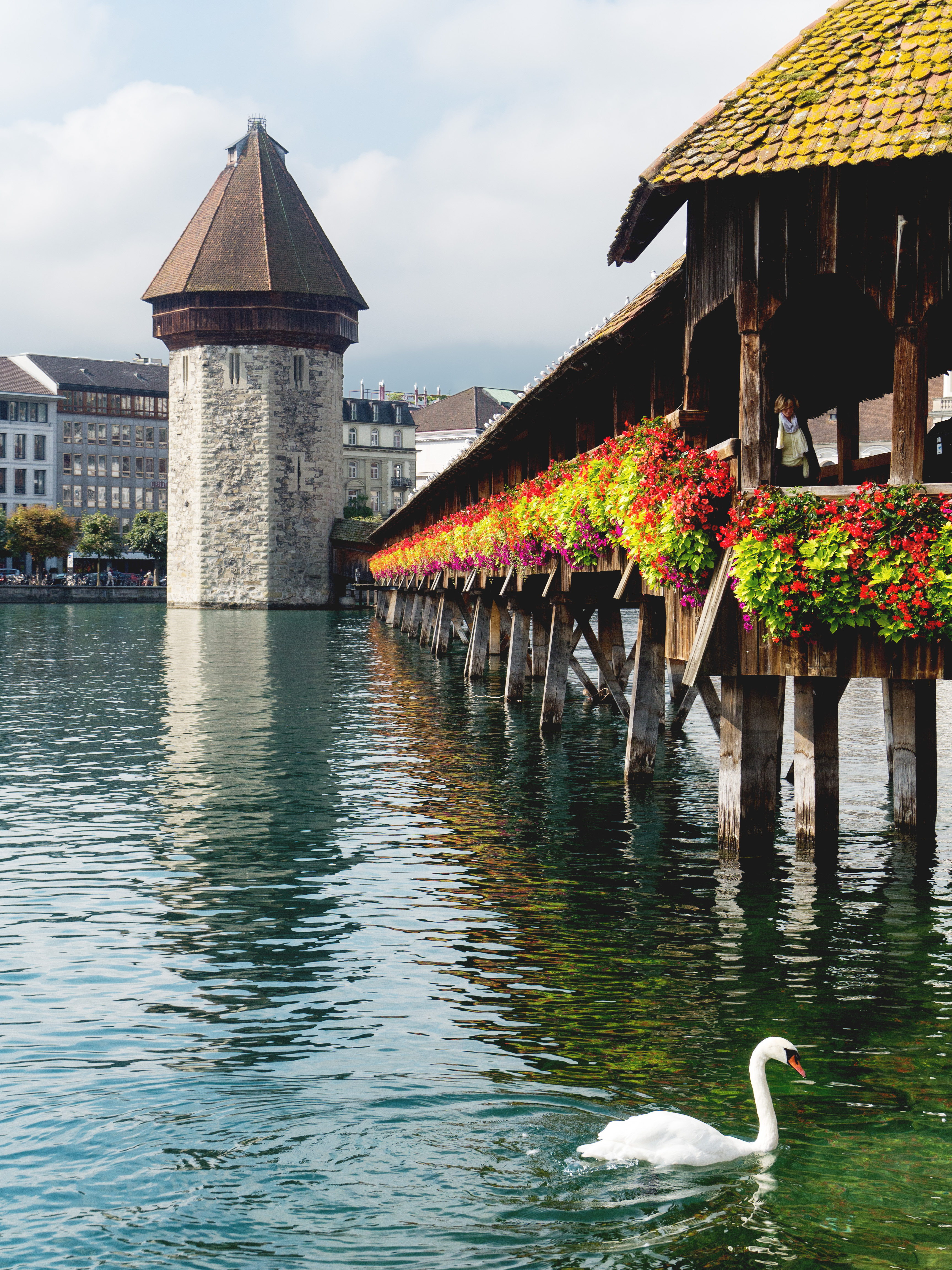
1 The Chapel Bridge (Kapellbrücke). The Chapel Bridge was built in the 14th century to aid in the protection of the city. It is a landmark of Lucerne and is said to be the oldest wooden bridge in all of Europe. A point of interest as you walk over it are the paintings in the rafters depicting 12th-century city life and Swiss history. The bridge was badly damaged by a fire on 18 August 1993; it was rebuilt within a year, but the damage is still visible in places and many of the original paintings were lost. The tower which has had multiple uses over the years (including as a dungeon) is still in the original condition, but not open for visitors. Free. (updated Dec 2019) 2 The Spreuer Bridge (Spreuerbrucke). The Spreuer Bridge, or Chaff Bridge, is the other surviving wooden footbridge in central Lucerne, a short walk from the more famous Chapel Bridge. It was built in 1566, replacing an earlier bridge destroyed by fire. It is known for its decorative paintings depicting the Dance of Death, by the studio of Kaspar Meglinger. (updated Feb 2020) 3 The Lion Monument (Löwendenkmal), Denkmalstrasse 4. Also known as the Lion of Lucerne, it is a sculpture designed by Bertel Thorvaldsen. It commemorates the Swiss Guards who were massacred in 1792 during the French Revolution, when revolutionaries stormed the Tuileries Palace in Paris, France. The American writer Mark Twain (1835–1910) praised the sculpture of a mortally-wounded lion as "the most mournful and moving piece of stone in the world.". The sculpture is a popular sight with a constant flow of tour groups arriving during the day - visit early or late in the day if possible for a more peaceful experience. Free. 4 The old city wall (Museggmauer). 1 April-1 Nov: 08:00-19:00, closed over winter. A part of the rampart walls built in 1386; the wall is still almost entirely intact and visitors are able to walk a section of the rampart. Four towers are open to the public: Schirmer, Zyt, Wacht and Männli. The Männliturm allows
Do
1 Explore the Old Town. One of the main reasons that Lucerne attracts so many travelers is its small but remarkably preserved old town. You can get lost (for a few minutes anyhow) in its maze of streets, passages, and squares, admiring the many and varied murals painted on what seems like every other building. A nice short walk on the Museggmauer starts at the Schirmer-Turm, walk up the road near Jazzkantine, open only at daytime. 2 Take a boat tour. Take a boat tour on the lake Lucerne with the traditional steamboats. A ride along the full length of the lake (Lucerne – Flüelen) takes approximately 3 hours. The lake has several tight bends and the landscape changes dramatically during the ride from the high mountains around Flüelen to the gentler hills around Lucerne. The villages and towns along the lake are generally very nice places to take a relaxed day with a walk/swim and food at the lakefront - Weggis and Brunnen for example. Flüelen and Brunnen at the far end of the lak
Overview adapted from Wikipedia, travel guide fromWikivoyage (CC BY-SA). Photography via Wikimedia Commons.