
Lichtenberg
Germany · Europe
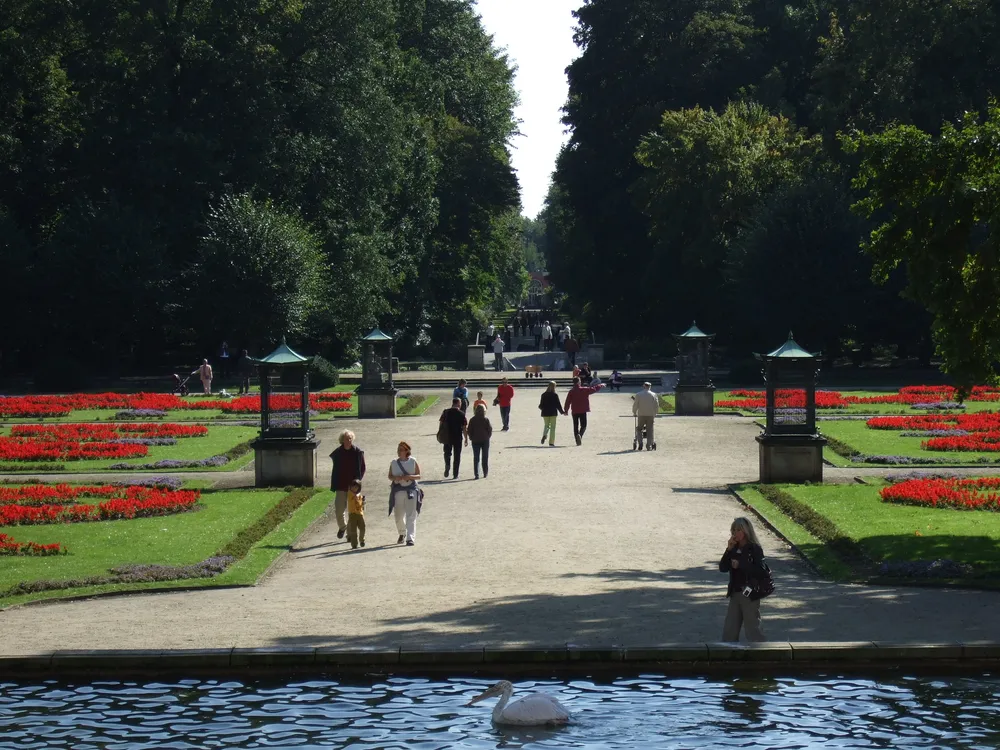
About Lichtenberg
The East is a district of Berlin. It consists of the boroughs Pankow (except for Prenzlauer Berg), Lichtenberg, Hohenschönhausen, Marzahn and Hellersdorf. The most interesting places for tourists are in Lichtenberg: the Stasi (secret service of the GDR) relics and museums, the Tierpark (zoo) and some remarkable architecture such as the Mies van der Rohe house.
Lichtenberg travel guide
Understand
Lichtenberg is a district in the east of Berlin. It was merged with Hohenschönhausen in 2001. Lichtenberg is mostly a residential district, but because of its heterogeneity there are all classes of people living there. The centre of Lichtenberg (where there are some buildings left from the 19th century) is home to the working class, as is the centre of Hohenschönhausen (built mainly in the 1970s in rather ugly East German (GDR) socialist building block architecture). The middle class resides in the greener areas like Friedrichsfelde, whereas in Karlshorst you can watch some smaller mansions of the upper class. Marzahn-Hellersdorf is a district in the northeast of Berlin. It is largely a residential district for the underclass and the middle class. It is famous for its GDR socialist building-block architecture, but often ignored are some old, village-like parts. In general it is a very green district. There are only a few interesting sites for visitors. Most interesting are maybe the "Gärten der Welt", the Gründerzeitmuseum and the Schlosspark Biesdorf with its small castle in late classical style. A more thorough description of the district can be found on its official website. Pankow is a borough of Berlin. In 2001 the three former districts of Prenzlauer Berg, Weißensee and Pankow were combined to form the new Pankow district. The former Pankow on the other hand is a very green, middle-class district with a laid-back atmosphere and some minor sights for tourists. Weißensee, too, is a largely residential district. Prenzlauer Berg is dealt with in East Central. Like other place - names ending in "ow" Pankow is pronounced ending in a slightly more open German o, certainly not "punk-off" and a wrong pronunciation is a frequent cause of derision.
Getting there
The GDR authorities prioritized the S-Bahn and later the Tram over the U-Bahn and it shows. While the U5 is the only U-Bahn that was extended during GDR times, it is a single line and where it doesn't go you'll have to make use of other modes of transportation. The stations of biggest interest are 1 Tierpark U5 and S-Bahn station 2 Lichtenberg S5 S7 S75 U5 . You can also use the long distance/regional trains, but departures are less frequent than for the S-Bahn. S75 also goes to Hohenschönhausen. The S-Bahn lines S75 or S5 and the U-Bahn line U5 will get you to most parts, otherwise take the tram: the M6, for example, starts in the city centre (e.g. Alexanderplatz) and runs through almost the entire district. U5 was one of only two U-Bahn lines operated in and by East Berlin during partition and it is the only one that saw any expansion by the GDR. It is the only line that reaches the city and state boundary of Berlin. As a matter of fact, the stop at Hönow was outside the Berlin borders when it opened and was annexed following reunification to make administration easier. To get into Pankow, get out at S-Bahn/U-Bahn station 3 Pankow U2 . .
See
1 Tierpark (get out at U-Bahn station Tierpark (U5)). The zoo in the former East Berlin is more spacious than its West Berlin counterpart, the historic Berlin Zoo and has been open for some 50 years. The Tierpark has nearly as many animals, but fewer reptiles and aquatic animals. It appears rather like a park with animals than a classic zoo, in fact it is one of the biggest zoos in Europe. There is an old castle from the late 17th century in the northeast of the Tierpark (Schloss Friedrichsfelde). 2 Stasi Museum, Ruschestraße 103 (Get out at U Magdalenenstraße (U5) and head to Ruschestraße), ☏ +49 30 5536854 (M-F only). M-F 10:00-18:00, Sa Su 11:00-18:00. This museum describes the procedures applied by the East German secret police. Every Friday to Monday, there is a guided tour in English at 15:00 (5€). €10 adults, €7.5 students/seniors/unemployed, 5€ children <12y.o. (updated Aug 2018) 3 Gedenkstätte Hohenschönhausen (Stasi Prison), Genslerstraße 66 (S-bahn to Landsberger Alee, then tram 6 to Genslerstraße, then walk 1 km along Genslerstraße, the prison is on the right), ☏ +49 30-98 60 82-30. Daily English-speaking tour between July 1st and November 14th, 14:30. Experience the Stasi Secret Police Prison first-hand. Tours are compulsory. Some of the tours are done by former inmates. €6. (updated Aug 2018) 4 Museum Karlshorst (German-Russian Museum), Zwieseler Straße 4 (get out at S-Bahn station Karlshorst and go by bus 396 direction Tierpark (2 or 3 stations)). Tu-Su 10:00-18:00. In this house the surrender of Germany was signed on May 9th, 1945, ending WWII in Europe. This museum describes the history of the war between Germany and the Soviet Union between 1941 and 1945 and the GDR/German-Russian relationship ever since. Historic rooms, permanent exhibition and special exhibits. free. 5 Mies van der Rohe Haus, Oberseestraße 60. Tu-Su 11:00-17:00. The last Mies van der Rohe building (a dwelling house) in Germany before his emigration to the U.S. (1938). Now there
Do
1 Harness racing, Treskowallee 129 (S-Bahnhof Karlshorst). Usually the races take place on Sundays. There is a harness racing track in Karlshorst. 2 Kienberg. Before or after visiting the "Gardens of the World", tourists might be interested in climbing on top of the Kienberg (a small hill nearby with a view on the surrounding suburbs) or to go for a walk in the valley of the Wuhle (a small river). More information on the area can be found on the district's official website (in German). IGA Cable Car (links to U5 Kienberg (Gärten der Welt) at one end). A cable car built for the international gardening exhibition in 2017 which remained in operation afterwards. Return ticket €6.50 (it is not part of the BVG fare system). (updated Apr 2018) 3 Brotfabrik. This institution, literally the "bread factory" has been converted into a cultural space hosting various theater, cinema and art events (updated Jul 2018) 4 Former Silent Cinema Delphi. This former cinema has become a theatre. (updated Jul 2018) Rugby Union: RK03 Berlin play the 15-a-side game in 1. Bundesliga, German rugby's top tier, at Stadion Buschallee on Hansastrasse.
Buy
Shopping centres mainly provide goods for the local population, but there are several shopping centres in the district such as the following:
1 Eastgate Berlin (next to the S Bahn Station Marzahn). About 150 shops, restaurants, etc. Close by is an entertainment centre with cinemas etc. 2 Helle Mitte (next to U5 Station Hellersdorf, in the area around Alice Salomon Platz). A smaller shopping centre. 3 Spree Center (at Hellersdofer Straße opposite to the U5 station "Kaulsdorf Nord"). Small shopping centre.
Eat
Most restaurants in Marzahn-Hellersdorf belong to the lower price segment, some to the medium range, and exclusive restaurants are virtually non-existent.
1 Tierpark Bistro (at the U5 station at Tierpark). Has some of the best Doener in the Berlin area. They have a great neighbourhood feel, and delicious Middle Eastern food in the German style. 2 La Paz, Kurt-Weill-Gasse 7, 12627 Berlin (about
Overview adapted from Wikipedia, travel guide fromWikivoyage (CC BY-SA)。Photography via Wikimedia Commons.