
Innere Stadt
Austria · Europe
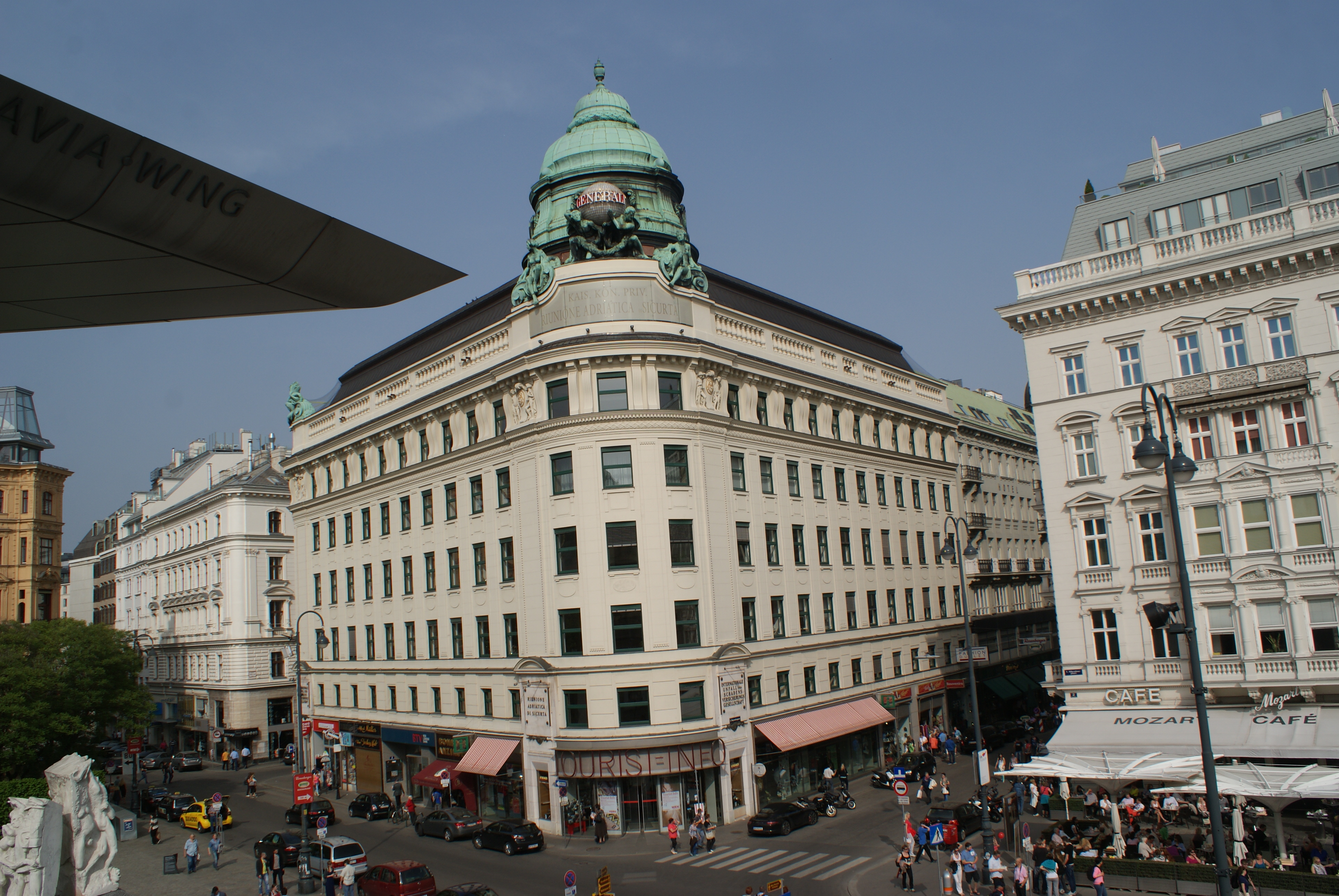
About Innere Stadt
Innere Stadt is the inner-most district of Vienna. Its historic centre dates back to Roman ages and has been inscribed on the UNESCO World Heritage list. It is encircled by the Ring Road (Ringstraße), a grand boulevard constructed along the old city walls, which were torn down starting in 1858. Along the Ringstraße are many famous and grand buildings, including the City Hall (Rathaus), the Austrian Parliament, the Hofburg Palace, the Natural History Museum (Naturhistorisches Museum), the Museum of Art History (Kunsthistorisches Museum), and the State Opera House (Wiener Staatsoper).
The very central point of Innere Stadt is the famous St. Stephen's Cathedral (Stephansdom), perhaps the most recognizable symbol of Vienna. From there, many of Vienna's most famous streets expand in every direction, including Graben and Kärntner Strasse. The centre is largely pedestrianised, and the remainder of streets open to traffic are mostly reserved for bus and taxi traffic - driving around is an intricate affair and is best avoided.
Innere Stadt travel guide
Understand
1 Tourist Info Vienna, Albertinaplatz/Maysedergasse (behind the Vienna State Opera; across from the Albertina), ☏ +43-1-24 555, fax: +43-1-24 555-666, [email protected]. Daily 09:00-19:00. Offers free walking maps and brochures, and can help with hotel reservations.
Getting there
From Vienna International Airport It may come as a surprise, but the Innere Stadt is not directly reachable from Vienna International Airport. The shortest way to get there from the airport is to take the City Airport Train (though more expensive than taking the S-Bahn) or S-Bahn line S7 to Wien Mitte-Landstrasse and then transfer to U-Bahn line U3 directly to Stephansplatz, or alternatively the U4 along the Donaukanal - a convenient stop to alight and start walking into the Innere Stadt is Schwedenplatz, while you can also choose to go south and alight at Karlsplatz by the opera house. Or, you can walk as the Wien Mitte-Landstrasse station is only some 250 m from the Ring, separated by the nice Stadtpark. Alternatively, you can travel on the S7 one station farther to Praterstern in Leopoldstadt, and from there the U1 will take you to the abovementioned Schwedenplatz, Stephansplatz or Karlsplatz. If you want to explore the Innere Stadt starting from the west, you can take the U2 from Praterstern, which stops along the western bend of the Ring, starting at Schottenring and terminates at Karlsplatz. There are no trams that go directly to the Innere Stadt from either Praterstern or Wien Mitte-Landstrasse.
From major railway stations Other than the above-mentioned Wien-Mitte Landstrasse and Praterstern, the major railway stations of Vienna are the Hauptbahnhof, Westbahnhof and Wien-Meidling. From the Hauptbahnhof, take U-Bahn line U1 (the station by the Hauptbahnhof is called Südtiroler Platz) to either Karlsplatz, Stephansplatz or Schwedenplatz. From the Westbahnhof, take U3 to Volkstheater, Herrengasse, Stephansplatz or Stubentor. If you end up at Wien-Meidling, which still serves as a terminus for some trains until the Hauptbahnhof is fully operational, your only option is a rather long ride on tram line 62 all the way to its terminus at Wien Oper (Kärntner Ring).
Getting around
The inner city is easily walkable. For a special flair and tourist guidance one can take a tour in an historic horse carriage. The underground lines U1 and U3 both cross the district, while U2 and U4 border it. The city-bus lines 1A, 2A and 3a cross the district too. The tram lines D, 1 and 2 run on some parts of the Ring. Chances are that on your journey to, from or around the Innere Stadt you will need to use the U-Bahn station Karlsplatz, or just one of its subways to get under the ring. Make sure to pay attention when nearing the Opera from the underground, as a globally unique attraction awaits you there – the 2 Vienna Opera Toilet. This public toilet in the subway passage is lushly decorated and incessantly blares Strauss tunes at tourists and locals relieving themselves and those passing by.
See
Religious buildings All of the religious buildings still function as a church, with Catholic Mass and Communion services on of course every Saturday night and Sunday, in addition to weekdays. Those that visit during Mass times, including those that do so other than for attending it, are expected to make as little noise as possible as a form of respect.
1 Stephansdom (St. Stephen's Cathedral), Stephansplatz 3 (U1/U3 Stephansplatz), ☏ +43 1 51552-3054, fax: +43 1 51552-3526, [email protected]. Daily M-Sa 06:00-22:00, Su and holidays 07:00-22:00; visits for tourists: M-Sa 09:00-11:30, 13:00-16:30, Su and holidays 13:00-16:300; tour of cathedral and treasury: M-Sa 10:30 (English), daily 15:00 (German). Yet another patchwork of architectural styles, but predominantly Gothic. None of the original construction remains, the oldest extant sections are the thirteenth century Giant Gate (Riesentor) and Towers of the Heathens (Heidentürme), both of which are Romanesque. In 1511, building in Gothic style ceased due to being out of fashion. The main altar has a Baroque panel showing St. Stephen, Christianity's first martyr. The organised tour is worth it, since some of the finest works of art in the cathedral can only be seen with a guide, such as Emperor Frederick III's red marble sepulcher and the immense Gothic carved Altar of Wiener Neustadt. Those interested in attending Mass may come Saturdays at 7PM for an English service. Cathedral/treasury tour: €5 (adults), €3 (students 14-18), €2 (children under 14). South Tower (Südturm) (access from the outside). Daily 09:00-17:30 (no registration required). The 137-m-high tower, often known by its Viennese diminutive Steffl (also a nickname for the entire cathedral), was finished in 1433. 347 steps lead to the Türmerstube and to a good view. €4.5 (adults), €2 (school parties 15-18 yr), €1.50 (children 6-14 yrs). North Tower (Nordturm), [email protected]. Daily Sep-June: 08:15-16:30, Jul-Aug: 08:15-18:00. S
Do
Cultural events
Vienna is of course famous for its classical music. The Musikverein or the Konzerthaus feature excellent concerts at their famous halls. The Opera plays classical masterpieces. Students can get reduced tickets, where they stand with other aficionados.
1 Wiener Staatsoper (Vienna State Opera), Opernring 2, ☏ +43 1 514 44-2250, 7880, [email protected]. Probably the most-beloved symbol of Viennese arts, and one of the first buildings to be rebuilt in the postwar era. It was built from 1861-1869 under the direction of architects Eduard van der Nüll and August von Siccardsburg for then-emperor Franz Josef I. The first performance was Don Giovanni, an opera by Austrian native Mozart, on 25 May 1869. The architecture of the opera was barely tolerated by the picky Viennese when it opened. Van der Nüll did not take these criticisms of his work lightly and committed suicide. A few weeks later, von Siccardsburg died of a heart attack. Doubly cursed, the opera building succumbed to bombs less than 100 years later, during World War II. After ten years of Allied control after the end of the war, many cultural institutions reopened to celebrate the birth of the new Austrian state. This time the opera opened with an adopted son of Vienna's work: Beethoven's Fidelio. The lush curtains and overall elegance contribute to the atmosphere (even the nosebleed seats; so steeply pitched and close to the ceiling a nosebleed becomes a distinct possibility). Inexpensive standing room tickets are made available for every performance and sold the day of the performance. The line forms about two hours prior to the performance. Guided tours in a number of languages are offered. The line at the front side door forms about 1/2 hour before the tour. 2 Wiener Philharmoniker (Vienna Philharmonic), Kärntner Ring 12 (ticket office), ☏ +43 1 505 65 25, fax: +43 1 505 65 25-270, [email protected]. Considered one of the world's best orchestras, subscription ti
Buy
The inner cent
Overview adapted from Wikipedia, travel guide fromWikivoyage (CC BY-SA). Photography via Wikimedia Commons.