
İzmit
Turkey · Asia
About İzmit
İzmit is an industrial city in the Eastern Marmara region of Turkey, just over 100 km east of Istanbul. It's at the tip of the sword-like Gulf of İzmit, a long inlet of the Sea of Marmara, and in 2021 had a population of 367,990. İzmit is the capital of the province and metropolis of Kocaeli.
İzmit travel guide
Understand
The first known city hereabouts, from maybe 700 BC, was called Astakos (Ἀστακός), and lay 20 km south, in what is nowadays Başiskele. It was at the tip of the Gulf of Izmit so it was an obvious place to establish a port trading between Anatolia and the Mediterranean. "Astakos" means lobster, so either the fishing was good or it indicated the pincer-like tip of the Sea of Marmara. To the north was the Kingdom of Bithynia bordering the Black Sea: this waged wars to gain Astakos and eventually won a pyrrhic victory. The wrecked town was rebuilt further north in 264 BC by Nicomedes I of Bithynia, who made it his capital and (no doubt after much thought) named it Nicomedia. By 70 BC Rome had grown into the regional power, and Bithynia sought their aid against foes further east. Aid slid into influence then into colonisation and it became a Roman province. It was important to them as the borderland against even more dangerous foes, the Persians. Nicomedia became one of the four co-capitals of the Roman Tetrarchy until 330 AD when power was centralised in Byzantium, the later Constantinople / Istanbul. The Ottomans took the city in 1337, calling it at first İznikmid: the prefix "Iz" means "towards" so this meant the vicinity of Nicomedia, and eventually got shortened to İzmit. The city was roiled by several conflicts, the last being the Greek-Turkish War of 1919-22, and by earthquakes. The most terrible recent shock was on 17 Aug 1999, a quake of magnitude 7.6 Mw that killed 17,000 and rendered half a million homeless. Much of Izmit's Ottoman architecture also perished. The city was rebuilt: it stands on the Istanbul-Ankara transport corridor and has long been industrial. It will never be mistaken for a beach resort: the head of the gulf is lined with commercial and military docks. So you're more likely to come here for business, such as the automobile industry, or passing through. The climate is oceanic, modified by the overarching Mediterranean zone and low altitude. Sum
Getting there
By train YHT fast trains run six times a day from Ankara and three times from Konya, via Eskişehir and Arifiye. From Izmit they continue west to Gebze and the Istanbul stations of Pendik (for SAW airport), Bostancı and Söğütlüçeşme, and once a day further out to Halkalı. You can also take the Marmaray suburban train from Istanbul to Gebze and change. Five regional trains run daily from Gebze to Izmit (40 min), Arifiye and Adapazarı (another 50 min). Ankara Express runs overnight, leaving Ankara at 22:00 to reach Izmit at 04:30 and central Istanbul at 06:00. The eastbound train departs around 22:50, calls at Izmit at 00:30 and reaches Ankara at 06:45. See TCDD for timetables and tickets. 1 Izmit railway station is west edge of town centre near the budget accommodation area.
By bus Buses run every hour or two from Istanbul Harem, the Asian terminal, taking an hour for a single fare in 2022 of 60 TL. A few start from Istanbul Esenler the European terminal or involve a change at Gebze. The main operator is Efe Tur. From Ankara they operate five buses a day taking 4 hr 15 min. The other bus line is Metro Turizm, with frequent services calling on their way between Istanbul and Ankara. 2 Otogar the main bus station is by the bypass, northeast edge of the city. You need a dolmuş to get to town and it may be included in your ticket, enquire when booking. Otherwise trams also run into the centre and onward to the esplanade.
By car D100 from Istanbul into Anatolia runs through the city centre. It's often congested as its course negotiates through town centres and extensive industrial areas. O-4/E80, a limited-access motorway (toll) tracing the route of D100 to its north, is a better choice. O-7 extends further north and is the fastest, but also has an accordingly higher toll than O-4/E80. Under normal traffic conditions, a drive from the Asian Side of Istanbul shouldn't take much longer than an hour.
Getting around
The area of most interest is around the clock tower and within walking distance. The rest of town sprawls so you need a dolmuş or taxi. Of the two boulevards between clock tower and commercial district, İnönü Cd is one-way westbound while Cumhuriyet Cd is two-way, so look for transport accordingly. Trams (Akçaray) run on a single line from the bus station in the east through the centre to Seka and the western suburbs.
See
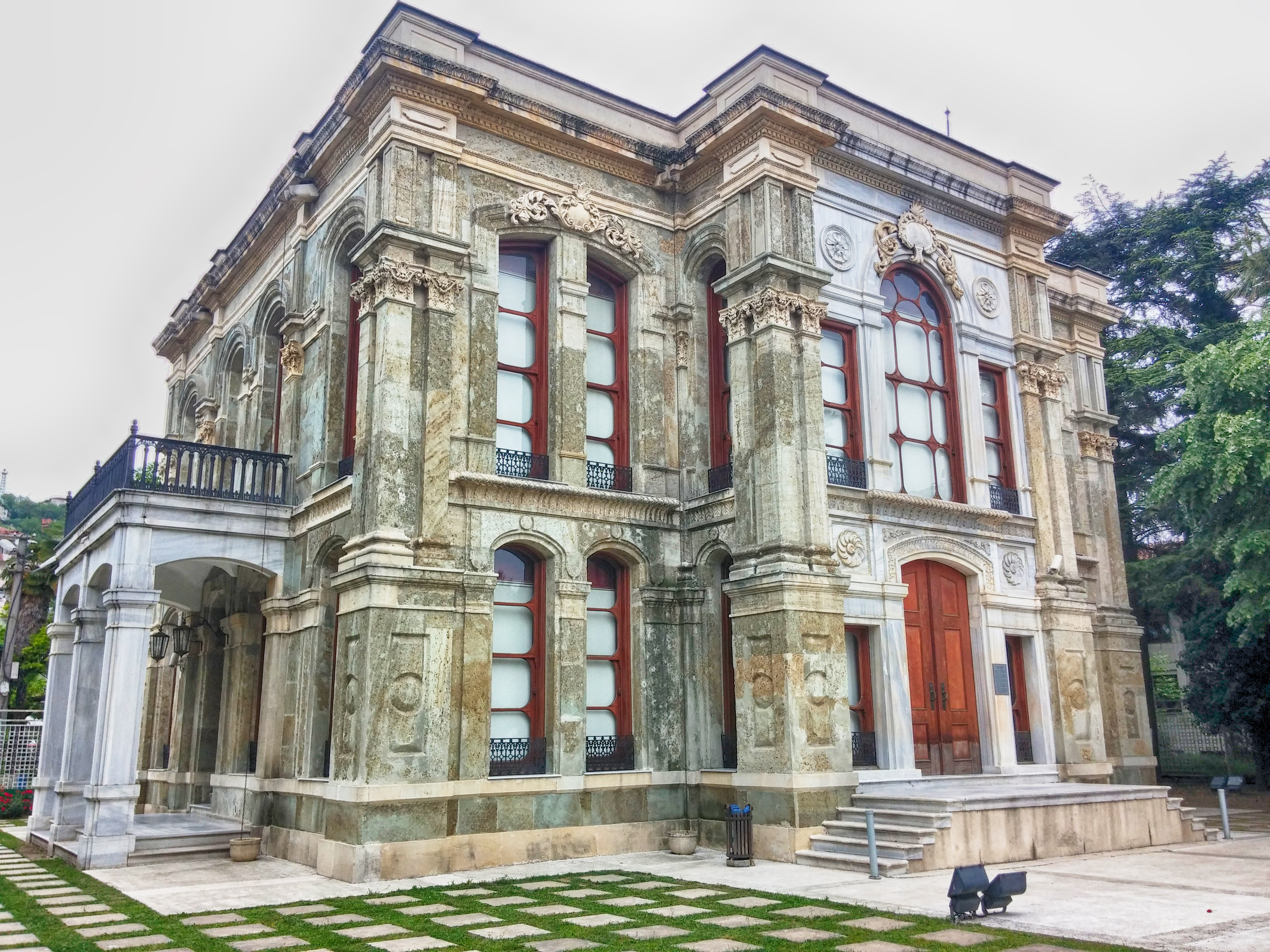
The Clock Tower (Saat Kulesi) is in the leafy plaza opposite the railway station, though it now feels cut off by D-100 highway roaring overhead. Built in 1901, it was one of a job-lot of neoclassical clock towers built all across the Empire to mark 25 years of the reign of Sultan Abdul Hamid II (1842-1918). He presided over a great expansion of the railways but a collapse of Ottoman power. He was deposed in 1907, and what with fear of assassination and 13 wives to mollify he didn't much get to travel and admire all his clock towers. The Izmit tower stands 16.4 m tall and is prettified with fountains; it was restored in 2006. Imperial Pavilion Museum (Kasr-ı Hümayun Saray Müzesi), off İnönü Cd (next to clock tower), ☏ +90 262 322 7554. Tu-Su 09:30-16:30. This was built in the 1860s as a lodge for Sultan Abdulaziz (1830-1876), who much admired Europe and sought a neoclassical bling pavilion in which to pose. He also built up the Turkish navy into a considerable force, but caused the Ottoman Empire to implode financially and militarily. He was deposed and soon afterwards was found in a pool of blood, like a scenario from Cluedo. His successor only lasted 3 months before being deposed then it was Abdul Hamid II's turn. (updated Oct 2022) Kocaeli Archaeology and Ethnograpy Museum (İzmit Museum), Istasyon Cd 5 (at railway station), ☏ +90 262 321 2274. Tu-Su 09:00-16:30. This is in the 19th century former railway station, facing the modern TCDD. It re-opened as a museum in 2007 and displays Paleolithic, Hellenic, Roman, Byzantine and Ottoman findings. However some exhibits are being moved to other city museums. Adult 20 TL. (updated Oct 2022) Izmit Naval Museum, Oramiral Salim Dervişoğlu Cd (coast next to railway station), ☏ +90 262 323 3383. Tu-Su 11:00-17:00. An old US warship and a submarine have been moored here and converted into a museum of maritime warfare. By prior booking of guided tour. Adult 25 TL. (updated Oct 2022) 1 Kapanca Sokak is an alley winding up fro
Do
Beach: the esplanade is alright for strolling, but you wouldn't sit on the shore or venture into the murky water. East at the head of the gulf is industrial. The best of a poor choice is Başiskele south shore of the gulf, though it's stony. Football: Kocaelispor were promoted in 2025 so they now play soccer in Süper Lig, the top tier. Their Kocaeli Stadyumu (capacity 34; 700) is on Tunaoğlu Cd 5 km east of town centre.
Buy
Lots of small supermarkets: Migros and A101 are the main chains, open daily to 22:00. Outlet Center and 41 Burda are big retail malls south side of town just beyond Kumla Creek. Its shops are open daily 10:00-22:00.
Eat
Pişman
Overview adapted from Wikipedia, travel guide fromWikivoyage (CC BY-SA). Photography via Wikimedia Commons.