
Haskovo
Bulgaria · Europe
About Haskovo
Haskovo (Bulgarian: Хасково) is a city in South-Central Bulgaria, in the Upper Thracian Plain. Nearby, there are mineral springs, ancient Thracian tombs, and the communist-era "model city" of Dimitrovgrad, built from scratch in the 1950s.
Haskovo travel guide
Understand
With a population of about 65,000 (2021), Haskovo is the administrative centre of Haskovo Province, which extends in the south-east to the borders with Greece and Turkey, including a chunk of the Eastern Rhodope Mountains. The only other sizable city in the province is nearby Dimitrovgrad, 14 km (8.7 mi) to the north; between the two cities run the river Maritsa and the A4 motorway. Two other towns in the province have a population above 10,000: Harmanli further down the Maritsa and Svilengrad on the national border, a major border crossing to both Greece and Turkey.
Getting there
The nearest international airport is in Plovdiv (PDV IATA), about 70 km (43 mi) away.
By train Haskovo is a major station on the secondary railway line that runs between Dimitrovgrad and Kardzhali, one of the few not-electrified lines in Bulgaria. In turn, Dimitrovgrad is a railway junction with connections to Plovdiv and Stara Zagora. Renovations of the railway network have caused major and inconvenient temporary changes to any train routes connected to Plovdiv. As of late 2024, in practice this means that the only daily direct train from Plovdiv to Haskovo and Kardzhali starts at the Plovdiv East station (about 110 min to Haskovo). The same train is also one of the two daily trains from Dimitrovgrad (less than 30 min), the other one being an early commuter shuttle train. In the opposite direction, there are also two daily trains from Kardzhali (about 100 min) - the Plovdiv train and another shuttle train. Intercity trains that would otherwise pass through Dimtrovgrad have been redirected to avoid Plovdiv and the southern lines; the international train Sofia - Svilengrad - Istanbul has been redirected through Stara Zagora.
1 Railway Station (ЖП гара; zhe peh gara) (in an industrial area 1.7 km (1.1 mi) east of the city centre). Renovated old building. Exits right onto the large Saedinenie Blvd, which connects it to the city centre. Walking is possible, but awkward and unpleasant because of the narrow sidewalks. It's better to take a taxi or bus. (updated Oct 2024)
By bus Intercity and international lines by the ubiquitous Union-Ivkoni and Arda Tur.
2 Bus Station (Автогара; avtogara) (right by the eastern end of the city centre; on the large Saedinenie Blvd; across the street from the monument to Cptn. Petko Voyvoda). Utilitarian Communist-era building. Like elsewhere in Bulgaria, each transport company has its own ticket office. (updated Oct 2024)
By car Haskovo is at the crossroads of several major roads, so drivers have a number of options. Motorway A4
See
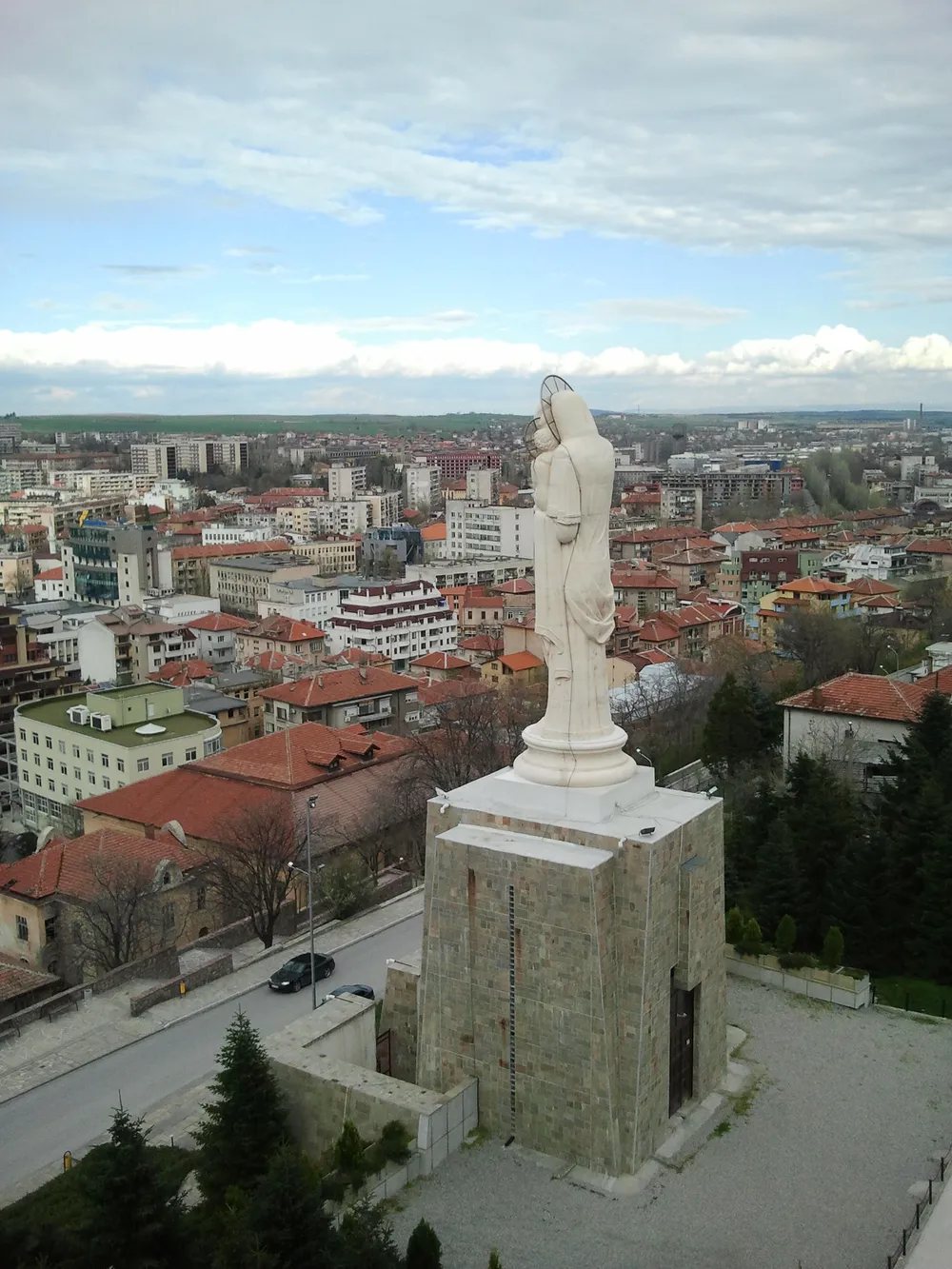
1 Monument to the Mother of God (on the hill south of the city centre; a pedestrian street and staircase connect it to the riverside Bulgaria Blvd). A 32.8-metre (108 ft) statue of the Madonna and Child, erected in 2003; there's a chapel in the base of the 17 m (56 ft) pedestal. Officially recognised by the Guinness Book of Records as the tallest such statue at the time. In 2010, they added nearby a 30-metre (98 ft) remotely-operated belfry, which is open to the public and offers a good view of Haskovo. Just avoid being up there when the bells start ringing if you value your hearing... (updated Mar 2025) 2 Regional History Museum (south side of Liberty Sqr). Apr-Oct: Tu-F 09:00-17:30, Sa 09:00-16:00 (closed Su M); Nov-Mar: Tu-F 09:00-17:00, Sa 10:00-16:00. First floor of a large angular 1970s building that it shares with other institutions and businesses (e.g. the city library), the entrance is on the north side, between a few shops. On the west façade there's a relief of the creators of the Cyrillic alphabet, surrounded by letters. Archaeological exhibits from the Stone Ages, classical Antiquity, and the Middle Ages, and then the history of Bulgaria until the late 19th century. Adults: 7 лв, students/pensioners: 4 лв, free for children up to 7 yr and the disabled; guided tour/lecture "in foreign language" (English?): 20 лв. (updated Mar 2025) City Centre - chained pedestrian streets and squares; public art and old buildings Theatre Ivan Dimov (western end of the pedestrian zone of the city centre). Built 1924-1926, a petty building with a classical portico. (updated Mar 2025) Atlantic Square (ploshtad Atlanticheski) (west of the main square). The name is almost certainly a reference to NATO, likely renamed after the Communist era. (updated Mar 2025) 3 Old Clock Tower. A 23-metre (75 ft) wood-and-stone tower, an exact copy of the original 19th-century tower that was demolished in 1913. This one was erected in 2012, amusingly making it newer than the New Clock Towe
Do
Open air stage and ice skating rink - amphitheatre-like, next to the Communist-era Sport Hall Spartak (Spartacus).
Sleep
Hotel Africa – a small 3-star, family-run hotel in an awkward-looking modern building on the riverside boulevard. Notable mostly for its interior decoration: African-themed kitsch that's both amusing and surprisingly pleasant, with every room having a different "patron animal" and colour scheme.
Go next
To the north: Dimitrovgrad, and further away Stara Zagora, Kazanlak and the Shipka Pass through the Balkan Mountains. If you like small towns and ancient sites, to the east is Harmanli, and then to the north-east Topolovgrad under the low mountain Sakar and Elhovo on the river Tundzha; you can then swing north towards Yambol and Karnobat, or proceed directly to Burgas on the Black Sea coast. To the south-east: Svilengrad on the border, then Greece and Turkey. To the south-west is Kardzhali in the Eastern Rhodope Mountains; on the way you can swing by the famous ruins of ancient Perperikon. To the west is colourful and ancient Plovdiv, a gateway to a number of other destinations either further west or in the Rhodope Mountains
Overview adapted from Wikipedia, travel guide fromWikivoyage (CC BY-SA). Photography via Wikimedia Commons.