
Girona
Spain · Europe
About Girona
Girona is the chief city of Província de Girona in Catalonia, northeast Spain. In 2023 the city had a population of 104,320, with about another 50,000 in the adjoining town of Salt.
The city is astride trade and pilgrimage routes from France into Spain, and pilgrimage traffic is as strong as ever: "But we're nowhere near Barcelona!" is the plaintive cry of sun-seekers who boarded a flight to a place that Ryanair called Barcelona-Girona. It's actually less than 100 km, the transfer bus will be along any minute, and for beach resorts along the Costa Brava, Girona is the closest airport. But it would be a mistake to rush away to those places and fail to explore this fascinating ancient city, with its cathedral, walls and higgledy-piggledy medieval streets ranged upon the hillside.
Girona travel guide
Understand
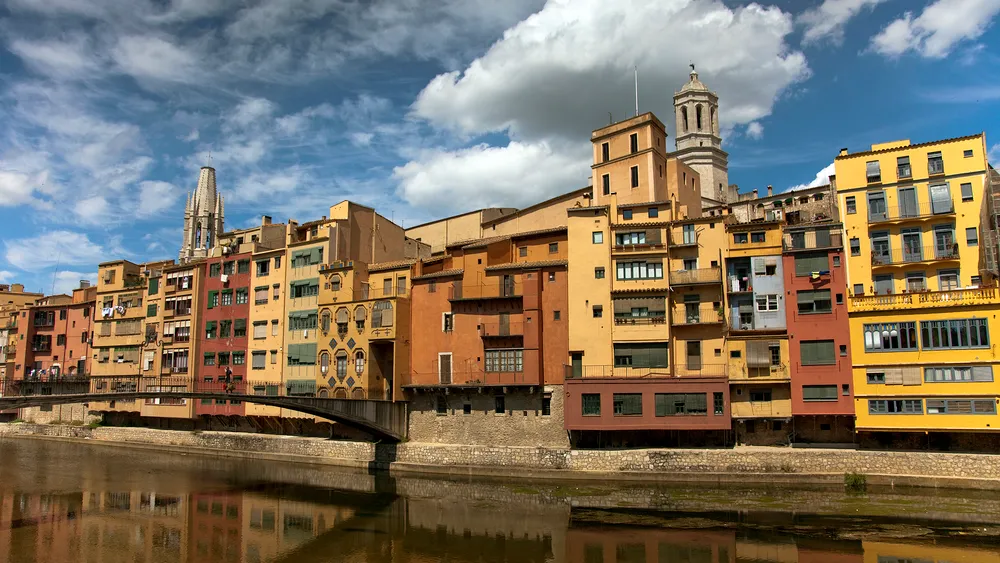
Girona is at the confluence of the Ter, Onyar, Galligants and Güell rivers, so transport routes across Catalonia are focussed here. It was the Roman city of Gerunda, astride their cross-country road to Cádiz. It was captured by the Moors in 715 AD but reconquered by the Holy Roman Empire in 785, though it suffered a century of destructive further attacks. So like other northern towns, Girona doesn't have the Moorish heritage seen in Andalucia, which they held for another 700 years. It did however acquire a large Jewish population, until they were expelled from Spain in 1492. From the 17th to 19th centuries it was repeatedly assaulted from France, but this ended with the defeat of Napoleon. Its city walls were then taken down on the west side, but have been retained on the east side around Old Town (Barri Vell) and the university. Town centre is along the Onyar river, with Old Town on the east bank; the Onyar then joins the larger Ter, swinging north towards the coast. C de Calderers is the main thoroughfare on this bank. New Town is west and south, a 19th-century grid with the majority of shops, hotels and restaurants, plus the railway and bus stations. Girona is an all-year destination but in winter can suffer cold winds from the mountains, with temperatures sometimes below −5 °C (23 °F), and frequent rain. In summer temperatures often soar to 30–40 °C (86–104 °F), and citizens escape to the coast whenever they can.
Tourist information Girona Tourism website
Getting there
By plane 1 Girona Airport (GRO IATA), ☏ +34 913 211000. Ryanair is the main operator. It's a single terminal with the usual facilities, plenty big enough for its limited traffic. Ryanair, along with other airlines also operate flights to more European destinations in the high season only. (updated Mar 2024) To town: Sagalés Bus 607 runs at irregular hours to meet the flights, taking 30 min to the bus station. Bus 602 from Barcelona Airport/Barcelona/Aeroport de Girona/Girona/Figures also stops here. It's the same ticket for either (€2.60 in 2024), buy from the kiosk by the bus stops.
By train Four high speed international trains per day run from Barcelona Sants (one starting from Madrid via Zaragoza), taking 40 min non-stop to Girona. They continue north to Figueres, Perpignan and Narbonne, then fan out to Paris, Lyon and Marseille. Reservations are compulsory. AVE fast domestic trains run every hour or so from Barcelona Sants, taking 40 min non-stop to Girona and continuing to Figueres. Rodalies are the regional trains. R11 runs hourly from Barcelona Sants taking 90 min, then continues north via Figueres and multiple other stops to Portbou and Cerbère across the border. Until the high speed line opened in 2010 this was the railway route from France (Salvador Dalí painted a typically surreal impression of the journey) and you can still come this way. 2 Girona railway station, Plaça Espanya. The main station hall is off C Barcelona beneath the elevated conventional tracks. This has a ticket office and machines, a cafe, newspaper shop and toilets but no luggage lockers, and taxi ranks both sides. The low anonymous building on its west flank has a cafe at ground level, the bus station one floor down and the high speed railway platforms three floors down. Only one ticket machine down here so buy in the main hall. (updated Jan 2024)
By bus The bus station is underground within the high-speed part of the railway station. One overnight Flixbus runs from Barce
Getting around
By foot Walk both Old Town and New Town west of the river are compact and mostly pedestrianized. In Old Town, expect gradients, lumpy cobblestones and steep stairs. Don't take a car into the old streets, you'll need a tin opener to get it out again.
By bus Buses have nine local lines:
L1 is north–south from Montjuïc to Devesa Park, railway & bus station, Migdia and Avellaneda. L2 is north–south from Josep Trueta Hospital to Devesa Park then as L1. L5 is north–south from Germans-Sabat to Devesa Park, Salt and Aiguaviva. L7 is east–west from Torre Gironella to Hospital Santa Caterina. L8 is from the railway & bus station, and L9 from Salt, and L11 from Güell, all heading south to the university Centre and Montilivi campuses. L10 is south from the railway & bus station to Fornells. L12 loops town from Josep Trueta Hospital to Av Ramon Folch and the cathedral to Sant Daniel.
By bicycle There are many well-signed bicycle trails in and around the city. See "Buy" for the bike shop near Plaza de Catalunya. Girocleta is the bike-share service, based at the bus station.
See
1 Catedral de Girona (Cathedral of Saint Mary of Girona), Plaça de la Catedral, ☏ +34 972 427189. Nov-Mar: M-Sa 10:00-16:30, Su 12:00-16:30; Apr May Sep Oct: to 18:00; Jun-Aug to 19:00. The main entrance from C de la Força is up a long broad flight of stairs: approach from the side streets if you wish to avoid these. Construction began in the 11th century in Romanesque style, but most of the interior is Gothic from the 13th century, including the yawning 23-m-wide nave. The west facade and approach stairs are 17th-century Baroque. In the Treasury & Museum is the Tapestry of Creation from around 1100. Your ticket includes this and nearby Sant Feliu, and you can also include the art museum. 2 churches: Adult €7.50, student €5, child €1.50. Including the art museum: Adult €12, student €8, child €1.50. (updated Jan 2024) 2 Basílica de Sant Feliu, C Trasfigueres 4, ☏ +34 972 201407. M-Sa 10:00-18:00, Su 13:00-18:00. This was the city's principal church before the present cathedral. It was built from the 12th century until the 17th, so there's a mix of Romanesque, Gothic and Baroque. It has eight Roman and early Christian sarcophagi of the 3rd and 4th centuries, along with the Gothic tomb of Narcissus of Girona, an early bishop. Feliu himself is St Felix, born in Scillium (nowadays in Tunisia) and martyred in Girona in 304 AD. Same ticket as cathedral. (updated Jan 2024) 3 Museu d'Art, Pujada de la Catedral 12 (south flank of cathedral), ☏ +34 972 203834. Tu-Th 10:00-18:00, F-Su 10:00-14:00. Extensive art collection, mostly medieval and Renaissance, in the former episcopal palace next to the cathedral. Adult €6, conc €4, child free, or combi with cathedral. (updated Jan 2024) 4 Banys Arabs, C del Rei Ferran el Catòlic, ☏ +34 972 190969. M-Sa 10:00-18:00, Su 10:00-14:00. This bathhouse was built in Romanesque style in 1194, over 400 years after the Muslim rulers were ousted from the city; the "Arab" tag only stuck in the 19th century. They've been restored but you can't ba
Do
Football: Girona FC. They were relegated in 2026 and play soccer in Segunda División, the second tier. Their Montilivi stadium (capacity 13; 500) is 2 km south of the city centre. (updated Jun 2026) Golf: there are 3 pitch & putts around town. The nearest full courses are at Sant Feliu de Guíxols on the coast, as Golf Girona has closed down. Long distance bicycle routes crossing the city are the Pirinexus, Ruta del Carrilet d
Overview adapted from Wikipedia, travel guide fromWikivoyage (CC BY-SA). Photography via Wikimedia Commons.