
Frankfurt am Main
Germany · Europe
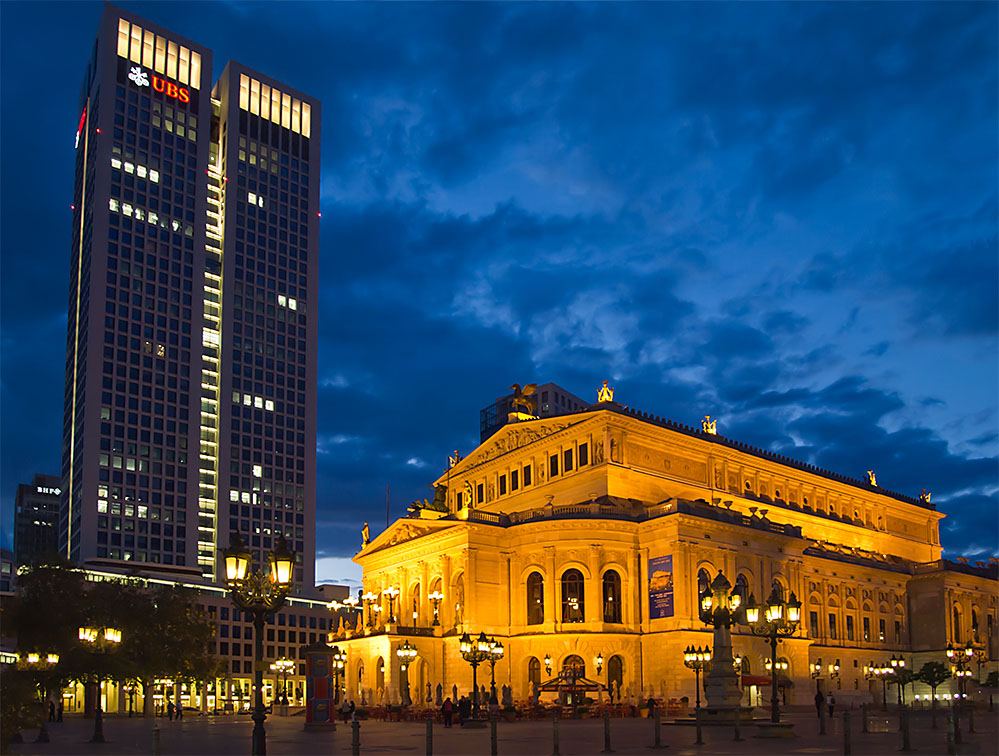
About Frankfurt am Main
Frankfurt (German, and sometimes in English: Frankfurt am Main) is the largest city in the German state of Hesse, and is considered the business and financial centre of Germany. It is the fifth largest city in Germany after Berlin, Hamburg, Munich and Cologne. The city is known for its modern skyline, and for hosting the headquarters of the European Central Bank, the Deutsche Börse stock exchange and numerous German financial services companies. Furthermore, it hosts some of the world's most important trade shows, such as the Frankfurt Auto Show and the Frankfurt Book Fair. It is on the river Main at a crossroad of the German Autobahn system and connected to several high-speed rail lines, with Germany's busiest airport on its outskirts, Frankfurt is one of the most important transportation hubs of Europe.
Frankfurt am Main travel guide
Understand
Frankfurt is a city of contrasts. Wealthy bankers, students and hippie drop-outs coexist in a city that has some of the highest, most avant-garde skyscrapers of Europe, next to well-maintained old buildings. The downtown area, especially Römer Square and the museums on the River Main, draws millions of tourists every year. On the other hand, many off-the-beaten-track neighbourhoods, such as Bockenheim, Bornheim, Nordend and Sachsenhausen, with their intact, beautiful 19th-century streets and parks, are often overlooked by visitors. It's the heart of the Rhine-Main region, spanning from Mainz and Wiesbaden in the west to Hanau in the east and Gießen in the north to Darmstadt in the south and has some 5.9 million inhabitants (2023) in the whole surrounding metropolitan area. Frankfurt is the place where Germany's major autobahns and railways intersect. About 480,000 people commute to the city each day, not counting some 756,000 people who live here (2024). With a huge airport, the third-largest in Europe, it is the gateway to Germany and for many people also the first point of arrival in Europe. Further, it is a prime hub for interconnections within Europe and for intercontinental flights. In the years following 1968, especially in the late 1970s and up to the early 1980s, Frankfurt was a centre of the left-wing Sponti-Szene, which frequently clashed with police and local authorities over politics and urban design issues (specifically whether or not old buildings should be torn down). Several members of these radical groups went on to have quite respectable careers in politics, among them Daniel Cohn-Bendit (long-time leading MEP for the Greens) and Joschka Fischer (Foreign Minister and Vice Chancellor 1998-2005), though their erstwhile radical and violent antics did hurt them in their later political careers. Frankfurt has one of the highest percentages of immigrants in Germany: about 25% of Frankfurt's people have no German passport, and another 10% are naturalised
Getting there
Frankfurt is the heart of central Germany and as such, it is one of the most important transportation hubs. It has excellent connections by rail, road and air. Reaching and leaving Frankfurt is easy.
By plane
Frankfurt Airport
1 Frankfurt Airport (FRA IATA) is among the busiest in Europe: Sixth in passenger traffic after London Heathrow, Istanbul Airport, Paris Charles de Gaulle Airport, Amsterdam Schiphol and Barajas Airport. Frankfurt is the banking centre of Germany and hosts numerous international trade fairs. Therefore all major airlines and all airline alliances fly frequently to Frankfurt and connect it to every inhabited continent and all major cities in the world. The German flag carrier Lufthansa is the main airline in Frankfurt and offers most connections. Lufthansa also has several domestic feeder flights to and from Frankfurt that also serve business travelers.
The airport is connected to downtown Frankfurt by taxi, bus (line 61 to Frankfurt Süd(bahnhof) U1 U2 U3 U8 S5 S6 (Frankfurt South Station), and most easily by S-Bahn (fast commuter trains). To get to the city by S-Bahn, take lines S8 or S9 in the direction of Offenbach Ost or Hanau at the regional train station, 2 Frankfurt(M) Flughafen Regionalbahnhof, on the lowest level of Terminal 1 (entrances in section A and B). If your plane lands or departs from Terminal 2, count in another 15 minutes as you need to move between the terminals with either the shuttle bus or the monorail Skytrain (both are free of charge; just follow the signs). If you want to go downtown, get off at Frankfurt Taunusanlage, Frankfurt Hauptwache or Frankfurt Konstablerwache, which are in the heart of the city. If you want to change to long-distance trains get off at Frankfurt Hauptbahnhof (Frankfurt Central Station). The ride from the airport to the central station takes about 20 minutes. You have to purchase a ticket at the vending machines in the train station before boarding the train. Adult ticket
Getting around
By public transport
Frankfurt has a good, co-ordinated public transport system of Underground (U-Bahn), tram (Straßenbahn) and bus. Public transit nerds will be quick to point out, that the "U-Bahn" is actually a bit of a misnomer, given the fact that it has moved traffic sections in the outskirts, more in line with systems called "Stadtbahn" in other German cities. The RMV site has basic information and timetable information available in English and other languages. The U-Bahn (metro) stations are signed with a white capital "U" on a blue background. For connections to the suburbs or airport, use the S-Bahn, signed with a white "S" on green background. Almost all S-Bahn lines and two U-Bahn lines (U6; U7) come together in the city-tunnel in central Frankfurt (7 Hauptwache U1 U2 U3 U6 U7 U8 and 8 Konstablerwache U4 U5 U6 U7), besides line S7, which ends at Central Station. If you want to go to the old city take the U-Bahn to 9 Dom/Römer U4 U5 or tram line 11 or 12. The S-Bahn, run by Deutsche Bahn, connects the downtown areas to outer-lying suburbs as well as other cities in the region, such as Mainz, Wiesbaden, and Darmstadt. Beware that the S-Bahn is notorious for its delays. If you need to get somewhere on time, allow for some buffer time. In the morning rush-hour, delays of 5–15 minutes are common. If you are catching a plane or have another similar time-critical appointment, allow an extra 30 minutes to be on the safe side. Other services (subway; tram and bus) are usually more punctual.
Tickets You can get single trip, all-day and weekly tickets. You can get tickets for one person or a group of up to five people travelling together. You must use a ticket machine to purchase a ticket before boarding. Ticket machines can be switched to English. You have to press Einzelfahrt Frankfurt for a single trip in the city and Tageskarte Frankfurt for a day ticket in the city. If you want to ride to the airport, you have to press Einzelfahrt
See
While most of the buildings in the inner town were destroyed during the second world war, many of them in Römerberg have been meticulously restored. The imposing town hall and the cathedral St Bartholomeus where emperors of the Holy Roman empire were crowned in the 17th and 18th centuries are among them. Walk on top of a tower or get to the Main for good views of the skyline.
Historical attractions
Sachsenhausen in Frankfurt/Süd is the part of the city south of the Main river. The old town is famous for its old cider bars and traditional half-timbered houses, many of which survived World War II (unlike much of the city centre). The Catholic Church of the Teutonic Order dates to the Middle Ages.
Skyline
Frankfurt has some of the tallest buildings in Germany (the Commerzbank Tower is the country's tallest office building). Its skyline is unique for the country, as the high rises are concentrated in a relatively small downtown area, giving Frankfurt the looks of a metropolis. One
Overview adapted from Wikipedia, travel guide fromWikivoyage (CC BY-SA). Photography via Wikimedia Commons.