
Food and drink
旅遊主題
Eating and drinking can be the greatest pleasure of a journey, as well as the greatest risk. While some travellers want to stick to familiar food, for comfort, health and ethics, others are more adventurous.
Retail food
See Legacy food markets for food retailers with legacy, fame or range beyond the usual. Buying food to cook is usually the cheapest way to get fed. Without cooking opportunities, choices are however limited to ready-made food. In some countries or types of stores there is at least one on-site restaurant, often a rather informal one with affordable prices. Of course no US-style shopping mall would be complete without a fast food "food court". A supermarket is the most common food retailer in high-income countries. Some provide a microwave oven or other means to heat food. A convenience store is a smaller shop implied to have late opening hours. A delicatessen or deli is a retailer which is usually specialized in high-end goods such as cheese, meat, seafood, confectioneries, or other specialities such as organic or ethnic food.
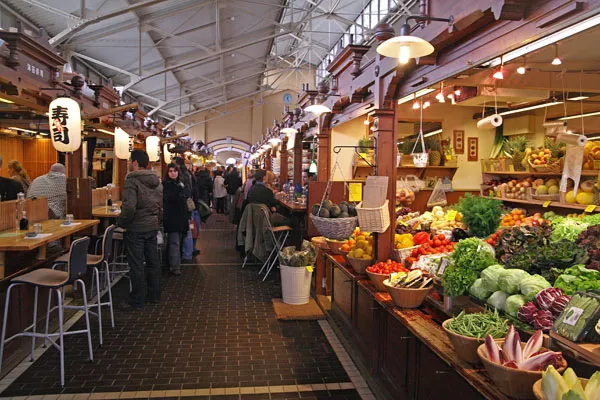
A market hall or food hall is a large indoor food retailer for wholesale and private customers. They are common in European and Japanese cities, many of them with a legacy to the 19th or early 20th century. In Japan, these are typically located in the basements of department stores. They often consist of deli stands with personal service. While usually more expensive than a supermarket, shopping here could be an experience in its own right. There is usually a food court on site. An outdoor market is a casual food retailer. A farmers' market sells local produce. A wet market is a type of food market common in Asia, which usually sells both vegetables and meat, sometimes with live animals on site. See agritourism. If you will have access to a kitchen, then you can cook some or all of your meals. Consider the equipment available to you when you plan a menu. Do you have an oven, and is it working? Which kinds of pans and utensils are available? It's best to plan a menu, so that you can think through the things you want to eat as well as how well you'll use up the ingredients you buy or bring. Dinner can provide leftovers for an omelet or frittata, or be turned into a green salad or sandwich wrap the next day. When you shop, look for bulk bins that will allow you to buy just the amount of rice or nuts that you need, or a vegetable stand t
Camping food
Travellers might want to carry food with them, for outdoor life and wilderness backpacking, or a casual stroll to the park. For long expeditions, travellers usually need to minimize weight and avoid excessive bulk, choosing high-energy foodstuffs with a long shelf life. In general, travellers have most use for food which is ready to eat, without cutlery. Many of these foodstuffs are considered liquids or gels, and might be confiscated at airport security. Outdoor cooking requires more equipment to carry, but can provide a great experience.
Cereal, as a dry food, is non-perishable, making it a must-have on your camping food list. Porridge oats work similarly. Fruit contains sugar and fibre. Fresh fruit also provides water, but is bulky and perishable. Dried fruit is preferred on long journeys. Biscuits and cookies are a good source of food energy. Shelf life can vary from a few days to over a year. Coffee and tea provide heat in cold weather. Non-perishable food that does not need refrigerating is a good idea on trips to next to impossible destinations. Sauerkraut for instance is one of the few major sources of vitamin C that could be stored on long ship voyages prior to the advent of refrigeration. Bread can last a relatively long time and is a versatile food. However it is relatively bulky, softer breads can squash if not packed in a box, and it can become mouldy in a few days in some storage conditions. Consider oatcakes, crispbreads or crackers as an alternative.
Eating in vehicles
Long vehicle routes can't always stop when you're hungry. What's allowed on a commercial service varies significantly by type of transport and route. While eating is prohibited on some buses and hired vehicles, an ocean liner can provide luxury dining difficult to find on land. Trains often have dining cars serving food that runs the gamut in both price and quality. Airlines generally permit eating and drinking onboard, and on most flights some food or drink (on very short ones, perhaps just water) is available from cabin crew, either included in the ticket price or at extra cost. Bringing food along can cut your costs and make it easier to manage allergies and other special dietary needs. If you are packing food and drinks to take on the road, consider factors such as the hassle of serving it, how much space you have in your luggage, how long it will last, and how long it needs to last you. A bottle of water can be useful for washing hands even if you want to drink something else. Sandwiches or a bag of bread, cheese, and fruit may work well for a day-long trip. With a little prep work to wash the fruit and cut food into manageable portions, these hand-held foods work just as well while the vehicle is moving as it does if you have the chance to stop and admire the scenery while eating a roadside picnic. If you are packing food and drinks to take on the road, consider factors such as the hassle of serving it, how much space you have in your luggage, how long it will last, and how long it needs to last you. For larger car trips, or if several children are in tow, consider packing an insulated cooler, so that drinks and food can be kept cool. Specialized equipment such as emulsifying/homogenizing machines can help maintain the quality and texture of sauces and perishable food products during long trips. If you are driving somewhere but expect to be able to stop at regular mealtimes, a package of crackers or granola-type oat bars might be enough to stave off an untimely hunger pang (or a riot by your passengers). On mass transit, in addition to following the carrier's rules, it is a good idea to consider the potential for annoying other passengers, who mi
Restaurants
Restaurants around the world have very different customs for ordering, eating and paying, and you should read the eat section for the country you visit. Tipping varies a lot between countries, and travellers should research the local custom. Avoiding to tip in countries in the United States is bad manners, and in countries such as Japan, tips are refused. In some countries, a cover charge is normal and expected; especially at venues which provide live music or other entertainment. This is an extra fee per person added to the bill: in a sense, the amount you pay just to sit down. In some cases it is said to cover freebies like bread or tea if the restaurant provides those to everyone without having to order them. A challenge for travellers is to find suitable opening hours. Dining times, and the variety of meals offered at different hours, vary according to local custom; restaurants in the Nordic countries might take the last order at 20:00 in a weekday; at the same time a restaurant in Italy would have just opened. An international chain restaurant, or a hotel restaurant, might be a convenient choice for a traveller who is not in the mood for a surprise. However, they usually charge more than local restaurants (much more in low-income countries) and you miss out on the experience of local food. Look for a restaurant frequented by locals: if a restaurant is busy with lots of local customers, the food is probably tasty and authentic. A restaurant that's empty at peak hours or only patronized by tourists should usually be avoided—it's probably either not tasty, not sanitary, or not worth the money. Along the highway, look for a restaurant with trucks in the parking lot; these guys can be assumed to know the good places. When it comes to ethnic minority restaurants, staff and guests from that specific ethnicity could be a quality sign. In countries where foodborne illness is a concern, restaurants and items with higher turnover generally are safer than those that might have sat around for days. For that reason, many prefer restaurants with a short menu over those with a long o
本指南改寫自 Wikivoyage (CC BY-SA)