
Earthquake safety
旅遊主題
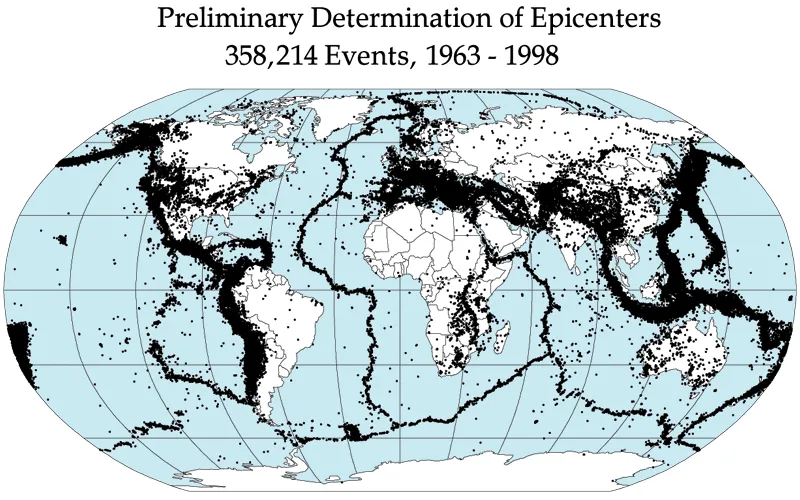
Earthquakes are some of the most serious natural disasters. Fortunately major earthquakes occur, even on a global scale, only a few times a year and hence short-term visitors are very unlikely to end up in one. Nevertheless, if you do end up in one, there is a serious risk to your life and health.
Understand
Minor earthquakes that are hardly noticeable can occur anywhere in the world. The truly disastrous ones occur mostly in these regions:
the Alpide belt area from Italy to southern China (roughly along the Silk Road), including much of the Balkans, Turkey, Iran and the Himalayas (Nepal, Bhutan, Northeast India, Sikkim, Kashmir, Gilgit-Baltistan, eastern Afghanistan, Tibet, Sichuan, Yunnan) along the Pacific rim (New Zealand, Indonesia, Philippines, Taiwan, Japan, Russian Far East and the west coast of the Americas from Alaska to Tierra del Fuego), also known as the Ring of Fire in the Caribbean These areas are known as convergent tectonic boundaries. In these areas, tectonic plates (that form the crust of the Earth) are pushed towards each other and when they get stuck, stress builds up. When they break free, the sudden release of this stress is experienced as an earthquake. In places where tectonic plates are moving away from each other (e.g. Iceland) you will encounter other phenomena associated with tectonic boundaries, such as volcanoes, but rarely major earthquakes. Earthquakes can cause tsunamis, which can wreak havoc thousands of miles away, on the other side of an ocean. Sometimes, earthquakes can also occur away from tectonic plate boundaries. These are known as intraplate earthquakes. While they are much rarer and usually less intense than the earthquakes that occur at the plate boundaries, they are often more devastating due to the fact that the areas where they occur are often not prepared for them. One of the most devastating examples of an intraplate earthquake is the 1976 Tangshan earthquake in China. Large earthquakes may destroy buildings and other infrastructure. During a major earthquake, expect windows to shatter, trees to fall and things to be thrown around. However, the danger isn't over once the quake has ended. Buildings that have been damaged by the earthquake can suddenly collapse, and severed gas pipes and power lines can cause fires. Landslides and soil liquefaction can make buildings and other infrastructure move, sink or collapse. In addition to all this, roads, water, electricity (and therefore communication) and other utility line
Prepare
In general, locals in earthquake-prone areas should know how to act if and when shaking starts. Follow their advice and example. If you are in an earthquake zone, always keep your travel documents (tickets, passport, etc.), money and important personal belongings in a place where you can easily grab them if you need to escape—though you should not make them so visible that they attract thieves. Keep a pair of shoes near your bed. If an earthquake strikes at night while you're sleeping, you'll want to put shoes on in case there's broken glass. Also, you may want to survey some ways for getting out in case the front door has collapsed or been blocked by debris or fire. If you stay at a hotel, have a look at the map of emergency exits on the inside of your room door. Emergency exits are usually designed to better evacuate a building in case of fire; however, they may also provide means of escaping a building you fear might collapse due to seismic damage. In the worst-case scenario, you may have to go out of the window and climb down along a downspout or even jump. Do not put heavy objects in high places, especially above your bed.
Longer stays If you are going to stay for a longer time in an earthquake-risk area, you may want to prepare an earthquake survival kit. This would include at least:
3 to 5 days provisions of food and water (1 gallon (4 L)/person/day), as well as water purification tablets or a portable water filter First aid kit, gloves, goggles and a dust mask Personal toiletries Copies of your important documents (passport, driver's license, insurance papers, etc.) as well as photos of everyone in your party (for helping emergency staff to look for missing persons) Emergency contact information on your person, so that authorities can contact your family/friends should you be found Cash ($100 at least), in small denominations, preferably local currency or a widely accepted "hard currency" Spare batteries, flashlights and a battery-operated radio In addition, if applicable, you would also want to make your place of abode more earthquake safe (don't keep a lot of loose objects at high places, make sure that shelves are well fastened to walls, etc.) a
During an earthquake
Earthquakes are unpredictable—they will often just start without any prior warning signs. However, an earthquake will spread out of the epicenter with a speed of about 7 km/s, and this has been used to develop an early warning system for earthquakes, giving people further away a warning on TV, radio and to people's cell phones in the affected area a few seconds before the quake will come to them. Such early warning systems has been used in Japan for many years, but many a government and private companies in other earthquake-prone countries have developed their own systems. For example, Google has developed the Android Earthquake Alert System; the accelerometers in smartphones make them mini-seismometers, so combining the data from thousands of shaking phones allows the system to detect an earthquake and send alerts to other Android-powered devices. If you get a warning, you may have barely enough time to extinguish any open fires (gas stoves, candles, etc.), or bring your car to a safe stop if you are driving. The main goal is to take cover immediately! Do not run during the quake! Standing up, walking and, most of all, running are things that you should avoid as you are likely to fall over and thereby injure yourself. Crawling may be the only way of getting around if you absolutely have to. A moderate-to-large earthquake usually persists less than a minute (though the exceptionally powerful 2011 Japan earthquake lasted for six minutes), but that is more than long enough to cause damage. Often it will be followed by aftershocks. Do not be complacent after an earthquake seems to be over—get to safety!
If you are indoors The U.S. FEMA and the New Zealand Civil Defence give the advice "Drop, Cover and Hold" in the case of an earthquake. Stay indoors. Get down on the floor on your knees and bow down, cover your head and neck, and take cover under a table, desk, or some other sturdy furniture if possible. Hold on to the table to prevent the shaking from separating you from your cover. If possible, shelter under furniture that is next to interior walls, away from windows and tall furniture (such as wardrobes and tall shelves), which could topple over on you. Yo
After the earthquake
After the shaking has ended it's safe(r) to move again. Remember that earthquakes are often followed by smaller quakes called aftershocks that can occur minutes, hours or even days or months after the original quake. In the case of an aftershock, follow the same procedures as above. Try to open up the door or a window as soon as possible, and keep it open by using something such as a doorstop in case it jams.
Get out If you are indoors, move out. In the worst case, the building has been damaged and may collapse. Move carefully as the light may not be working and there may be broken glass, other debris and live wires around. Small fires should be extinguished and dangerous chemicals cleaned up if you can do so safely. If you're staying at a building that you're responsible for (rented vacation home, etc.), check for damaged utilities, and if needed, turn off the gas and electricity from the meter — again, only if you can do it safely and if you know what you're doing. If you've been trapped inside a building, avoid lighting matches or kicking up or inhaling dust. Tap on walls or pipes so that rescue crews know that you're there. In built-up areas, if you move around outside on foot, be aware of potholes on roads and the fact that buildings, bridges, street lights, trees and such may not be standing as firmly as before the quake. If you are moving around in the wilderness, wat
本指南改寫自 Wikivoyage (CC BY-SA)