Astronomers Discover New Black Hole Object in Orion Constellation
Astronomers who have been searching for the enigmatic little dots for four years have announced the discovery of a new type of celestial object. Astronomer
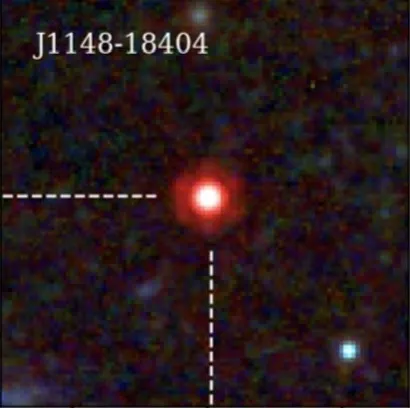
Astronomers who have been searching for the enigmatic little dots for four years have announced the discovery of a new type of celestial object. Astronomers have announced in the journal Nature that after four years of effort, they have finally uncovered the truth behind the little dots, which were discovered four years ago by the James Webb Space Telescope, and are referred to as "Little Red Dots" (LRD) in the telescope's catalog. The latest research findings have revealed that these little red dots are actually a new type of celestial object, known as MoM-BH*-1, located in the constellation of Orion, which is similar in size to the solar system, and exhibits a pure spectrum with intense light, far surpassing that of its host galaxy.
Behind the discovery of the enigmatic little dots lies a history of research by astronomers on these objects. The little red dots were discovered by the James Webb Space Telescope, and date back to 13.2 to 12.2 billion years ago, or 0.6 to 1.6 billion years after the Big Bang. Approximately 6 million years ago, the number of these little dots reached its peak, and currently, 341 little red dots have been discovered. Early research suggested that these little red dots might be a form of primitive galaxy, but this theory was also questioned, as the characteristics of the little red dots differ from those of known galaxies and supermassive black holes.
Another theory proposed that these little red dots are supermassive primitive stars, also known as third-generation stars, and this theory was put forward due to the fact that the spectral characteristics of these little red dots match those of this type of star. When this theory was proposed, astronomers began to study the behavior and properties of this new type of celestial object. This discovery has significant implications for our understanding of celestial objects and the formation of the universe.
This discovery has also sparked further research and exploration, as astronomers are working to understand the properties and behavior of these black hole stars, making important contributions to our understanding of celestial objects and the universe. For our understanding of the mysteries of the universe, this discovery will provide more clues and information.
For Taiwan, this discovery does not have a direct impact on our daily lives, but it makes an important contribution to our understanding of the mysteries of the universe. This also demonstrates human ability and spirit in exploring the universe, providing hope and guidance for our future.
Produced by our editorial team, with AI assistance in editing.