
Adam's Peak
Sri Lanka · Asia
About
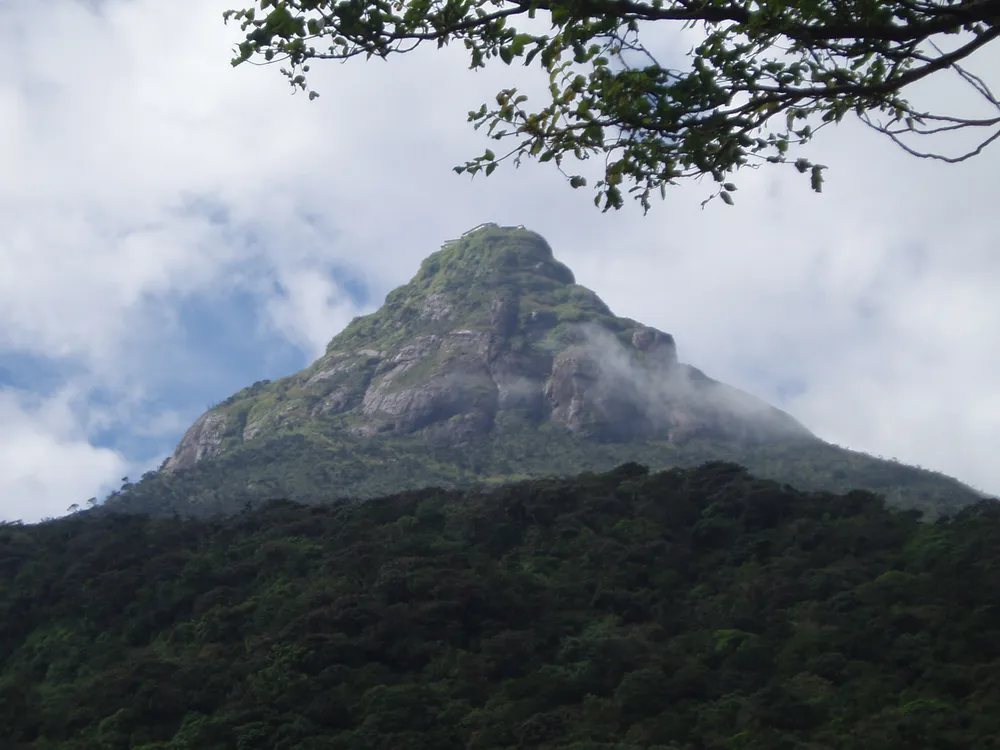
Adam's Peak is a 2,243-metre-tall (7,359-foot) conical sacred mountain and place of pilgrimage in central Sri Lanka, famous for the Sri Pada (IAST: Śrī Pāda; Sinhala: ශ්රී පාද, lit. 'sacred footprint'), a 1.8 m (5 ft 11 in) hollow, footprint-like rock formation near the summit whose name is also used for the mountain itself. The formation is identified differently by adherents of several religious traditions: in Buddhist tradition as the footprint of the Buddha; in Sri Lankan Hindu tradition as that of Hanuman or Shiva (its Tamil name, சிவனொளிபாதமலை, Sivanolipaathamalai, means 'Mountain of Shiva's Light'); and in some Islamic and Christian traditions as that of Adam or St. Thomas the Apostle. In Buddhist sources the mountain is also known as Mount Malaya, particularly in the Mahayana Lankavatara Sutra, which states that the Buddha preached the sutra on its summit and describes the mountain as the abode of Ravana, overlord of the Rakshasas and ruler of Lanka. Other names found in Sanskrit sources include Mount Lanka, Ratnagiri ("Mountain of Gems"), Malayagiri, and Mount Rohana. Adam's Peak is also regarded as the abode of the deity Saman and consequently bears several names associated with him, including Samanthakūta in Pali and Samonalakanda ("Mountain of Saman").
The mountain is located in the southern reaches of the Central Highlands in the Ratnapura District and Nuwara Eliya District of the Sabaragamuwa Province and Central Province—lying about 40 km (25 mi) northeast of Ratnapura and 32 km (20 mi) southwest of Hatton. The surrounding region is largely forested hills with no mountain of comparable size nearby. The region along the mountain is a wildlife reserve, housing many species varying from elephants to leopards, and including many endemic species. Adam's Peak is important as a watershed. The districts to the south and the east of Adam's Peak yield precious stones—emeralds, rubies and sapphires, for which the island has been famous, and which earned for it the ancient name of Ratnadvipa. Adam's Peak is the source of three major rivers in Sri Lanka: Kelani River, Walawe River, and the Kalu Ganga (river).
Access to the mountain is possible by six trails: Ratnapura–Palabaddala, Hatton–Nallathanni, Kuruwita–Erathna, Murraywatte, Mookuwatte and Malimboda. The Nallathanni and Palabaddala routes are most favoured because they are shorter, better developed with facilities such as tea shops and lighting, and more accessible from transport hubs. The Kuruwita–Erathna trail is used less often because it is longer, more strenuous, less convenient to reach, and less supported by facilities compared to the more popular routes. These trails are linked to major cities or towns by bus, accounting for their popular use. The Murraywatte, Mookuwatte and Malimboda routes are seldom used but do intersect with the Palabaddala road midway through the ascent. The usual route taken by most pilgrims is ascent via Hatton and descent via Ratnapura. Although the Hatton trail is the steepest, it is also shorter than any of the other trails by approximately five kilometres. Once one of the starting 'nodes' of Palabadalla, Nallathanni or Erathna is reached, the rest of the ascent is done on foot through the forested mountainside on the steps built into it. The greater part of the track leading from the base to the summit consists of thousands of steps built in cement or rough stones. The trails are illuminated with electric light during the six-months period considered in-season, making night-time ascent possible and safe to do even when accompanied by children. Rest stops and wayside shops along the trails serve refreshments and supplies during the same period. Whilst there are many ancient monuments on the mountain, there is an important Peace Pagoda located halfway up, built by Nipponzan Myohoji in 1978.
Adapted from Wikipedia (CC BY-SA). Photography via Wikimedia Commons.