
Canaima National Park
Venezuela · Americas
About
Canaima National Park (Spanish: Parque Nacional Canaima) is a 30,000 km2 (12,000 sq mi) park in south-eastern Venezuela that roughly occupies the same area as the Gran Sabana region. It is located in Bolívar State, reaching the borders with Brazil and Guyana. The park was named a World Heritage Site by UNESCO.
Canaima National Park was established on 12 June 1962. As early as 1990, the countries that participate in the Amazonian Cooperation Treaty had recommended expanding the Canaima National Park southward to connect it with Monte Roraima National Park in Brazil, with coordinated management of tourism, research and conservation. In 1994, the Canaima National Park was named a World Heritage Site by UNESCO. The International Union for Conservation of Nature performed a conservation assessment in 2017, which listed Canaima National Park as an area of significant concern, citing ineffective protection and management.
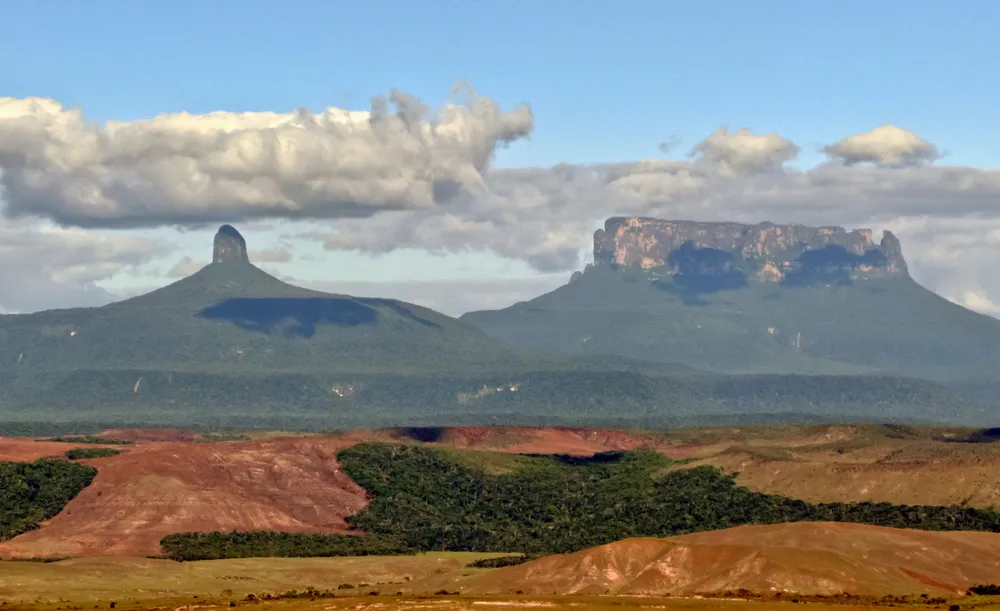
Canaima National Park is the second largest park in Venezuela, after Parima-Tapirapecó, and sixth biggest national park in the world. It is roughly the same size as Belgium or Maryland. The park protects part of the Guayanan Highlands moist forests ecoregion. About 65% of the park is occupied by plateaus of rock called tepuis, which are a kind of table-top mountain millions of years old, with vertical walls and almost flat tops. These constitute a unique biological environment and are also of great geological interest. Their sheer cliffs and waterfalls including Angel Falls, which is the highest waterfall in the world, at 979 metres (3,212 ft). The most famous tepuis in the park are Mount Roraima, the tallest and easiest to climb, and Auyantepui, the site of Angel Falls. The tepuis are sandstone and date back to a time when South America and Africa were part of a super-continent. The park is home to indigenous Pemon Indians, part of the Carib linguistic group. The Pemon have an intimate relationship with the tepuis, and believe they are the home of the 'Mawari' spirits. The park is relatively remote, with only a few roads connecting towns. Most transport within the park is done by light plane from the airstrips built by various Capuchin missions, or by foot and canoe.
Canaima has a varied fauna, which is distributed throughout the park according to multiple environmental factors such as altitude and vegetation type. Among the species found are:
Giant armadillo (Priodontes maximus) Giant otter (Pteronura brasiliensis) Giant anteater (Myrmecophaga tridactyla) Cougar (Puma concolor) Jaguar (Panthera onca) Linnaeus's two-toed sloth (Choloepus didactylus) White-faced saki (Pithecia pithecia) Brown-backed bearded saki (Chiropotes israelita) Roraima mouse (Podoxymys roraimae) Tyleria mouse opossum (Marmosa tyleriana) Harpy eagle (Harpia harpyja) Red-shouldered macaw (Diopsittaca nobilis) Dusky parrot (Pionus fuscus) Yellow-banded poison dart frog (Dendrobates leucomelas) Green iguana (Iguana iguana) Hummingbirds (Trochilinae) Toucans (Ramphastidae) South American bushmaster (Lachesis muta) Green acouchi (Myoprocta pratti) Bush dog (Speothos venaticus) Canaima National Park is among one of several dozen regions in Venezuela that has been identified as an Important Bird and Biodiversity Area (IBAs) by BirdLife International, a global cooperative of non-governmental organizations focused on the conservation of the world’s birds and their natural habitats.
There are over 300 botanical species endemic only to La Gran Sabana. Some endemic plant species are categorized as "carnivorous", which are thus the food supply (mainly insects) that are so scarce in the mountains.
Adapted from Wikipedia (CC BY-SA). Photography via Wikimedia Commons.