
Zacatlán
Mexico · Americas
About Zacatlán
Zacatlán is an historic small town in the northern reaches of Puebla, Mexico. The area around town is hilly as the town lies in an area of the Sierra Madre Oriental mountain range that's locally known as the Sierra Norte. It's an area surrounded in apple orchards, eventually giving way to mountain forests, streams and even a few waterfalls. The town displays a lot of colonial charm, with a beautiful town square, a 16th-century church, cobblestone streets, and a propensity for red tile roofs. Clocks are a big thing here, owing to the presence of a company making "monumental" clocks (think big clocks!)
Zacatlán travel guide
Understand
The city takes its name from the first known settlers, the Zacateca people, who moved here in 583 AD. In the 12th century, they experienced a minor wave of immigration from Chichimecs, Olmecas, and Toltecs. In the late 15th century, the town was invaded by the Aztecs (Mexicas) and was forced to pay tribute to the Triple Alliance until the arrival of Spanish conquistadors. The first Spanish governor was Hernán López de Avila, in 1522. One of his first acts was to round up most of the indigenous people and move them to Tenamitac, then 40 years later, turn around and move them back to Zacatlán, by which time Franciscan monks had shown up to start civilizing the natives through Christian gospel and plenty of hard work building a monastery to support even more monks. That first monastery was the Ex-convento San Pedro, established in 1562 (still the town's main church). The town's first apple trees were planted in the early 1600s, and have flourished ever since. Zacatlán is sometimes referred to as Zacatlán de las Manzanas. The town manufactured guns during the Mexican War of Independence. It served as the Puebla state capital for a period during the 19th century. The town is one of Mexico's Pueblos Magicos. In 2010, it was home to 34,000 people.
Landscape
There are 14 mountains within a half-hour drive of town. Many of these offer outstanding hiking and rappelling opportunities. A number of rivers and streams flow from these mountains, including the Rio Ajajalpan, which flows through Zacatlán and is a main tributary for the Rio Tecolutla. Where there's mountains and rivers, there's often waterfalls, and that is certainly the case in Zacatlan. The largest local waterfall is Cascada Tulimán, which drops 250 to 300 meters. Zacatlán is blessed with cool weather most of the year and frequent rainfalls all year round. Most mornings and late evenings are foggy and photographers can often get some amazing fog shrouded photos of local landmarks if they get out early enough.
Getting there
By bus From Mexico City, ATAH has 2 direct buses daily to Zacatlan and several more that connect in Apizaco. It's a 3-hour ride and will cost from M$100 to M$400 depending on bus class and demand. Buses depart from Mexico City's TAPO bus terminal. ATAH operates hourly buses from Puebla's CAPU bus terminal to Zacatlan. The 2½ hour trip costs M$60 to M$400 (depending on time and class). Combis operate between Apizaco and Zacatlan. Futura also operates buses to Zacatlan, leaving Mexico City from Central Autobuses del Norte.
1 Central de Autobuses Zacatlan, Barrio San Bartolo. Small, clean waiting room with restrooms. Serves ATAH and Supra bus lines with first-class and ejecutivo buses. It's about 1.5 km from the bus station to the zocalo, so you'll probably want a taxi. There are also combis leaving from the bus station that will take you downtown for M$8.
Getting around
Zacatlan is a compact, easily walkable city, but you'll want to use a taxi for some of the outlying attractions, such as waterfalls. A taxi sitio in el Centro on Av. Luis Cabrera Lobato near the zocalo.
See
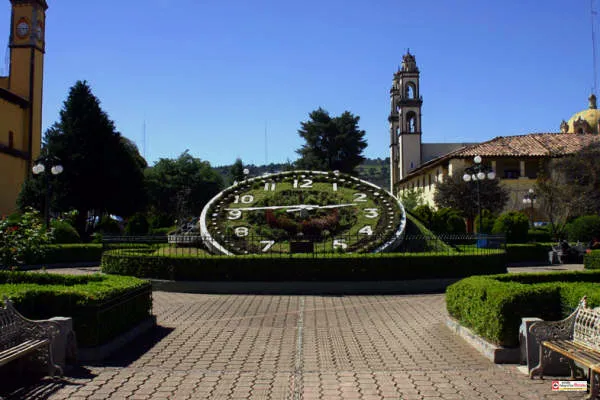
1 Relojes Centenario (Clock Museum), C. Nigromante 3, Centro, ☏ +52 797 975 0050. M-F 08:00 - 16:00, Sa 08:00 - 13:00, closed Su. Clock company established in 1921 by Alberto Olvera Hernandez. The company makes only "monumental" clocks, such as those on government buildings, railway stations and church clock towers. The company built the large flower clock in the town square and thousands of highly visible big clocks throughout Mexico and the world. They also repair historic clocks, including those built in Germany and France. The factory is open for public tours and the upper level of the factory includes a clock museum, open to the public free of charge. 2 Zocalo (Main square). The town's plaza principal is a great place for hanging out, relaxing on a park bench, and doing some serious people watching. It's also the place you'll find some of the town's most iconic sights for your Instagram photos, like the huge clock of flowers (made by the town's famous clock company). There's also a tourist information booth if you want some local tips or more ideas for things to do.
3 Panteón, Paseo de La Barranca o 11 Oriente. 08:00 - 22:00. The cemetery is somber and filled with dozens of impressive monuments and mausoleums, it's especially spooky early in the morning when fog makes it look like the setting of a horror movie. The star of the Panteon is the wide variety of amazing murals that fill all of its walls for blocks. It's bright, colorful and very inviting, making it a place that locals are just dying to get into.
4 Parroquia de San Pedro (St Peters Church), Lic. Luis Cabrera Lobato, Centro. Clean, austere looking church with interesting side chapels, including one devoted to the Virgen of Guadalupe. A place for peaceful contemplation. Located next to the Ex-convento (monastery) from the 17th century. 5 Vitromurales (Callejon de los Huesos), Calle Nigromante, Centro. There is a series of mosaic murals downtown created by contemporary artists using colored glass
Do
1 Barranca de los Jilgueros (Goldfinch Canyon), Paseo de la Barranca. Wide canyon with a deep, forested valley. Very scenic and an enormously popular place for sightseers and nature lovers. There are some good viewpoints if you walk along Paseo de la Barranca, but most tourists flock to the glass overlook (Puente Cristal Mirador) near the Panteon, though the glass floor of the observation deck gives some people vertigo. You can hike into the canyon, there are some areas for rapelling and camping. A zip-line route over the canyon provides the biggest thrills in town, and you can even do it at night.
Festivals Feria de la Manzana - week long festival held in August each year since 1941, lots of food, regional folk dances (and danzon; a local favorite), symphony performances, and concerts by some of the biggest names in Latin music (past performers included Juan Gabriel; Alejandro Fernández; Aleks Syntek and Grupo Elefante). In addition to thousands of crates of apples, there's also plums and pears (Mom always said to eat a balanced diet). Festival de la Sidra - where there's apples, there's bound to be cider, and Zacatlán produces more than a million bottles of the sweet elixir each year. The Cider Festival takes place in November. Festival Cuaxochitl- each May, the historically indigenous villages around Zacatlan get together for an annual festival of historic cultural activities, traditions, and to hobnob with fellow speakers of Nahuatl and other indigenous languages. Indigenous folk crafts are displayed (and sold) and indigenous foods are available.
Eat
Everything great about Puebla's regional cuisine can be found in Zacatlan, but the town also has some niche specialties of its own. Zacatlan is known regionally for their empanadas, or other wrapped pastries, filled with cheese. Look for things like apastelada con queso, picado con queso, and similar varieties. Ask the server if you want to know t
Overview adapted from Wikipedia, travel guide fromWikivoyage (CC BY-SA). Photography via Wikimedia Commons.