
Ypres
Belgium · Europe
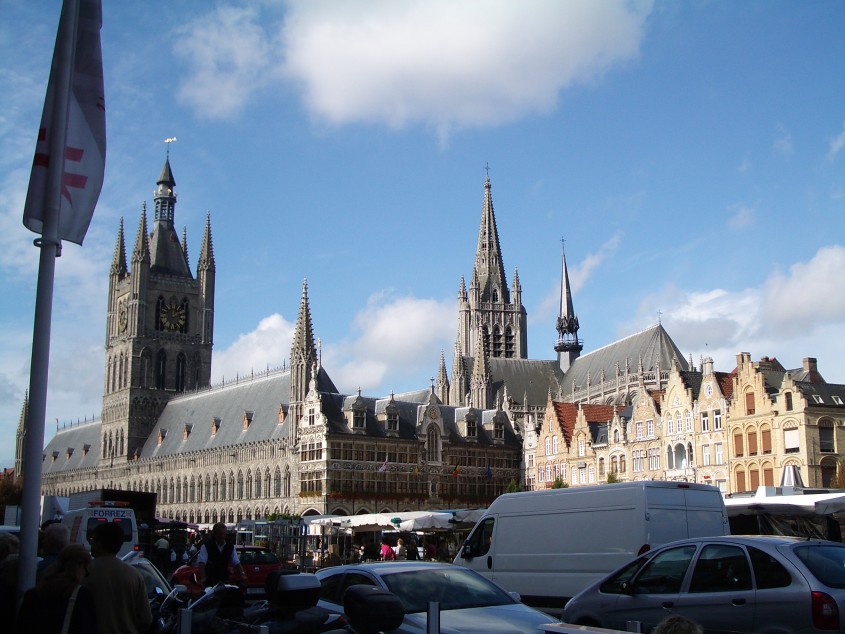
About Ypres
Ypres (Dutch: Ieper, both pronounced "eeper") is a friendly town of 35,000 inhabitants in Flanders endowed with wonderful architecture and a troubled past. Ypres is best known as the site of three major battles of the First World War, the most famous being the Battle of Passchendaele from July to November 1917. The many memorials and cemeteries of the fallen in and around Ypres draw thousands of visitors each year. The belfry of Ypres is a UNESCO World Heritage Site.
Ypres travel guide
Understand
Town name and languages The official Dutch name for the city is Ieper - this is the version of the name you will see most commonly in and around the Flemish-speaking town. Most native English speakers, however, will know the town by its French name Ypres, as popularised in media and history texts during and immediately after the First World War.
History The town of Ypres formed the centre of the so-called "Ypres Salient" during most of the First World War—an area of Allied (British and Belgian)-held land surrounded on three sides by the German front line that formed the northernmost section of the Western Front. Holding Ypres was vital for the Allies in their bid to prevent the Germans from gaining control of all the Channel ports, vital for the transport and supply of the British Expeditionary Force. As a result, the city became the focus of several major battles to break in and out of the Salient and was subjected to fairly continuous bombardment by German artillery for most of the war. By 1918, little remained of the town but shattered ruins surrounded by muddy shell-pocked fields. After the First World War, most of central Ypres was rebuilt with German reparations (war debt) money. This was a lengthy process: the famous Cloth Hall was not completed until the 1960s.
Getting there
By train Ypres has its own 1 Train Station. From there, you can easily walk to the city center. But the station is poorly served, causing slow connections to most other towns a bit further away.
By bus Ypres has bus lines towards neighbouring towns.
By car Ypres is easily reachable by car - highway to Kortrijk, then follow directions for Ieper (A19). From the ports of Calais or Dunkirk, take the A16 East, turning off at junction 28 (A25 towards Lille). Get off at Junction 13 and follow the signs for Ypres (Ieper). Ypres isn't big, so it's perfectly traversable by car. You can park at the main square, in front of the cloth hall for a small fee (except during the weekly or other market), or freely near to the train station. A car also allows you to visit places further on such as the various cemeteries.
By bicycle Although it's a nice region to cycle, the distances are often too far when you have a specific destination outside the city centre.
Getting around
Ypres city centre is best approached on foot. For visiting the war graves and memorials, one could use a car or cycle. Take the guided "Battle field tour" - bus, or buy an audio tour on the internet - same sites, but a lot cheaper if you have your own transport
See
The attractions of Ypres are divided between the town center and several villages in the surrounding countryside - most of the battlefields and cemeteries are in the latter. For these, a car, bike or an arranged tour would be best.
Landmarks and memorials 1 Menin Gate Memorial (Menenpoort). Dedicated on 24 July 1927 as a memorial to the missing British and Commonwealth soldiers who fell in Belgium during World War One. Has a Last Post Ceremony each night at 20:00 as a way for the Ypres citizens to express their gratitude towards those who died for Belgium's freedom. This memorial contains huge panels inside and out into which are carved the names of the 54,896 officers and men of the British Empire forces who died in the Ypres Salient area and who have no known graves. The names recorded on the gate's panels are those of men who died in the area between the outbreak of the war in 1914 and 15 August 1917. The names of a further 34,984 of the missing - those who died between 16 August 1917 and the end of the war, are recorded on carved panels at Tyne Cot Cemetery, on the slopes just below Passchendaele. The first Cloth Hall was built around 1200 as a center of Flemish wealth, and completely destroyed by German artillery shelling in 1916. The Cloth Hall was rebuilt in 1962 as the symbol of a resurgent city. Contains the In Flanders Fields Museum (see below). 2 In Flanders Fields Museum (in the Ypres Cloth Hall; in the center). Apr-Sep: daily 10:00-18:00, Oct-Mar: Tu-Su 10:00—17:00, last entry 1 hr before closing. This museum gives an excellent overview of World War I. It is more like an experience that takes you right into daily life during the war. The experience is very moving, and it's a must-see for everyone coming to Ypres, young and old. Allow at least 2 hr for a full museum visit. When the weather is good enough, the belfry tower is also available for visiting for an additional cost, giving you a great overview of the front region. €9, youths 18-25 €4, child
Do
Wonderful countryside with many routes for walking and cycling. Ballonvaart Westhoek. Daily hot air balloon flights over battlefields around Ypres. The best way to see the impact of the war from the sky. See the large number of bomb craters (now lakes), cemeteries, and trenches. (updated Jan 2024) 1 Bellewaerde theme park, Meenseweg 497, ☏ +32 57 46 86 86. Bellewaerde was established in 1954 as a zoo and safari park. The park evolved into a theme park. Bellewaerde attracts 850,000-900,000 visitors a year and is one of the main theme parks in Flanders. (updated Jun 2017)
Events Kattenstoet. A parade in Ypres devoted to the cat. It is held every third year on the second Sunday of May. This "Festival of the Cats" commemorates an Ypres tradition from the Middle Ages in which cats were thrown from the belfry tower of the Cloth Hall to the town square below. Symbolically reviving this practice for the parade festivities, a jester tosses stuffed toy cats from the Cloth Hall belfry down to the crowd, which awaits with outstretched arms to catch one. The throwing of the cats from the belfry is followed by a mock witch burning.
Buy
Lovely shops and cafes selling Belgian chocolates and beer. Things from the World War I period in dedicated shops, for example near the Menin Gate.
Eat
The marketplace has several restaurants, pubs and places to sit outside during the summer. Tuesdays usually host a music night outside, organised by "'t Klein Stadhuis" next to the cloth halls and the city hall.
1 Frituur De Leet, Vandenpeereboomplein 43, ☏ +32 57 21 25 55. Tu-Su 11:30-14:30 and 17:30-23:00, M closed. Belgian fries and other fast food. (updated Jan 2018)
Sleep
The region around Ypres has many small B&Bs, and in the city centre, there are also several hotels.
1 Ambrosia Hotel Ieper (Ambrosia b&b Ypres), D'Hondtstraat 54, ☏ +32 476 467-016. Small hotel (10 rooms). Cooked and/or continental breakfast and free internet. 2 Cherry Blossom B&B (between Ypres and Poperinge). English family-run B&B. Motorcyclists and children are welcome. Evening meals and packed lunches by arrangement. Tea and coffee-making facilities/TV in all rooms. A small collection of artifacts to view. 3 B&B Fresco, Kunstenlaan 38 (10 min walking distance up from the station), ☏ +32 57 200137. Check-in: flexible, check-out: flexible. English, French, German, and Flemish spoken. The hosts are very friendly. Wi-Fi, terrace, privatised floor with fridge, big comfortable rooms, nice bathroom with
Overview adapted from Wikipedia, travel guide fromWikivoyage (CC BY-SA). Photography via Wikimedia Commons.