
West Java
Indonesia · Asia
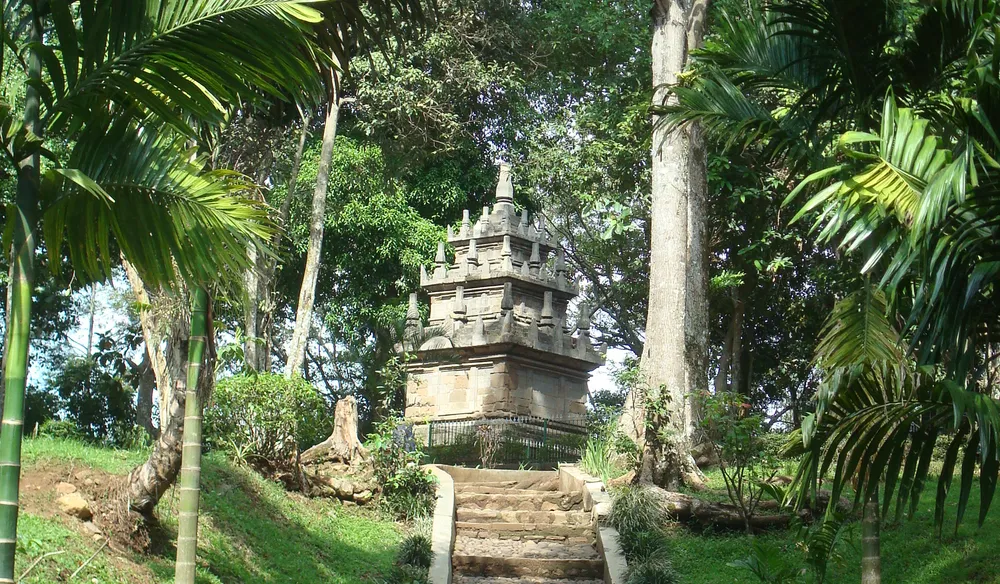
About West Java
Western Java is the western third of the island of Java, Indonesia. It covers from west to east the province of Banten, the Jakarta Special Capital Region (DKI Jakarta), and the province of West Java (Jawa Barat). Western Java is one of the most densely populated regions on earth, but still there are extensive natural areas of impassable rainforest, as well as many active volcanoes and secluded beaches.
West Java travel guide
Understand
Western Java is very densely populated, with 73 million people living on an area of about 45,000 m2 (a similar area to the country of Estonia or the US state of Pennsylvania), or a population density of on average more than 1,600 people per km2. However, the population density is very unevenly divided, with especially many people living in the Greater Jakarta area and a few other urban areas, while much of the remainder of the region consists of rainforest and volcanoes where only few people live.
History
For almost 1000 years, from the 7th century to the 16th century, Western Java was under control of the Hindu kingdoms of Sunda (centred in Bogor Raya) and Galuh (centred in East Parahyangan). In turn, for many centuries these kingdoms were under domination of the Buddhist Srivijaya Kingdom from Sumatra. In the 16th century, the kingdoms lost their territory quickly to the newly established Islamic sultanates of Banten and Cirebon, and Islam spread among most of the population. This is the case until today, although Islam in the region is still influenced by Hindu, Buddhist, and animist beliefs. Soon after, also the European colonists (mainly the Portuguese and the Dutch) came to the Indonesian archipelago and to Western Java. The Dutch East India Company (VOC) established a trading post near the port of Sunda Kelapa (in present-day North Jakarta) in 1611, and by 1619 a fort was built, named Batavia. For two centuries, the Dutch administration in Batavia coexisted with the sultanates of Banten and Cirebon, but the power of the colonial power steadily increased. By the early 18th century the entire Parahyangan mountain region was under control of the Dutch, and by the early 19th century the sultanates were no more than protectorates under Dutch rule.
In 1798 the VOC was dissolved, and the colony was taken over by the Dutch state to become the Dutch East Indies. Soon after, the Great Post Road was constructed across Java to be able to quickly move troops in case
Getting there
By plane The new Kertajati International Airport (KJT IATA) is intended to be the main airport of the region, but it only serves some domestic flights and a seasonal flight to Medina with a fuel stop at Thiruvanathapuram. Despite this, there are a lot of plans for the airport, as it is intended to decongest Jakarta's airports by redirecting air traffic to West Java to the new airport and replace the Bandung airport.
The busiest airport of the region by far, and also the busiest airport of the country, is Soekarno-Hatta International Airport (CGK IATA) in Tangerang, about 20 km northwest of Central Jakarta. The airport has highly frequent flights from virtually all Indonesian provinces, as well as major cities in Southeast Asia. There are also direct flights from various destinations in Australia, East Asia, South Asia, the Middle East, and Europe. The second airport of Jakarta, Halim Perdanakusuma Airport (HLP IATA) in East Jakarta, has connections from most of the larger cities in Indonesia, but no international flights. Husein Sastranegara International Airport (BDO IATA) in Northwest Bandung is a good point of entry for the central and eastern parts of West Java, with international flights from Malaysia and Singapore, and domestic connections from most larger cities in Indonesia.
By train Western Java can be reached by train from the other parts of Java, with the key connections being from Surabaya (East Java) or Yogyakarta via Semarang (Central Java) to Cirebon and Jakarta, and from Yogyakarta to Bandung. Trains are operated by PT. Kereta Api Indonesia.
By bus There are many interprovincial bus connections (named AKAP for Antar Kota Antar Provinsi, intercity/interprovince) to the key cities in Western Java, mainly Jakarta and Bandung. There are frequent bus services from the main cities of Central and East Java (e.g. Semarang, Yogyakarta, and Surabaya), but also long-distance bus services from Sumatra, Bali, and Lombok. Keep in mind that these bus trip
Getting around
The infrastructure struggles to cope with the very high population density of Western Java. Especially in Greater Jakarta, but also in other urban areas such as Bandung and Cirebon, traffic is very crowded and chaotic. Most of the roads in these areas are heavily congested during rush hours, but also outside peak hours traffic jams are common. During weekends and holidays, also the roads to and from tourist attractions see long traffic jams (for example the toll roads from Jakarta towards Bandung, the Puncak mountain pass, and Anyer beach). During the annual holiday exodus at the end of the Ramadan fasting month, traffic jams between Greater Jakarta and Central Java often last for days.
By car or motorbike The road network of Western Java is extensive, with tolled motorways connecting the major cities, and major trunk roads throughout the region. However, as indicated above this is insufficient to cope with the number of vehicles, so the roads are severely congested. Especially off the main roads, road quality is sometimes poor. During the rainy season, landslides may hamper traffic in the mountainous areas, while flooding of roads is widespread, even in Jakarta. Indonesian driving habits are daunting and chaotic, and traffic rules are often ignored. Trucks and buses generally follow their rule "the bigger vehicle has right of way." On the other hand, in the case of an accident, motorcycle riders never accept any blame. Especially if it is your first time in Indonesia, it is advisable to rent a car with a driver, rather than to drive by yourself. The additional cost of hiring a driver is usually about Rp100,000 to 150,000 per day, and some car rental companies are even reluctant to rent cars without a driver to foreigners.
By train
Most of the cities and larger towns in Western Java are connected to the railway network. Trains are generally reliable, but not very fast. The most frequent trains run in the Greater Jakarta area. The KA Commuter Jabodetabek netwo
See
National parks
There are five national parks in Western Java. Ujung Kulon National Park, on the western tip of the island in Banten, was the first national park of the country, and is since 1992 a UNESCO World Heritage Site. The national park includes the largest remaining lowland rain forest of Java, and in addition to the part on the mainland it also includes Panaitan island, as well as the natural reserve of the Krakatoa volcano. It is the only remaining home of the critically endangered Javan Rhinoceros, the rarest large animal on earth, with an estimated remaining population of about 50 to 60. Another national park in the region is the Thousand Islands National Park, just off the coast of Jakarta. Its name is slightly exaggerated, as the marine park consists of 'only' 110 islands. 13 of the islands have been fully developed for tourism, while most of the others are either uninhabited or have a small fishing village. In the national park, there are big coral reefs as well as man
Overview adapted from Wikipedia, travel guide fromWikivoyage (CC BY-SA)。Photography via Wikimedia Commons.