
Wernigerode
Germany · Europe
About Wernigerode
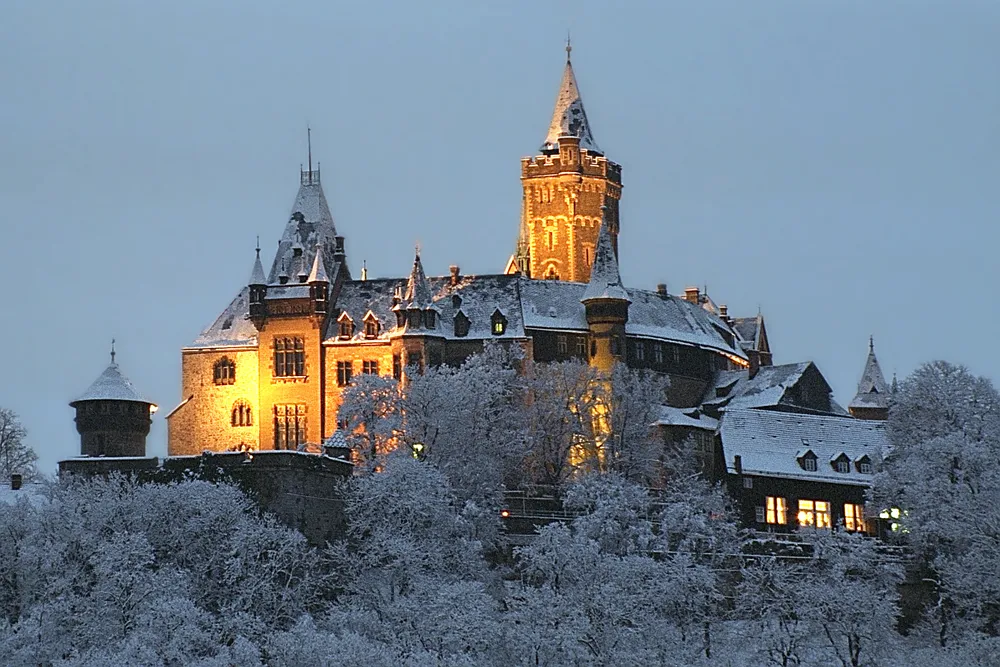
Described by the German heath poet, Hermann Löns, as the "brightly coloured town by the Harz", Wernigerode is an attractive destination on the Holtemme river, nestling against the northern foothills of said mountain range.
Wernigerode travel guide
Understand
Wernigeorde's charm — derived from its impressive medieval-era Old Town with its fascinating fairy-tale castle and rows of centuries-old timber-framed houses — have led to it becoming a popular waystop on two major tourist routes: the German Timber-Framed Road and the Orange Route, a German-Dutch holiday road. The town is also a good base for exploring the northern Harz on foot or by mountain bike.
1 Tourist Information, Marktplatz 10, ☏ +49 3943 5537835.
History Wernigerode is first recorded in 1121 when it was the seat of the medieval County of Wernigerode, a status it held until 1429. It was during that time, in 1229, that it was granted town rights. Wernigerode's heyday came during the 14th and 15th centuries as it grew wealthy through trading in cloth, beer and brandy. However, it suffered from plague epidemics in the 16th century as well as the ravages of the Thirty Years' War and fell into decline. From 1645 to 1807, Wernigerode was the seat of the County of Stolberg-Wernigerode. At the end of the 18th century, the town's economy picked up again, this time based on tanning and the manufacture of cloth and linen. In 1815 it was absorbed into the Prussian Province of Saxony. During the Industrial Revolution, new metal and wood industries settling here. The railways arrived in 1872, the same year that the Harz's best known brewery, the Hasseröder Brauerei, was founded. After the Second World War, Wernigerode fell on the East German side of the Inner German Border in the newly-created state Saxony-Anhalt. Wernigerode became part of the restored state of Saxony-Anhalt in 1990 after German reunification and did not take long to restore the beauty of its timber-framed town houses. Wernigerode has a population of about 35,000.
Getting there
By car Wernigerode has two junctions (Wernigerode-Nord and Wernigerode-Zentrum) on the B 6, a motorway-like dual carriageway that runs along the northern edge of the Harz from west to east. The B 6 branches off the A 7 motorway near Goslar and the A 395 motorway from Brunswick to Vienenburg.
By train 1 Wernigerode railway station is on the Heudeber-Danstedt–Vienenburg line with two-hourly services that run between Hanover and Halle using the Harzexpress. Wernigerode is also the main depot and terminus on the Harz Narrow Gauge Railways. Trains, including steam-hauled services, than run to various destinations in the Harz, including its highest mountain, the Brocken. Tip: The HarzTourCard enables you to travel by bus, train and narrow gauge train (except trains to the summit of Brocken) as much as you like within three days. It costs €18 for a single card, €34.50 for a family.
By plane Wernigerode is about 1 hr 15 min by car from Hanover airport and about 1½ hours from Leipzig airport.
Getting around
On foot The vast majority of Wernigerode's important tourist sites are contained within the compact area of the old town, whose narrow cobbled streets aren't particularly amenable to motorized transportation. Walking is probably the most sensible way to get around.
By car If you're staying in a further-flung area, your best bet is to leave your car at one of the several car parks or roadside parking meter bays near the centre.
By bus The local public transport organization Harzer Verkehrsbetriebe (HVB) operates a municipal bus network throughout the city, consisting of four lines that converge on the 2 Rendezvous bus station, located at Ringstraße 31 in the centre of town. Regular buses run seven days a week, from roughly 06:00 until 19:00 on weekdays and 09:00 until 17:30 on Saturdays, Sundays and legal holidays. From roughly 19:00 until 00:00, there's also more limited service courtesy of a night bus (Abendlinie). HVB's website includes a system map and schedules for each route.
See
Wernigerode has a wealth of historic sights and curiosities. Without a shadow of doubt, though, its top sights are its preserved medieval castle overlooking the town and its splendid town hall. But wandering around its ancient, sometimes still cobbled streets, the tourist will come across rows of colourful timber-framed houses and oddities like the Leaning House and the tiny "Smallest House" in Wernigerode, as well as museums that reflect the town's history and culture.
Old fortifications 1 Wernigerode Castle (Schloss Wernigerode), Am Schloss 1 (follow the signs from the town centre). A walk around this striking medieval castle is well worth the effort of the climb from the town centre. There are numerous paths through the woods and grounds of the castle. A climb onto the Agnesberg hill behind it is rewarded with a view over the castle, the town, and the edge of the Harz mountains that many visitors simply miss. The more adventurous can make their way through the woods into the valley of Christianental, where there is a forest inn serving traditional German fare and a small wildlife park with deer, wild boar and birds of prey. The castle is now a museum which is open to the public - see "Museums" section below. (updated May 2017) 2 Emperor Tower (Kaiserturm). 24 hours a day. This stone observation tower is not part of the town's old fortifications, though it certainly looks of a piece with the remaining medieval-era towers: named and dedicated in honor of Kaiser Wilhelm II, the Kaiserturm has stood since 1902 at the 478-m summit of the Armeleuteberg hill a short distance south of the town centre. From its top, you can enjoy breathtaking views of the castle and old town of Wernigerode and out to the high summits of the North Harz. Free. 3 Half Tower (Halbschalenturm), north side of Burgberg between Nöschenröder Straße and Lindenallee. In the middle of a small park near the castle is another remnant of Wernigerode's medieval city wall: the semicircular shell of on
Do
There are several worthwhile walks in the local area, but Wernigerode is also a great starting base for exploring the Harz by rail, road, mountain bike or on foot.
Local walks Market Place to Wernigerode Castle, start at Marktplatz. From the market square (Marktplatz) head down Marktstraße to the end, turn L into J.S.Bach Straße, at Schöne Ecke follow the Burgberg road uphill, turn R by the Fürstengrotte restaurant onto the steep path (Schlossaufstieg) up to the castle. Distance: about 1.3 km. Time: 30 min. Return by foot or on the road train (Schlossbahn or Bimmelbahn) Armeleuteberg, start at Marktplatz. Head down Westernstraße from the Marktplatz and through the Western Gate Tower. Turn L at the Westernkreuzung crossroads into Salzburgstraße. Continue straight up the long winding forest road called Die Winde. After just under 3 km you reach the Försterplatz and restaurant of Armeleuteberg, named after the hill. The Emperor Tower (Kaiserturm) is above the inn about 400 m away and has super views of the town. The return leg is via the Zwölfmorgental valley.
Steam railway Harz Narrow Gauge Railways (Harzer Schmalspurbahnen), Hauptbahnhof Wernigerode, ☏ +49 3943 558-0, [email protected]. Explore the Harz
Overview adapted from Wikipedia, travel guide fromWikivoyage (CC BY-SA). Photography via Wikimedia Commons.