
Štip
North Macedonia · Europe
About Štip
Štip is the largest city in Eastern North Macedonia with about 44,000 people (2002). It has been perhaps the most important educational, cultural, and economic centres of this half of Macedonia for centuries. The first opera in Macedonia was played in Štip in 1924. In 2007, Štip became home to the country's fourth state university when Goce Delčev University opened.
Štip travel guide
Understand
Štip is a very pleasant city that gets fewer tourists than the west, which makes the people nicer and more willing to help than the people in the western part of the country. Smoking is prohibited in all nightclubs and bars (kafanas). Cigarettes and alcohol can be sold to individuals aged 18 and over. As in all other cities in North Macedonia, if you are not a Macedonian citizen, you must check in with the local police station when you arrive and leave.
History The history of Štip goes back a few thousand years, evidenced by archaeological findings. Perhaps the best intact archaeological site in its vicinity is Bargala, listed below in this guide. Štip was an important city in Ottoman Macedonia: Turkish traveller Evliya Çelebi noted in 1661 that Štip had 2,240 homes, 24 Islamic religious buildings, seven hans (Turkish baths), one caravansary (inn), and a bazaar with 450 shops. The city was briefly under Austro-Hungarian rule from 1689 to 1691. Štip once had a relatively significant Jewish community. Following the Spanish Inquisition at the beginning of the 16th century, a number of Sephardic Jews settled in the city, with roughly 200 living here by 1519. On 11 March 1943, Štip's 551 Jews were deported to Treblinka by the occupying Bulgarian fascists where virtually all of them were killed. The city's Jewish quarter, including its synagogue and Jewish school, were destroyed.
The city was active between the world wars, home to the Association against Bulgarian Bandits from 1922 to 1930. Factions within Bulgaria felt that it deserved a larger share of Macedonia and other parts of Yugoslavia and thus organized guerilla attacks within eastern portions of Yugoslavia. Organizations like Štip's Association against Bulgarian Bandits helped suppress these attacks. Today, Štip is home to a population that is nearly 90% ethnic Macedonian. The city also has sizeable minorities of Roma (Gypsies), Vlachs (Aromanians), and Turks.
Getting there
By bus 1 Bus Station (Автобуска станица Штип), Partizanska (Партизанска) St (near the City Stadium). The inter-city services are provided by the public transportation company "Balkan Ekspres" (Macedonian: Балкан Експрес) which has connections from all cities in North Macedonia and from some neighboring countries.
By car By car from the north (Skopje), the main regional road circumvents Štip, but any of the several clearly marked exits will take you downtown. From the south: the main Strumica-Štip road enters through the Bregalnica canyon in the south and goes directly to downtown. There are many local roads entering from the east and west.
By train Štip lies on the Skopje - Kocani line. Passenger services are running again as of January 2021, according to Macedonia Railways (MŽ) website. There is one daily train each way, departing for Skopje in the early morning, and one coming from Skopje in the afternoon.
By plane By sport airplane: Štip is served by the largest sport airport in Eastern North Macedonia, accommodating single and twin-engine aircraft. The third international airport in North Macedonia, to be built in Štip, is still in the initial stages (the first phase is planned to be for cargo only).
Getting around
The best ways to get around are by foot or by taxi, though there is a municipal bus fleet which connects the center with the outlying of Babi, Senjak, Prebeg, Makedonka, Kezhovica, etc.
See
Štip offers a variety of sights to see including fortress ruins, medieval churches, Ottoman monuments, Jewish sites, and museums plus more in the immediate surrounding area.
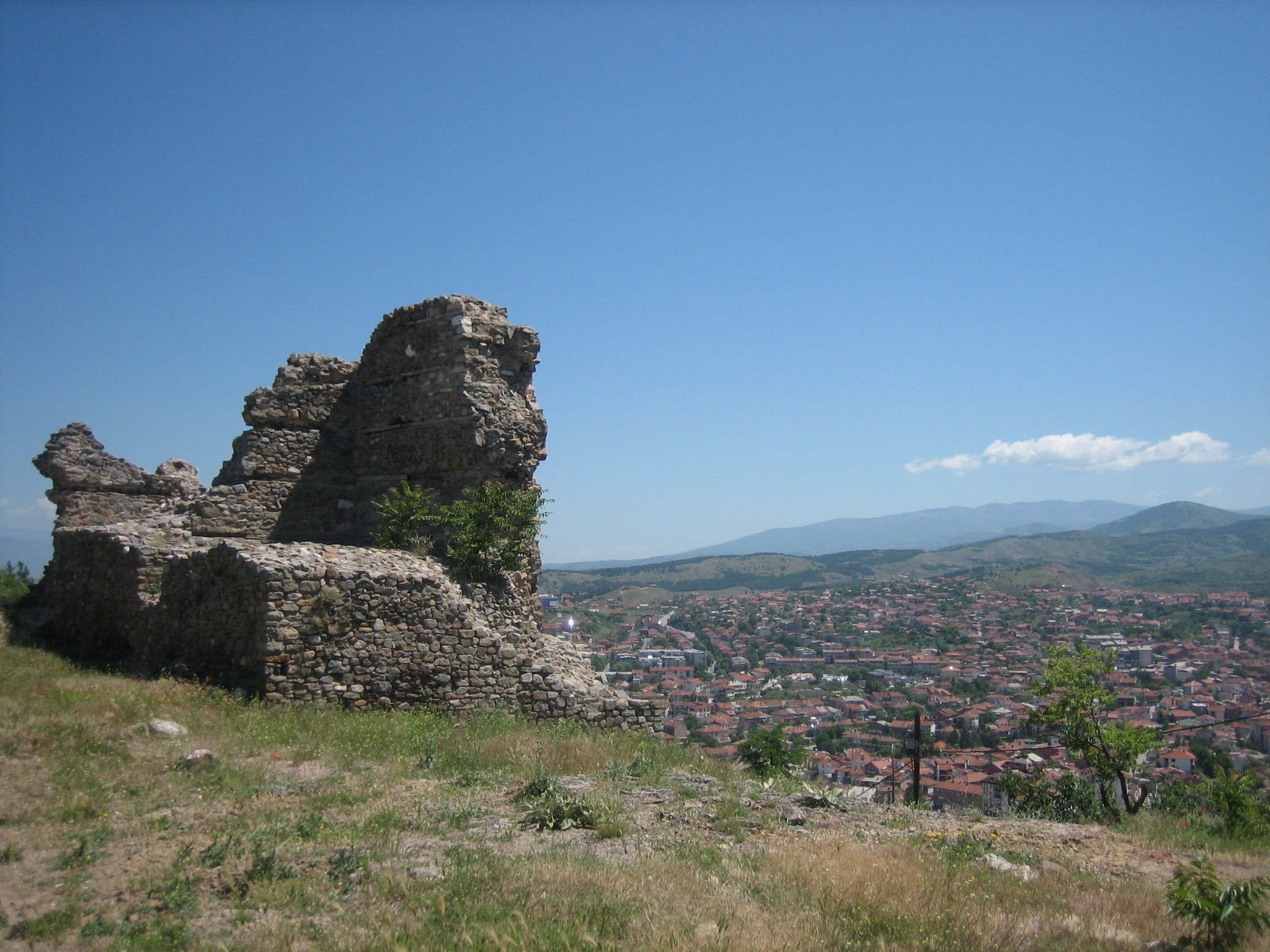
1 Štip Museum (Завод и музеј), ☏ +389 32 392 044, [email protected]. M-Sa 08:00-16:00. Founded in 1950 in the center of the city. It features exhibits on the archaeology, art, ethnology, and history of Štip. In particular, it houses over 1,000 archaeological pieces. The museum is found in the Arsovi House, a historic estate with traditional architecture. The building sits on open park space filled with various statues. The museum also maintains exhibits in the Bezisten and the Church of the Dormition. (updated Oct 2019) 2 Church of Saint Michael the Archangel (Црква „Свети Архангел Михаил Главатов“), 4-ta Makedonska brigada Street. One of the most valuable medieval monuments of Štip, this church was built in 1332 by Serbian nobleman Hrelja. It lost its frescoes during the Ottoman era when it was converted into a mosque. The church is cross-shaped and capped by a single dome. In 2000, it received a new marble iconostasis. (updated Oct 2019) 3 Isar Fortress (Исар; Štip Fortress). Above the confluence of the Bregalnica and Otinja rivers, these fortress ruins overlook Štip and its surroundings from a strategic point. The original date of its construction in unknown, though today's ruins likey date from the Serbian Empire. Varying amounts of walls and foundations survive today. A cross was erected among the ruins and it is illuminated at night. Several churches were built on the slopes below the fortress. This includes the churches of Saint Michael the Archangel, Saint Nicholas, and Saint John the Bapist, among a couple of others. (updated Oct 2019) 4 Husa Medin Pasha Mosque (Џамија Хусамедин Паша). Built on the foundation of a church called Saint Elijah (Црква Свети Пророк Илија), this Ottoman mosque was built sometime in the 16th century and named after a local Turkish pasha who donated the
Do
1 Kežovica Spa (Кежовица Бања), Novo Selo. The temperature of the thermal mineral waters in the spa-resort reaches 62°C and the radioactivity reaches 42.82 moch units. The water is characteristic for its very favorable chemical composition: it contains sodium chloride, sodium sulfate, and sodium oxide. The spa-water is believed to be curative of rheumatism, ankle and nervous system issues, diabetes, arteriosclerosis, high blood pressure, and more.The unit for physiotherapy, included in the spa-resort, uses the most modern devices and treatment methods and possesses 110 beds. The main spa-resort possesses 40 beds while in the vicinity there is also Hotel Astibo with 130 beds. (updated Oct 2019) 2 City Park Suitlak (Градскиот парк Суитлак), Todor Kolarov St (in the upper part of the city; on the left side of Otinja). is a beautifully maintained hilly park with well maintained trails and benches. 3 Lake Mantovo (езерото Мантово) (about 25 km south (last 5 km are unpaved roads)). This is an artificial lake with deep blue waters. Popular place for fishing and recreation in the summer. 4 River Bregalnica. - the second largest river in North Macedonia, joining Vardar river after Štip. Roads follow the entire flow of Bregalnica around Štip and this is a very scenic drive.
Events Feast of the Holy Forty Martyrs. Inscribed on the list of UNESCO Intangible Cultural Heritage, this feast is observed every March 22 in Štip. There is music throughout the day, with people first gathering in the city and then hiking up to Isar Hill, stopping to greet forty people, to gather 40 pebbles and 40 flowers or twigs
Overview adapted from Wikipedia, travel guide fromWikivoyage (CC BY-SA). Photography via Wikimedia Commons.