
Strontian
United Kingdom · Europe
About Strontian
Ardnamurchan Peninsula is in Lochaber in the Scottish Highlands. It's the most westerly and remote part of mainland Britain, accessed only by a long, winding single-track lane. For visitor purposes the name applies to the entire triangle of land west of Loch Linnhe, north of the Sound of Mull, and south of the A830, taking in Moidart, Sunart, Ardgour and Morvern as well as Ardnamurchan which geographically is just the western tip. The total population is about 2000.
Strontian travel guide
Understand
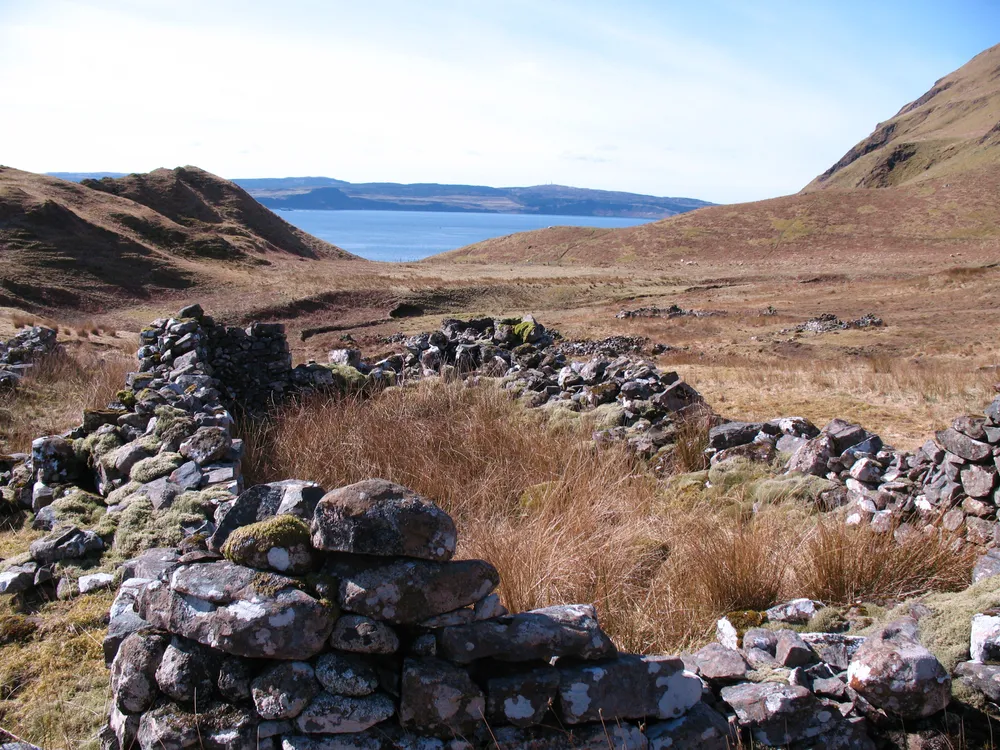
Àird nam Murchan in Gaelic means "headland of the great seas". The soil is poor and the terrain though of no great height is rugged. There are few natural resources, though lead was mined and oak forests managed for charcoal. The population mostly lived by crofting — subsistence farming — until the 19th century. Then the landowners realised they'd earn more from sheep-farming than from the meagre rents of their tenants, so the crofters were evicted. The emptiness of Ardnamurchan, as elsewhere in the Highlands, has been man-made by these "Clearances", of which the village of Bourblaige is a silent but eloquent witness. Strontian is the tiny village at the centre of this triangle of land which gave its name to the element strontium. In 1790 geologists discovered a new mineral in the lead mines, which they called "strontianite", and within it identified strontium from its distinctive crimson-red flame. It became commercially important in the 19th century in the extraction of sugar from beet, and in the 20th century for the coating of TV cathode-ray tubes; nowadays a major use is for red firework flares. It's chemically similar to calcium and is therefore taken up by bones and other body tissues. The natural isotope is mostly strontium-88, which is non-toxic, radio-stable and not a health concern. It's strontium-90, a radioactive product of nuclear fallout such as of the Chernobyl accident, that causes bone cancer, leukemia and other serious conditions. You're not at heightened risk of these through visiting Strontian.
Getting there
See Fort William for inter-city routes. You need a vehicle to get in and around this remote place. 1 Corran Ferry is reached by A82 through Glencoe and over Ballachulish Bridge. It's operated by Highland Council and saves a long detour around Loch Eil. It sails M-Sa 6:30AM-9:30PM every 20 min, Sundays from 08:30 every 30 min, taking five minutes. No booking, just turn up and queue. You land at Ardgour, follow the lane south to Strontian, Lochaline and Kilchoan The other route from Fort William is to take A830 west along Loch Eil then past Glenfinnan, branching south at Loch Ailort. This road leads to Moidart, Acharacle, Salen and Kilchoan. See under Mallaig and Fort William for buses and trains along the Glenfinnan stretch. There are two Calmac car ferry routes from the island of Mull:
between Fishnish near Craignure and Lochaline every 90 min, taking 20 min, see Craignure#Get in. between Tobermory and Kilchoan every couple of hours, taking 35 min, see Tobermory. The Tobermory-Drimnin ferry no longer sails.
Getting around
You need a car. Ardnamurchan's few buses are timed for school run and shopping trips and similar errands to Fort William, with one bus there in the morning and one bus returning mid-afternoon. Shiel Bus 506 runs n-Sa between Kilchoan and Fort William, via Salen, Acharacle, Strontian and the Corran ferry, taking 2 hr 30 min. The eastbound bus leaves Kilchoan around 8AM, connecting with the ferry from Tobermory. The westbound bus leaves Fort William at 1:50PM. Shiel Bus 502 runs M-Sa between Acharacle and Fort William via Moidart, Loch Ailort and Glenfinnan, taking 90 min. It's basically a school bus for Lochaber High School, with the eastbound bus leaving Acharacle around 7AM and the westbound bus leaving Fort William at 3:30PM; it doesn't connect with the 506. Shiel Bus 507 is mostly just a school bus from Drimnin via Lochaline to Strontian. On Thursdays only, it runs from Lochaline at 9:30AM via Argour and the Corran ferry to Fort William, taking 80 min, and setting off back at 2:50PM.
See
1 Ariundle Oakwood is in the glen north of Strontian. Oak forests once carpeted the Atlantic coast from Norway to Portugal; Ariundle is a rare survival in Scotland, designated as a National Nature Reserve. Both sessile and pedunculate oaks (plus hybrids) thrive here. Their presence is partly artificial, as they were cultivated for charcoal to fuel the ironworks at Bonawe (hence their multiple stems, from coppicing). There are two trails through the woods, which can be combined into a 3-mile loop; watch out for otters, pipistrelle bats, wildcats, pine martens and badgers. The woods are also notable for mosses, liverworts and lichens. Higher up the glen are old lead mines and eventually the trail leads to the summit of Sgùrr Dhòmhnuill, a Corbett of 888 m or 2913 ft. 2 Castle Tioram (pronounced "Cheerum") is a ruin on a tidal island on the shore of Loch Moidart, dating perhaps to 12th century. A bastion of Clan Ranald, it was burned out in the 1715 uprising. The ruin is unsafe to enter but you can stroll around the exterior at low tide - Tioram is Gaelic for "dry" but don't push your luck. 3 RSPB Glenborrodale is an oak woodland and wildlife reserve. It's free to access 24 hours, donation appreciated. Glenborrodale Castle half a mile east is an Edwardian mansion that has been a hotel but is now a private residence, no tours. 4 Bourblaige or Buarblaig is the haunting remains of a village. Its seven families were brusquely evicted in 1828 to make way for a sheep farm, as part of the Highland Clearances. The site had been inhabited since prehistoric times and may have been a battlefield in 731 AD between the Picts and the Dalriads, the Ulster folk who colonised southwest Scotland. Wear stout boots for the soggy path from B8007. 5 Ardnamurchan Lighthouse, PH36 4JB, ☏ +44 1972 510210. Apr-Oct: M-F 11AM-4PM. It was built by Alan Stevenson in 1849, a 36-m (118-ft) column in pink granite. It's unlike other fluted Stevenson creations and this style is called "Egyptian", which
Do
Scuba diving: preferably in a dry-suit, though you can get away with a chunky wet-suit in summer or early autumn. Lochaline has a dive centre, with the signature dive being along the wall near the slipway. The Sound of Mull is littered with wrecks, many of historical interest. The dive centre has a bunk-house and occasionally runs archaeological dives on protected sites where diving is normally restricted, such as the Swan, a Cromwellian warship lost in a storm in 1653; prior booking is essential. Morvern Highland Games are held on Knock Park in Lochaline, with the next on Sa 18 - Sa 25 July 2026.
Buy
Stock up before you come, there's limited supplies of anything here.
Eat
Cafe Sunart, Strontian PH36 4HZ (by campsite), ☏ +44 1967 402277. M-Sa 9AM-4PM, Su 10AM-3PM. Friendly cafe for full meals or light bites. (updated Aug 2023) Hotels have bar meals and fine dining restaurants.
Drink & nightlife
The hotels mostly have public bars. Adelphi Distillery, Glenbeg PH36 4JG (on B8007 between Salen and Kilchoan), ☏ +44 1972 500285. M-Sa 10AM-5:30PM, Su noon-5PM. Delightful small place producing single malt whisky. The original Adelphi was near Glasgow, but folded after the Great Gorbals Whisky Disaster of 1906, when a building collapsed to send a tidal wave of whisky down the street, and folk literally drowned. The site was demolished and is now Glasgow's main mosque. The Adelphi name was revived in the 1990s, the Ardnamurchan distillery began pr
Overview adapted from Wikipedia, travel guide fromWikivoyage (CC BY-SA). Photography via Wikimedia Commons.