
Stockholm County
Sweden · Europe
About Stockholm County
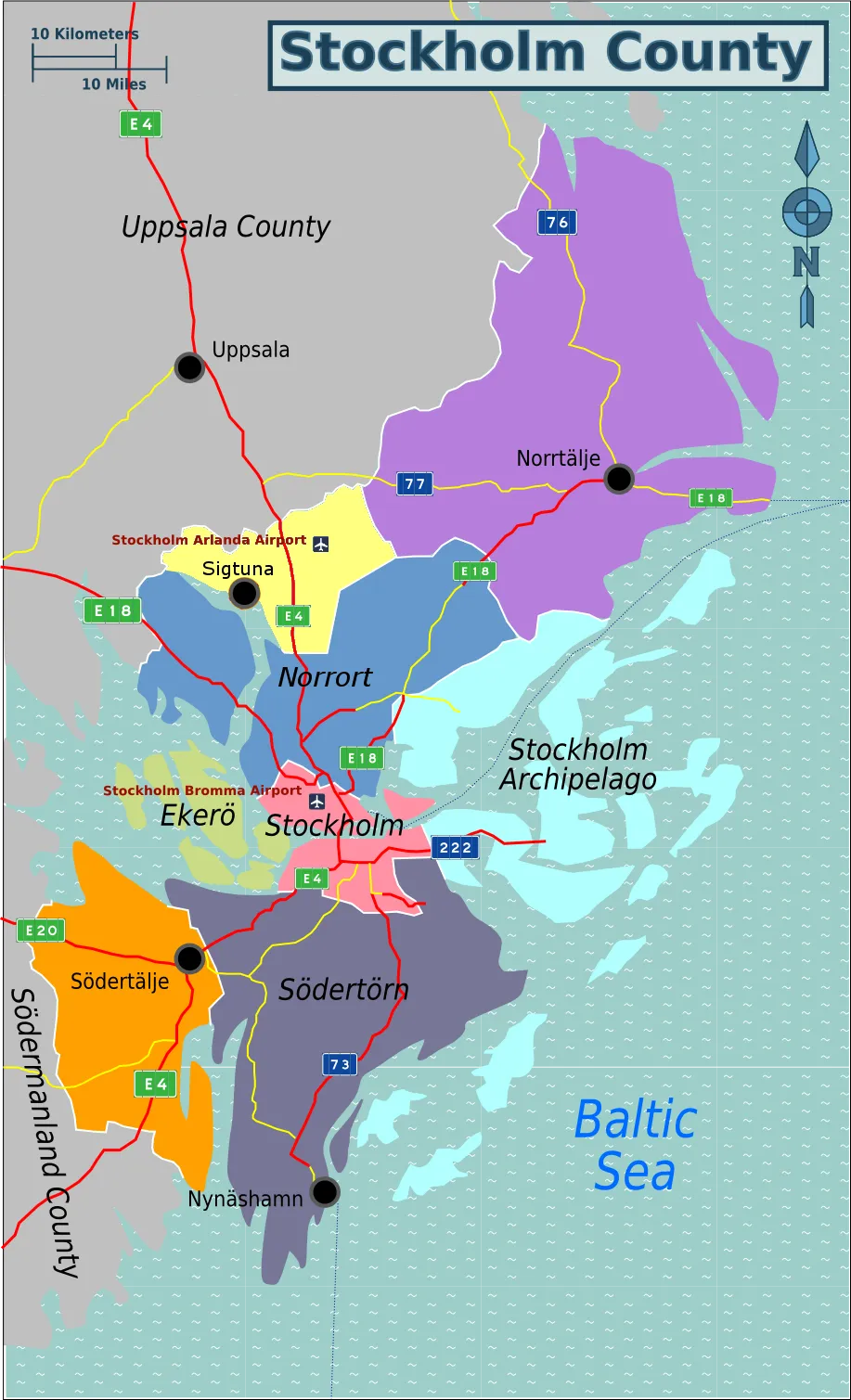
Stockholm County (Stockholms län) in Sweden comprises the country's capital city, Stockholm, and its surrounding municipalities. With 2.3 million inhabitants, it is both the country's most populous region and the most densely populated one. Far from homogeneous, it includes dense urban areas as well as large expanses of forests and the Stockholm Archipelago, made up of more than 30,000 islands.
Stockholm dominates the area, and while most other municipalities are essentially suburbs, some of them have an identity on their own, notably Sweden's oldest city Sigtuna, the port of Nynäshamn, and the industrial hub of Södertälje.
Stockholm County travel guide
Understand
Due to the post-glacial rebound, the land is rising. Until the 15th century, lake Mälaren was a bay of the Baltic Sea, and much of the land around Stockholm was beneath sea level. While Birka became Sweden's first city in the 8th century, Sigtuna was the cradle of the Swedish Kingdom. Stockholm was founded in the 13th century, and became the effective capital 200 years later. Stockholm County was established in 1714 from parts of the Uppland and Södermanland provinces, not long after the county system was created in 1683. While most Swedish counties were formed by the provinces (landskap), each with their distinctive folk culture and local patriotism with roots in the Middle Ages, the identity of Stockholm County has emerged from the capital city. The city of Stockholm was an autonomous entity until it merged with the county in 1968; it contains 26 municipalities. While the whole county is effectively suburbs of Stockholm today, towns such as Sigtuna, Vaxholm and Södertälje have their own interesting history.
Getting there
The main hub of the county is the Stockholms Centralstation (Stockholm C or Centralen), which is the busiest station for long-distance and regional trains, local trains (underneath the metro station), the Stockholm metro (whose adjacent station is called T-Centralen) and airport, boat port and long-range buses (which stop at the adjacent Cityterminalen).
By plane Stockholm county includes two major airports with scheduled passenger traffic:
Stockholm Arlanda is the country's largest airport by far in terms of passenger traffic and the number of international and intercontinental connections. It has a railway station served by Storstockholms Lokaltrafik's local trains (pendeltåg), which can take you to all over the county (and even up to Uppsala County) either directly or with a transfer. There is also an express direct connection to Stockholm's central railway station called Arlanda Express, and bus connections locally within Sigtuna, to Uppsala and to Stockholm. See Stockholm Arlanda Airport for airport amenities, and Stockholm#Get in for transfer to central Stockholm. Stockholm Bromma is Stockholm's older airport, still within the city borders, now served mostly by domestic connections within Sweden. Stockholm Skavsta in Nyköping and Stockholm Västerås in Västerås also serve Stockholm, though they are each about 100 km away from the city. Most of the traffic consists of no-frills airlines.
By rail The only train station in Stockholm served by long-distance domestic and international trains is the Centralstation, where you can change to local trains, the metro or a local bus further on to your destination. Some long-distance trains also call at Södertälje Syd, Flemingsberg, and Arlanda.
By bus Tapanis Buss has a route between Tornio, Finland and Stockholm serving coastal region along road E4 FlixBus
By boat Baltic sea ferries with passenger and vehicular (car and truck) capacities connect Stockholm with Helsinki, Turku, Riga and Tallinn. A ferry from G
Getting around
By car Though public transport serves nearly all settlements in the county, driving can be a practical option for the countryside. Some archipelago islands are connected to the mainland by car ferries. Tourist destinations can be congested around holidays. The north-south divide in Stockholm (between Södermalm and the northern boroughs) is a chokepoint during rush hour. Despite the size of Stockholm, much of the outer county is wild nature. Even a few kilometres outside built-up areas, traffic lighting is scarce, and animal collisions become a concern. Passage through inner Stockholm is subject to a congestion tax; see Stockholm#By car for details.
By public transit
Storstockholms Lokaltrafik AB, SL provides public transportation across the county. This includes light rail, metro, trains and bus lines. There are also regular ferries between the islands which are operated by independent companies - some are under the same SL fare scheme, and others are not, requiring separate tickets. Some lines extend to Uppsala, Gnesta and Bålsta for an extra fee (see below).
The SL website has detailed ticket and price information in English, and a journey planner. It is always updated.
Tickets
SL tickets can be bought at the public transport centers (in stations; including Central station and the T-Central), at all Pressbyrån stores, major grocery stores and some smaller kiosks. They can also be bought at the Arlanda visitor center at the airport. Stockholm operates a RFID card called SL Access which triggers entry gates and other electronic readers. There are two forms of ticketing, period passes and single tickets. All travel cards can be loaded onto the SL access card. 24-hour and 72-hour travel cards are additionally available as individual disposable paper RFID tickets. A VISA or a Mastercard can be used as an adult single ticket. Tickets are checked upon entering a ticket gate, or boarding a bus. They must be carried throughout the journey for random inspections
See
As Stockholm has been the nation's capital for centuries, it is packed with museums, palaces, art galleries and other attractions — the Royal Palace, the Skansen outdoor museum and the Vasa Museum, to mention a few. The outskirts of the county have impressive natural features, as well as a rich cultural heritage.
The Stockholm Archipelago is both a tranquil refuge and home to quite a few historic monuments and museums scattered across the islands - just getting there over the water provides for some spectacular sights Ekerö contains the Drottningholm Palace, the residence of the Royal family, as well as Viking Age settlement Birka Sigtuna is Sweden's oldest continually existing city, and holds many artefacts thereof Tumba and Huddinge in Södertörn have museums devoted to their natural heritage
Do
The city of Stockholm contains many sports and entertainment venues, and there is always something major happening to be experienced live. Though the county is the most populous of Sweden, most of its area consists of nature, with many opportunities for outdoor life, even within less than an hour of commuting from Stockholm. The county has a very long coastline and includes vast expanses of water, which lends itself to all kinds of activities, from water sport to simply sunbathing or picnicking on one of the many sea- and lakeshores. Surprisingly for localities easily reachable by commuter railway, you do not have to get far out of Stockholm either to observe wildlife up close and engage in a Nordic photo safari.
Eat
There is not much in the way of a particular cuisine of Stockholm County. Seafood is prevalent, and local catch is usually available. You will of course be able to enjoy favourites and specialties from all of Sweden, and fine dining. Due to the region's diverse ethnic makeup, you may also take advantage of the wide range of foreign cuisines represented throughout the county, in particular Middle Eastern cuisine (including kebab and falafel stand
Overview adapted from Wikipedia, travel guide fromWikivoyage (CC BY-SA). Photography via Wikimedia Commons.