
St Helens
United Kingdom · Europe
About St Helens
St Helens is a town in Merseyside in England, 14 miles northeast of Liverpool. It was historically part of Lancashire, but in 1974 became a separate metropolitan borough. It's industrial and in 2021 the borough had a population of 183,200.
Two famous families from St Helens are the Beechams, who established the pharmaceutical company and who included the conductor Sir Thomas Beecham, and the Pilkingtons who manufacture plate glass.
St Helens travel guide
Understand
Industry and population boomed in this area in the 18th century. The four towns of Sutton, Parr, Windle and Eccleston grew together and became known as St Helens, from St Elyn's chapel-of-ease in Parr. A town hall was built in 1839, and in 1868 St Helens was incorporated as a borough. The big drivers of its growth were coal-mining and glass, especially plate glass. These marched together because you need coke from coal to achieve the very high temperatures of glass furnaces, approaching 1600°C. Glass has been made for over 6000 years and the Romans introduced the technology across Europe. Early manufacture produced an uneven puddle, so when it was carved into squares to fill windows, glaziers naturally placed the thicker end at the base. This led to the misconception that glass is a weird kind of liquid that flows over centuries. Plenty of counter-examples disprove this, where the thicker end is at the top, and it is in fact a solid. That said, the precise nature of the transition from flowing liquid to glassy liquid to solid glass remains an unsolved problem in physics. Only small glass plates could be made, so the Victorians peered out of their homes or into shops through their characteristic partitioned windows. Making larger plates necessitated something clean and flat to lay the molten glass on, that could withstand the intense heat. Baths of molten tin were used from the 19th century, but it only became a viable mass-production method in 1960, thanks to Alastair Pilkington and Kenneth Bickerstaff in St Helens. Their "float-glass" process was licensed and used worldwide. Shops installed broad store windows and changed the face of the High Street, offices opened out their architecture, and "plate-glass universities" sprang up on greenfield campuses. The process patents expired in the 1980s but Pilkington Brothers tried to maintain a monopoly until busted by US anti-cartel legislation. The company now faced the chill winds of competition. They still manufacture
Getting there
The area around St Helens is criss-crossed by motorways. M6 east is the usual approach from London and the Midlands. M62 south connects Liverpool, Manchester and Leeds. M57 southeast, effectively Liverpool ring road, connects Widnes and Kirkby, for Formby and Southport. St Helens is 14 miles from Liverpool (with John Lennon LPL IATA airport) and 22 miles from Manchester (with the much better connected MAN IATA airport).
By train Trains from Liverpool Lime Street run every 30 min via Edge Hill, Eccleston Park and Thatto Park, taking 30 min to St Helens Central. They continue to Wigan North Western, and some go on to Preston and Blackpool. From London Euston change at Liverpool or Wigan, either way takes 2 hr 45 min. 1 St Helens Central has a staffed ticket office and machines, toilets, and a waiting room on each platform. There is step-free access to both platforms. Plusbus tickets are available. Trains from Manchester Piccadilly and Victoria run hourly via Newton-le-Willows towards Liverpool Lime Street, and stop at St Helens Junction and Lea Green three miles south of town. 2 St Helens Junction has a staffed ticket office and machines but no toilets. For step-free access to the Liverpool-bound platform you need to call ahead, no barriers Manchester-bound. Plusbus is available, and you'll want the bus to reach town centre.
By bus The major bus lines no longer have regular services to St Helens. Arriva Bus 10 / 10A runs every 20 min from Liverpool Queen St, taking 70 min. Don't take the 10B, which branches off to Huyton. Bus 329 runs every 40 min from Warrington, taking 35 min. Bus 352 runs every 20 min from Wigan, taking 45 min. Bus 35 runs every 30 min from Junction railway station to the rugby stadium and bus station, then west to Gillars Green. Bus 17 runs every 30 min from Widnes via Sutton Manor, Lea Green railway station, Sherdley Park and the rugby stadium. St Helens bus station is 100 yards west of Central railway station.
Getting around
Most of the attractions are within walking distance. Bus 12 circles every 30 min between the bus station, Central railway station and the shopping centres. Taxi operators include AtoB (☏ +44 1744 600600).
See
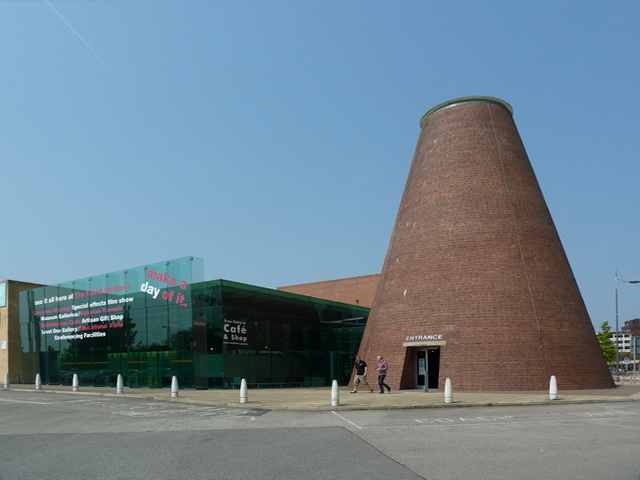
"... a township unpleasing to the eye, where the natural amenities have been replaced by everything unlovely that man could devise" - St Helens circa 1905 Town Hall is a rambling 19th-century sort-of-Italianate building on Corporation Street and houses the municipal offices. St Helens Parish Church is on Church St 200 yards west of Central station. It's Anglican, completed in 1926 after its predecessor burned down. North West Museum of Road Transport, Old Bus Depot, 51 Hall St WA10 1DU (100 yards north of Central station), ☏ +44 1744 451681. Su 11AM-4PM. Great collection of old buses and cars, many built at Leyland Motors not far north. Dog-friendly. Adult or conc £4, child £2.50. (updated Aug 2022) 1 World of Glass, Chalon Way East WA10 1BX, ☏ +44 1744 22766. Tu-Sa 10AM-5PM. Museum demonstrating the town's history of glass manufacture. Adult £8, child or conc £6. (updated Aug 2022) 2 Carr Mill Dam originally just impounded a mill pond, but was enlarged in 1750 to create a reservoir for Sankey Canal. So it's a mile-long lake used for angling and competitive powerboating. Lakeside trails lead into Sankey Valley. Sankey Valley Country Park stretches for 7 miles southeast from Carr Mill Dam along the line of Sankey Canal, which is joined by Sankey Brook and flows to Newton-Le-Willows. There are footpaths and cycleways. The canal is disused. 3 Colliers Moss Common is a reclaimed brownfield site, on waste from a power station. It's been landscaped with parkland, lagoons and pathways. 4 Sherdley Park is an extensive green space yet was once very much greater, owned by the Hughes mining dynasty, lords of all they surveyed. In the 20th century it was sold off piecemeal, and its mansions were demolished, until after the Second World War the Borough bought the remnant as a park. The north end is Sherdley Park Golf Club, the south has formal gardens, woodland, ponds and play areas. It's sometimes used as an event space. 5 Sutton Manor is a park, centred on "The Dream", a 66 f
Do
What's on? Read Liverpool World. Theatre: Theatre Royal is on Corporation St (Box Office +44 1744 756000). The Citadel is on Waterloo St (+44 7821 659962). 1 St Helens RFC, McManus Drive, Peasley Cross Lane WA9 3AL, ☏ +44 1744 455050. The Saints play rugby league (13 a side) in the Super League, Britain's top tier. They often win it and qualify for European tournaments. Their home ground is Totally Wicked Stadium (formerly Langtree Park), capacity 18,000, half a mile south of town centre. The women's team likewise play in their top tier at the same stadium, which in 2022 hosted matches in the Rugby League World Cup, postponed from 2021. The RL playing season is Feb to Sept. (updated Sep 2023) Cineworld, Chalon Way WA10 1BF, ☏ +44 330 333 4444. Chain multiplex cinema showing mainstream releases. (updated Aug
Overview adapted from Wikipedia, travel guide fromWikivoyage (CC BY-SA). Photography via Wikimedia Commons.