
Southern Maryland
United States · Americas
About Southern Maryland
Southern Maryland consists of Calvert, Charles and St. Mary's counties as well as the southern portions of Prince Georges and Ann Arundel counties.
Southern Maryland travel guide
Understand
Southern Maryland's economy used to be fueled by tobacco and watermen. Both activities have declined steeply. Oyster and fish stocks in the Chesapeake Bay have suffered dramatic declines since the 1980s, partly due to overfishing but largely caused by reduced water quality and introduced diseases and parasites. Efforts to improve the water quality of the bay are ongoing but because the bay watershed covers four states they are difficult to coordinate. The economy of the area is now largely governed by the heavy military presence, as the area is home to the Patuxent River Naval Air Station, the Navy's primary air-test facility, and Andrews Air Force Base, the home of Air Force One. Many residents commute to Washington DC or Annapolis. Southern Maryland was the first area in Maryland settled by Europeans. Much of the area was explored by John Smith from Jamestown in the late 1500s. It began as a Catholic colony, and has many lovely 17th- and 18th-century Catholic and Episcopal churches. The area was the hiding place of John Wilkes Booth during much of the manhunt to find him after President Lincoln's assassination, and the home of Doctor Samuel Mudd, who treated him during his escape. Supreme Court Justice Roger Taney, infamously known as the Chief Justice who presided over the Dredd Scott decision, was from Calvert County. Other famous (or infamous) residents include author Tom Clancy (Huntingtown), and Socks, the First Cat during the Clinton Presidency (now, sadly, deceased) who lived with her owner, Clinton Secretary Bettie Curry, in Saint Mary's County. Geologically, southern Maryland has been shaped by the Chesapeake Bay which borders it on the east and by the two major rivers which pass through it: the Patuxent, and the Potomac, which forms its western boundary. The area is characterized by low, rolling hills (most of the area is less than fifty feet above sea level); flat fields; and very steep, narrow ravines due to the easily erodable nature of its sandy soil
Getting there
Southern Maryland is served by three regional airports: Washington Reagan National, Dulles International, and Thurgood Marshall Baltimore-Washington International. A ride-sharing service called the Southern Maryland Express offers comfortable transportation between the region and the major airports nearby. The major driving routes to the area from Washington, DC include Route 4 (Calvert Country) and Route 5 (Charles and St. Mary's Counties). From points south, take Route 301. From points north, take I-95 South to the Washington Beltway (I-495) and follow the Inner Loop to either the Route 4 or Route 5 exit. There are no passenger rail lines serving Southern Maryland. There is commuter bus service to and from Washington, D.C. that is provided by the Maryland Transit Agency.
Getting around
Drive. It's the only way. If you're hard core, biking is a popular activity in southern Maryland, but be prepared to ride long distances between attractions, and you'll have to bring your own bike.
See
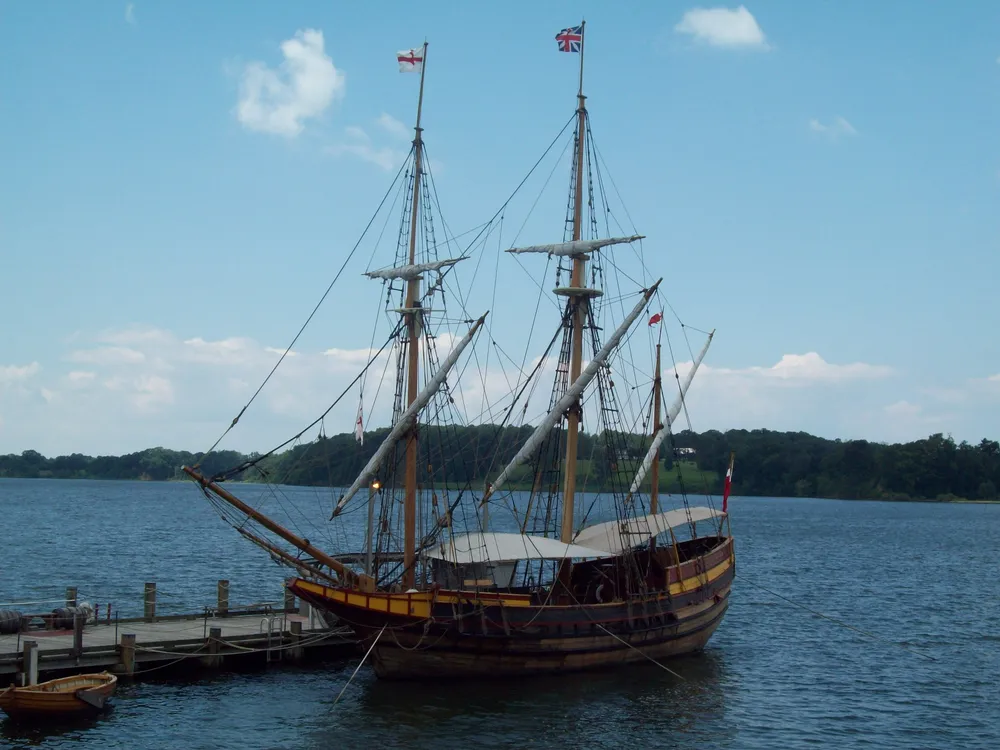
Saint Mary's City is an easy highlight for any visit to Southern Maryland. It was the first settlement in Maryland, the seat of the Calvert family, and Maryland's first capital. Founded in 1634, Saint Mary's City was the fourth permanent English settlement in North America, and because it was a Catholic colony, it is sometimes considered to be the birthplace of religious freedom in America. The city was almost completely abandoned by the late 1700s. It is now an active archeological site with some reconstructed buildings, notably the original statehouse and the print shop. The city chapel has been reconstructed on the original foundation. Historic interpreters are active on the grounds. The museum shows artifacts discovered on the site and has a collection of over 5 million items. The grounds include the Godiah Spray tobacco plantation, a working colonial-era farm, and a reproduction of the Dove, one of the two English ships that brought colonists to Maryland. A popular local resort town, Solomons is an island at the inlet of the Patuxent River to the Chesapeake Bay. Many good restaurants, quirky shops with local handicrafts, and a beautiful boardwalk area. Home of the Calvert Marine Museum, University of Maryland laboratories that study the Chesapeake Bay, and the US Navy Recreation Center-Solomons. It is also within short striking distance of beautiful Calvert Cliffs State Park and the Patuxent River Naval Air Museum. La Plata also has a couple nearby sights worth seeking out, including the Thomas Stone National Historic Site, and the historic, tiny village of Port Tobacco. Battle Creek Cypress Swamp, right by Prince Frederick is also a highlight for visitors from the north, as it is the country's northernmost cypress swamp. Point Lookout State Park, the southern tip of Maryland, near Lexington Park, is also worth a visit both for its natural beauty, and for its Civil War history and museum.
Do
There are many interesting things to do here, but one activity that is interesting is finding shark teeth. An example of a beach where you can find shark teeth is Brownie Beach in Calvert County. Here, they range from barely a millimeter up to several inches. Other items found include skate and ray teeth, porpoise teeth, and other interesting items. Fossil hunting sites include [1]:
Flag Ponds Park provides lovely views of the Chesapeake Bay, wide sand beaches, and a fishing pier as well as being an active site for finding shark's teeth. Calvert Cliffs State Park has access to the Calvert Cliffs, site of rich fossil beds. Bayfront Park (also known as Brownie Beach-Route 261, Calvert) is possibly the richest shark's teeth hunting site in the area. The National Oyster Shucking Contest is held at the Oyster Festival each year in St. Mary's County (Leonardtown Fairgrounds). A fun two day event with 4H, crafts, beer stands, tractor pulling contests, and of course oysters. Water recreation is a major pastime in the region, with the Chesapeake Bay and numerous tributary rivers as well as countless small connected creeks and coves. Motor-boating, sailing, canoeing on calmer waters, jet skis, epic fishing and waterfowl hunting are all essential activities to southern Maryland. High seasonal concentrations of "sea nettles" (the local term for jellyfish) make waterskiing and swimming less common activities, however. Swimming is possible in net protected beach areas, like Chesapeake Beach in Calvert County, for example, or in the transitional season between late spring and early summer. Gamefish include rockfish (the Maryland word for "striped bass"), bluefish, sea trout and cobia to name some of the most popular. The names of other recreational sport fish species go to nearly a hundred. The upper reaches of Bay tributaries like the Patuxent and the Potomac Rivers have brackish to fresh water and are prime areas for catfish, as well as largemouth bass, bluegill and sunfish, pe
Eat
Fish and seafood is absolutely the focus of food in this region.
Much of the regional cuisi
Overview adapted from Wikipedia, travel guide fromWikivoyage (CC BY-SA). Photography via Wikimedia Commons.