
Arches National Park
United States · Americas
About
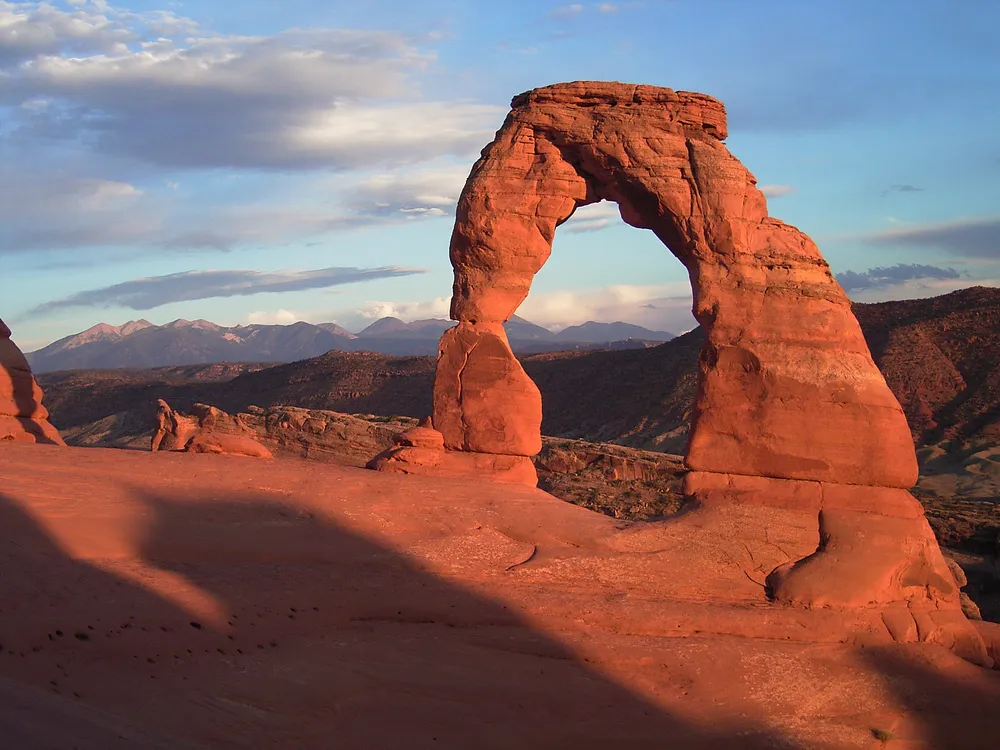
Arches National Park is a national park of the United States in eastern Utah. The park is adjacent to the Colorado River, 4 mi (6 km) north of Moab, Utah. The park contains more than 2,000 natural sandstone arches, including the well-known Delicate Arch, which constitute the highest density of natural arches in the world. It also contains a variety of other unique geological resources and formations. The national park lies above an underground evaporite layer or salt bed, which is the main cause of the formation of the arches, spires, balanced rocks, sandstone fins, and eroded monoliths in the area. The park consists of 310.31 km2 (76,680 acres; 119.81 sq mi) of high desert located on the Colorado Plateau. The highest elevation in the park is 5,653 ft (1,723 m) at Elephant Butte, and the lowest elevation is 4,085 ft (1,245 m) at the visitor center. The park receives an average of less than 10 in (250 mm) of rain annually. Administered by the National Park Service, the area was originally designated a national monument on April 12, 1929, before being redesignated a national park on November 12, 1971. The park received more than 1.8 million visitors in 2021. This has declined in recent years with visitor numbers in 2024 being just under 1.5 million.
As stated in the foundation document in U.S. National Park Service website:
The purpose of Arches National Park is to protect extraordinary examples of geologic features including arches, natural bridges, windows, spires, and balanced rocks, as well as other features of geologic, historic, and scientific interest, and to provide opportunities to experience these resources and their associated values in their majestic natural settings.
The national park lies above an underground evaporite layer or salt bed, which is the main cause of the formation of the arches, spires, balanced rocks, sandstone fins, and eroded monoliths in the area. This salt bed is thousands of feet thick in places and was deposited in the Paradox Basin of the Colorado Plateau some 300 million years ago (Mya) when a sea flowed into the region and eventually evaporated. Over millions of years, the salt bed was covered with debris eroded from the Uncompahgre Uplift to the northeast. During the Early Jurassic (about 200 Mya), desert conditions prevailed in the region and the vast Navajo Sandstone was deposited. An additional sequence of stream laid and windblown sediments, the Entrada Sandstone (about 140 Mya), was deposited on top of the Navajo. Over 5,000 feet (1,500 m) of younger sediments were deposited and have been mostly eroded. Remnants of the cover exist in the area including exposures of the Cretaceous Mancos Shale. The arches of the area are developed mostly within the Entrada formation. The weight of this cover caused the salt bed below it to liquefy and thrust up layers of rock into salt domes. The evaporites of the area formed more unusual "salt anticlines" or linear regions of uplift. Faulting occurred and whole sections of rock subsided into the areas between the domes. In places these blocks were tilted until their rock layers stood almost vertical. The result of one such 2,500 ft (760 m) displacement, the Moab Fault, is seen from the visitor center.
As this subsurface movement of salt shaped the landscape, erosion removed the younger rock layers from the surface. Except for isolated remnants, the major formations visible in the park today are the salmon-colored Entrada Sandstone, in which most of the arches form, and the buff-colored Navajo Sandstone. These are visible in layer-cake fashion throughout most of the park. Over time, water seeped into the surface cracks, joints, and folds of these layers. Ice formed in the fissures, expanding and putting pressure on surrounding rock, breaking off bits and pieces. Winds later cleaned out the loose particles. A series of free-standing fins remained. Wind and water attacked these fins until, in some, the cementing material gave way and chunks of rock tumbled out. Many damaged fins collapsed. Others, with the right degree of hardness and balance, survived despite their missing sections. These became the famous arches.
Adapted from Wikipedia (CC BY-SA). Photography via Wikimedia Commons.